
To pursue a personal injury lawsuit against a public corporation in New York, an injured person generally must serve a written, sworn Notice of Claim within 90 days after the claim arises. In Nassau County and its towns, villages, and special districts, this statutory requirement applies before an action can be commenced in Nassau County Supreme Court or another court of competent jurisdiction.
Whereas private negligence claims often follow a three-year limitations period, claims involving municipal roads, public buildings, or government-operated vehicles trigger much shorter statutory deadlines. Understanding how New York General Municipal Law § 50-e and related provisions govern service, contents, pre-suit examinations, and lawsuit filing deadlines helps claimants preserve essential records across Valley Stream, the Town of Hempstead, and surrounding Nassau County communities.

When a Notice of Claim Is Required in Nassau County
Under General Municipal Law § 50-e(1)(a), any tort case where a Notice of Claim is required by law as a condition precedent to commencing an action against a public corporation—or its officers, appointees, or employees—requires service within 90 days after the claim arises. For wrongful death claims, the 90-day period runs from the appointment of a representative of the decedent’s estate rather than the date of death.
In Nassau County, multiple layers of local government operate side by side, and each public entity is legally distinct. Depending on where an incident occurs, the responsible public corporation might be the County of Nassau, the Town of Hempstead, the Town of North Hempstead, the Town of Oyster Bay, an incorporated village such as the Village of Valley Stream, a school district, or a local fire district.
Identifying the correct public entity early is critical because serving one municipality does not notify another. For example, a roadway, parking field, or sidewalk near a boundary in Valley Stream could fall under village, town, county, or state jurisdiction depending on exact ownership and maintenance responsibilities. Readers organizing initial scene documentation can review our guide on documenting personal injury locations in Valley Stream to see why street-level details matter.
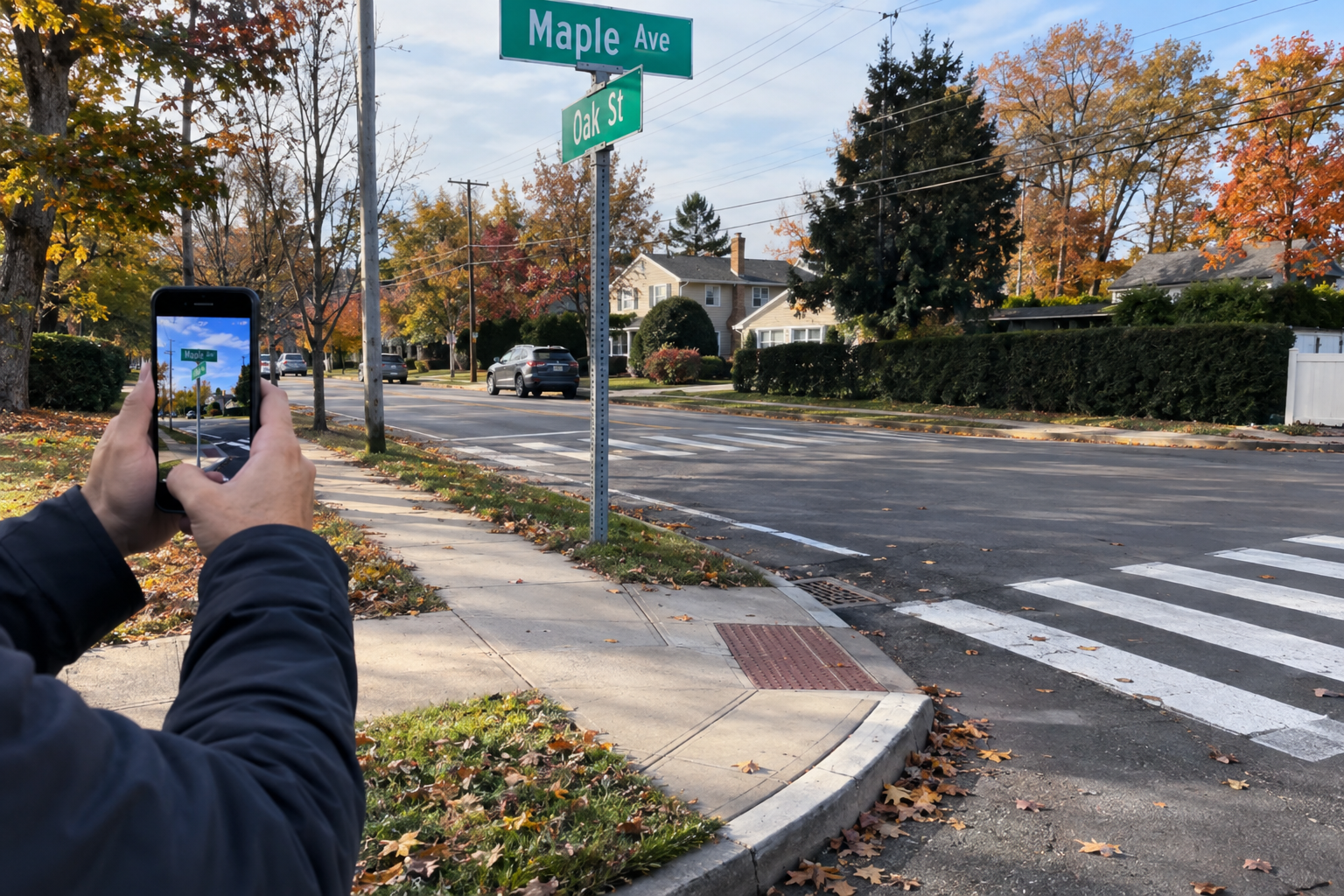
Before preparing a notice, record the location as precisely as possible: the street name, nearest cross streets, side of the roadway, and any fixed nearby landmark. Photographs that show both the condition and its surroundings can help distinguish the exact site from a general neighborhood description. These details may help identify which public entity’s records or maintenance responsibilities are relevant, although they do not alone establish ownership or responsibility.
The statute also clarifies when individual public employees must be served. Under General Municipal Law § 50-e(1)(b), serving the individual officer, appointee, or employee is not a condition precedent to suing that individual personally, but serving the public corporation itself remains required whenever the public corporation has a statutory obligation to indemnify that person.
Required Contents and Statutory Form Under General Municipal Law § 50-e
A Notice of Claim is a formal legal document rather than an informal complaint letter or maintenance request. Under General Municipal Law § 50-e(2), the notice must be in writing and sworn to by or on behalf of the claimant. It must state the name and post-office address of each claimant and of the claimant’s attorney, if any, along with the nature of the claim.
The document must also set forth the time when, the place where, and the manner in which the claim arose, as well as the items of damage or injuries claimed to have been sustained so far as then practicable. Specific location descriptions—such as exact cross streets, building entrances, or fixed landmarks—help prevent ambiguity when a municipal investigation takes place.
Because the statute calls for injuries and damages so far as practicable, the description can reflect what is known when the notice is prepared without implying that every later medical or repair detail is already available. Keeping the notes and records used to prepare the notice can help check that its stated time, place, manner, and claimed harm are consistent.
New York law includes a specific rule regarding dollar amounts in municipal claims outside New York City. Under General Municipal Law § 50-e(2), a Notice of Claim against a municipal corporation other than a city with a population of one million or more persons must not state the amount of damages to which the claimant deems himself or herself entitled. This rule applies to Nassau County and its towns and villages.
Although the initial notice in Nassau County omits a specific dollar demand, the municipal corporation may at any time request a supplemental claim setting forth the total damages claimed. Under § 50-e(2), the claimant generally must provide that supplemental claim within 15 days of the request, or the court may order its production upon motion.
Rules for Serving the Public Corporation and Prior Written Notice Distinctions
Proper service is governed by General Municipal Law § 50-e(3). A claimant generally must serve the public corporation by delivering a copy personally, or by registered or certified mail, to the person designated by law to receive a Supreme Court summons for that corporation, or to an attorney regularly engaged in representing that public corporation, such as the Office of the Nassau County Attorney at One West Street in Mineola for county claims.
When service is made by registered or certified mail, General Municipal Law § 50-e(3)(b) provides that service is complete upon deposit of the Notice of Claim, enclosed in a postpaid properly addressed wrapper, in an official depository under the exclusive care and custody of the United States Postal Service within New York State. Alternatively, § 50-e(3)(f) permits service on the New York Secretary of State in Albany as agent for a public corporation using duplicate copies and the statutory fee.
Whichever permitted method is used, retain a complete copy of the notice and available mailing or delivery records with the incident file. A clear record of what was sent, where it was directed, and when it was mailed or delivered can make later deadline and service questions easier to review. Confirming the intended public corporation is equally important: proof of delivery to one entity does not establish service on another.
Claimants should also distinguish between serving a post-accident Notice of Claim and establishing prior written notice of a surface defect. Under General Municipal Law § 50-e(4), complying with Notice of Claim service rules does not dispense with separate statutory or local-law requirements that a municipality must have received prior written notice of a defective, unsafe, dangerous, or obstructed street, highway, bridge, culvert, sidewalk, or crosswalk condition—or snow and ice thereon—before the accident occurred. For a comparison of how sidewalk defect rules operate in neighboring jurisdictions, see our guide on evidence and deadlines after a sidewalk fall.
Municipal 50-h Examinations and Pre-Suit Waiting Periods
Filing a Notice of Claim gives the municipality an opportunity to investigate the claim before litigation begins. Under New York General Municipal Law § 50-h, wherever a Notice of Claim is filed against a city, county, town, village, fire district, ambulance district, or school district, the public entity has the right to demand an examination of the claimant concerning the occurrence and the extent of the injuries or damages.
This proceeding, commonly called a 50-h hearing, is conducted under oath upon oral questions and may also include a physical examination by a duly qualified physician. Under General Municipal Law § 50-h(2), the municipality’s demand for examination is not effective unless served within 90 days from the date of filing the Notice of Claim, or within 100 days if the notice was served through the Secretary of State.
In addition to the 50-h process, New York General Municipal Law § 50-i establishes mandatory waiting and pleading rules. Under § 50-i(1)(b), the complaint or moving papers in a subsequent lawsuit must allege that at least 30 days have elapsed since service of the Notice of Claim—or at least 40 days if served upon the Secretary of State—and that adjustment or payment has been neglected or refused.
Where a timely 50-h examination demand has been served, General Municipal Law § 50-h(5) generally bars the claimant from commencing an action until the claimant has complied with the demand. If the examination is not conducted within 90 days of service of the demand through no delay of the claimant, the claimant may commence the action, whereas claimant adjournments beyond that window require rescheduling and compliance before filing suit.
Lawsuit Deadlines, Late Notices, and Recent New York Amendments
Even when a Notice of Claim is timely served, the lawsuit itself faces a strict statutory deadline. Under General Municipal Law § 50-i(1)(c), an action or special proceeding against a city, county, town, village, fire district, or school district for personal injury or property damage must be commenced within one year and 90 days after the happening of the event upon which the claim is based, while wrongful death actions must be commenced within two years after the death. By contrast, ordinary negligence actions against private defendants generally follow the three-year period in CPLR § 214(5).
If the 90-day Notice of Claim window is missed, General Municipal Law § 50-e(5) allows a claimant to apply to the Supreme Court or County Court for leave to serve a late Notice of Claim. However, the court’s discretionary extension cannot exceed the one-year-and-90-day time limit for commencing the action against the public corporation, and the application must include a copy of the proposed notice under § 50-e(7).
When evaluating a late-notice application under § 50-e(5), the court considers in particular whether the public corporation, its attorney, or its insurance carrier acquired actual knowledge of the essential facts constituting the claim within the 90-day period or within a reasonable time thereafter. The court also weighs factors such as infancy, mental or physical incapacity, excusable error concerning the public corporation’s identity, and whether the delay substantially prejudiced the municipality’s defense on the merits.
In motor vehicle collisions involving municipal vehicles in Nassau County, claimants must also track separate insurance and fault rules. No-fault benefit applications typically carry a 30-day written notice rule, and comparative fault in actions subject to Insurance Law Article 51 is governed by the amended text of CPLR § 1411(b), effective in 2026, which bars recovery in those covered auto cases if the claimant’s culpable conduct is greater than that of the person or combined persons against whom recovery is sought. Readers can review our guides on New York no-fault insurance claims and obtaining a New York car accident report to coordinate these parallel requirements.

Common Questions About Nassau County Municipal Injury Claims
Does a police report or municipal complaint count as a Notice of Claim?
No. A police accident report, an internal incident report, or a roadway repair complaint does not satisfy the formal writing, verification, and service requirements of General Municipal Law § 50-e. While those records may help document the event, the sworn Notice of Claim must still be properly served on the designated municipal official or agency within the 90-day statutory period.
What happens if a good-faith mistake is made in the Notice of Claim?
Under General Municipal Law § 50-e(6), a mistake, omission, irregularity, or defect made in good faith in the Notice of Claim—other than one pertaining to the manner or time of service—may be corrected, supplied, or disregarded in the discretion of the court at any stage of an action or special proceeding, provided the other party was not prejudiced thereby.
Does a 50-h examination demand extend the one-year-and-90-day lawsuit deadline?
Generally no. General Municipal Law § 50-i(3) explicitly states that nothing contained in § 50-i or in § 50-h shall operate to extend the period limited by § 50-i(1) for the commencement of an action or special proceeding. Claimants and their counsel should track the one-year-and-90-day date independently of hearing schedules.
What records should be gathered before preparing a Notice of Claim?
An organized file should include the exact date and time of the incident, wide and close-up photographs showing fixed landmarks and street signs, police or incident report numbers, witness contact information, and initial medical treatment records. Having exact location details helps verify whether the property or vehicle belongs to Nassau County, a town, a village, or a special district before the 90-day deadline expires.