
Bronx Car Accident Lawyer
A clear starting point after a Bronx collision
A Bronx car accident lawyer examines the collision, insurance coverage, medical evidence, and deadlines to determine what claims may be available. That investigation may involve an expressway pileup, a turning vehicle on the Grand Concourse, a delivery truck in Hunts Point, or a neighborhood crash close to home.
The most useful first steps are practical: identify the exact location, preserve what you have, and address medical needs. A broad description such as “near Yankee Stadium” or “on the Cross Bronx” may help someone recognize the area but is not precise enough to reconstruct a collision. Direction, lane, intersection, and sequence all matter.
This guide explains local evidence issues and the questions a licensed New York attorney should evaluate. Do not wait for a settlement estimate before checking time-sensitive notices. The facts needed to preserve a claim are often available before the full medical picture becomes clear.
AI-generated Bronx-inspired illustration; not documentation of a particular street or crash.
Grand Concourse: safety context and crash documentation
The City's August 2025 Grand Concourse project announcement described a $44 million fifth phase between East Fordham Road and East 198th Street, including pedestrian and roadway safety work. A capital project establishes local safety context; it does not establish liability for an individual collision.
For an accident on the Grand Concourse, distinguish the main roadway from a service road and identify the closest cross street. Note whether the impact occurred during a turn, at a crossing, while changing lanes, or after a vehicle entered from the curb. A photograph taken from only one side can omit a median or signal that matters.
Construction and permanent improvements can change the layout. Preserve photographs showing what existed on the accident date rather than relying solely on a map or an old street-view image. If temporary barriers affected movement, record their position and the direction from which each driver approached them.
Fordham Road, Jerome Avenue, and nearby destinations
Around Fordham Road and Jerome Avenue, identify the exact corner, lane, and travel direction. A bus stop, store entrance, or transit structure can help locate a camera or witness, but a claim still needs the actual street position. Save a location pin if you have one and confirm that it matches the scene.
If a stopped vehicle obscured a view, describe its position without assuming what another driver could see. If you were a passenger, state which seat you occupied and what you observed before impact. Separating observation from inference makes a statement more useful and avoids accidental inconsistencies.
Cross Bronx Expressway and Bruckner Expressway
For an expressway collision, note the travel direction, nearest exit, and whether the first impact was on a ramp or the main roadway. A backup near an interchange may create several separate contacts. Write down the sequence as soon as practical, including whether your vehicle had stopped before it was struck.
If photographs were taken after vehicles moved to a shoulder, make that clear. Preserve towing and repair documents because they may help establish vehicle condition and timing. Never walk into traffic to recover a loose item, photograph a plate, or inspect damage. Responders' directions and personal safety take priority.
Hunts Point, commercial vehicles, and local deliveries
In Hunts Point and nearby commercial areas, a collision may involve a truck making a delivery, entering a loading area, or turning through a constrained intersection. Record the company markings and plate if safely possible. The name painted on a vehicle does not necessarily identify its owner, employer, or insurance arrangement.
A commercial vehicle investigation may require driver, maintenance, dispatch, or employment records. An attorney can assess which records are relevant and how to seek preservation lawfully. The site's New York truck accident guide explains related issues without assuming every large-vehicle crash has the same cause.
Mott Haven, Pelham Parkway, and neighborhood streets
For crashes around Third Avenue, Melrose Avenue, Boston Road, or Pelham Parkway, record both street names and the precise crossing or driveway. In Riverdale, Kingsbridge, Parkchester, and other neighborhoods, residential turns and curbside movements can raise different questions from a highway collision.
These areas are included as practical local references, not a ranked list of dangerous locations. A claim that a particular intersection has unusually high injury numbers should specify the source and years. Historical safety concerns may guide questions, but evidence from the actual collision must support an individual liability claim.
First steps: safety, reports, and a usable timeline
Request emergency assistance when appropriate and obtain medical evaluation based on your symptoms and circumstances. Follow responders' directions. Once safe, exchange driver and insurance information and gather witness contact details. Do not confront another driver or place yourself in danger to document a disagreement.
Take wide photographs showing the roadway and closer views of damage. Include relevant signals, lane markings, and obstructions if they can be photographed safely. Note weather and visibility without exaggeration. A clear photograph of a wet roadway supports a description of conditions; it does not by itself prove that weather caused the collision.
The New York MV-104 instructions explain the 10-day report requirement for qualifying crashes involving death, injury, or property damage above $1,000 to one person's property. Keep a copy of any report you submit and distinguish police reporting from insurance notice requirements.
Create a dated timeline of the accident, initial symptoms, medical visits, and insurer communications. Include what you know and mark what remains uncertain. If you later remember an additional detail, record when it came to mind rather than rewriting the entire account as though it was always known.
Preserve Bronx accident evidence early
Nearby businesses, residential buildings, vehicle cameras, and witnesses may provide information. A camera's presence does not guarantee a recording exists or covers the relevant angle. Identify potential sources promptly and let an attorney assess preservation requests. Avoid assuming that a public camera is continuously recording or that footage will remain available indefinitely.
Keep original video and image files. Preserve the portion before and after impact, not only a short clip. If you create an annotated copy for explanation, retain the original separately. Do not overwrite a dashcam memory card or discard a damaged device before considering whether it contains useful evidence.
For rideshare trips, save the receipt, vehicle details, and trip status shown in the app. For passengers in a private vehicle, retain information for that vehicle as well as the other drivers. The site's Uber and Lyft accident page addresses related coverage questions.
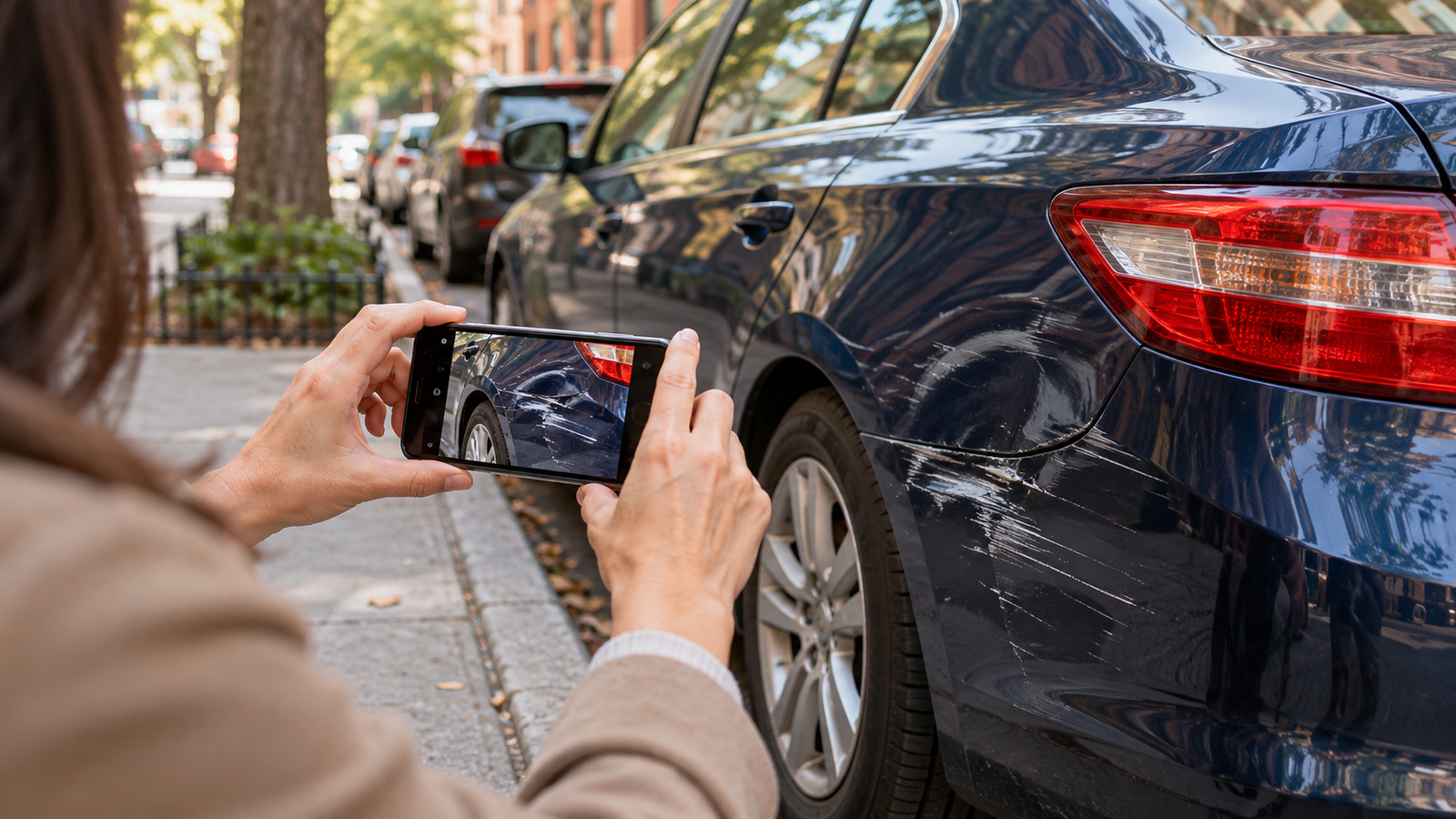
AI-generated illustration of damage documentation; not evidence from an actual collision.
Insurance benefits and an injury claim are different
New York no-fault generally covers up to $50,000 in basic eligible economic losses, subject to coverage rules. It does not pay for car repairs or pain and suffering. Review the DFS auto insurance guide for the coverage framework.
Written no-fault notice generally is due within 30 days, with a limited justified-delay exception. The DFS no-fault FAQs explain notice and insurer identification. Preserve proof of submission and review requests for additional information promptly.
Keep separate records for medical bills, wage documentation, vehicle damage, and liability correspondence. These may involve different adjusters and different coverage questions. A paid repair bill does not establish that an injury claim is resolved. Likewise, a medical provider submitting a bill does not necessarily mean every notice or document required from you has been supplied.
If several vehicles were involved, identify which insurer is handling each part of the claim. A passenger, pedestrian, vehicle owner, and rideshare customer can have different insurance questions. Do not assume the company that first calls you is responsible for every benefit. Save envelopes, emails, claim numbers, and the names of people you speak with.
Medical evidence and New York's injury threshold
For covered motor vehicle claims, Insurance Law § 5104 generally requires serious injury to recover non-economic damages. The categories are in § 5102. A lawyer should assess the applicable law and medical evidence.
Medical records should accurately describe symptoms, examination findings, recommended care, and changes in everyday function. Tell providers about earlier injuries and symptoms so they can assess causation and any aggravation. Neither a dramatic vehicle photograph nor a single diagnostic image answers every medical question. A consistent, truthful account is more useful than an exaggerated description.
If treatment is interrupted, record the practical reason and discuss it with the relevant provider or adviser. Transportation, coverage disputes, work obligations, and other barriers can affect attendance. Keep track of limitations at home and work without diagnosing yourself. Treatment decisions should serve your health; they should not be driven by an attempt to increase the appearance of a claim.

AI-generated illustration; no real client or medical records are shown.
Fault, compensation, and filing deadlines
The current CPLR § 1411 provides for reduced recovery based on claimant fault and an Article 51 injury recovery bar when claimant fault exceeds the combined fault of the defendant or defendants. Individual applicability requires legal review.
Potential losses can include unreimbursed medical expenses, lost earnings, future financial effects, property damage, and legally available non-economic damages. Policy limits, causation, proof, and applicable law affect the outcome. An online settlement calculator cannot reliably value a specific case. A large demand is not the same as a supported settlement assessment or the amount ultimately received.
Keep wage statements, employer correspondence, relevant tax records, and receipts. Self-employed people may need invoices and contracts showing actual lost income rather than only gross revenue. Ask how reimbursements, outstanding bills, legal fees, and case expenses could affect a proposed settlement. Understand the scope of any release before signing it, including which claims it ends.
Ordinary negligence injury actions generally have a three-year limit under CPLR § 214. Where applicable, General Municipal Law § 50-e generally requires notice within 90 days. Other limits and exceptions need prompt review.
Do not use the longest possible deadline as a reason to wait. Footage may be overwritten, witnesses can become difficult to reach, and insurers may require information long before a lawsuit would be filed. Bring the accident date, correspondence, and any government-vehicle involvement to a licensed lawyer's attention early. A deadline assessment should address all relevant notices and claims.
Preparing to speak with a Bronx auto accident attorney
Bring the accident date, location, report number, photographs, insurance letters, and treatment information you already have. Explain whether a government vehicle, commercial driver, or unidentified vehicle was involved. Ask what needs immediate preservation and which deadlines apply before discussing the possible value of the case.
A useful consultation also addresses communication and costs. Ask who will answer questions, how updates are provided, and how fees and expenses are handled under a written agreement. Verify the attorney's professional identity. Do not treat a website's borough coverage or a confident advertisement as proof of relevant experience.
The site's Bronx personal injury information covers broader injury topics. The car accident FAQs can help organize questions, but neither resource evaluates your own claim or creates an attorney-client relationship.
Bronx car accident questions
What if several vehicles hit mine?
Describe the impacts in sequence and distinguish what you saw from what you felt. Preserve photographs of damage on every affected side. A multi-vehicle claim may require comparing different accounts and vehicle positions; it should not be reduced to a single assumption about the last vehicle in line.
Does a crash near a construction project prove the road was unsafe?
No. The investigation needs evidence of the condition present, who controlled it, and whether it contributed to the collision. A project announcement or planned improvement is useful context but does not establish negligence. Preserve photographs and the date rather than relying on an undated online image.
What if I missed work but used paid leave?
Keep payroll records, absence dates, and information about the leave used. The effect on a particular claim depends on the benefit, reimbursement rules, and applicable law. Do not assume every missed day has the same financial effect or that using available leave makes documentation unnecessary.
Can I still seek advice without a police report?
Yes. A report can be useful, but a deadline discussion should not wait solely because it has not arrived. Bring the information you have, including report numbers, photographs, exchange documents, and witness details. Explain what is missing so counsel can identify appropriate next steps.
Should I accept the first settlement offer?
Understand what it covers, what claims a release would end, and what medical or financial questions remain unresolved. An offer's timing alone does not establish whether it is reasonable. Review the supporting records and potential deductions before deciding whether a proposed resolution meets your circumstances.
Move forward with a clear record
From the Grand Concourse to the Bruckner Expressway, a useful claim assessment begins with specific facts and preserved evidence. Address health needs, track notices, and seek individualized advice about responsibility and coverage. For website questions, use the Tokov Law contact page.