
New York Personal Injury Lawyer: Accident Claims in NYC and Long Island

Injured because someone else failed to act safely? A serious accident can leave you juggling medical treatment, missed paychecks, and calls from insurance companies before you know what comes next. A new york personal injury lawyer can explain whether you have a legal claim, what evidence may support it, and how New York law affects your options.
Tokov Law’s personal injury information is designed for people hurt in New York City, Nassau County, Suffolk County, and surrounding communities. Whether you are researching an nyc personal injury lawyer after a collision or seeking guidance after a fall, the first questions are usually the same: Who was responsible? Who pays the bills? How long do I have to act?
Quick answer: Most New York negligence-based personal injury lawsuits must be started within three years, but some claims have much shorter notice requirements. Compensation may include qualifying medical costs, income losses, and pain and suffering. The details depend on how the accident happened, who caused it, and which laws apply. See CPLR § 214(5).
Request a consultation with Tokov Law to discuss the facts and determine what deadlines may affect your situation.
What Does a Personal Injury Lawyer in New York Actually Do?
A personal injury lawyer new york residents consult typically investigates the incident, identifies the responsible people or companies, reviews available insurance, documents losses, and handles settlement discussions or litigation when appropriate.
An investigation may include obtaining police or incident reports, checking surveillance footage, speaking with witnesses, requesting maintenance logs, examining employment relationships, and reviewing medical records. Complex matters may require accident reconstruction, medical experts, building-code evidence, or vocational analysis.
A personal injury attorney new york claimants retain should also explain possible weaknesses in a case. A serious injury does not automatically establish legal responsibility. Good legal advice separates what can be proven from what is understandably suspected.
Types of New York Personal Injury Cases
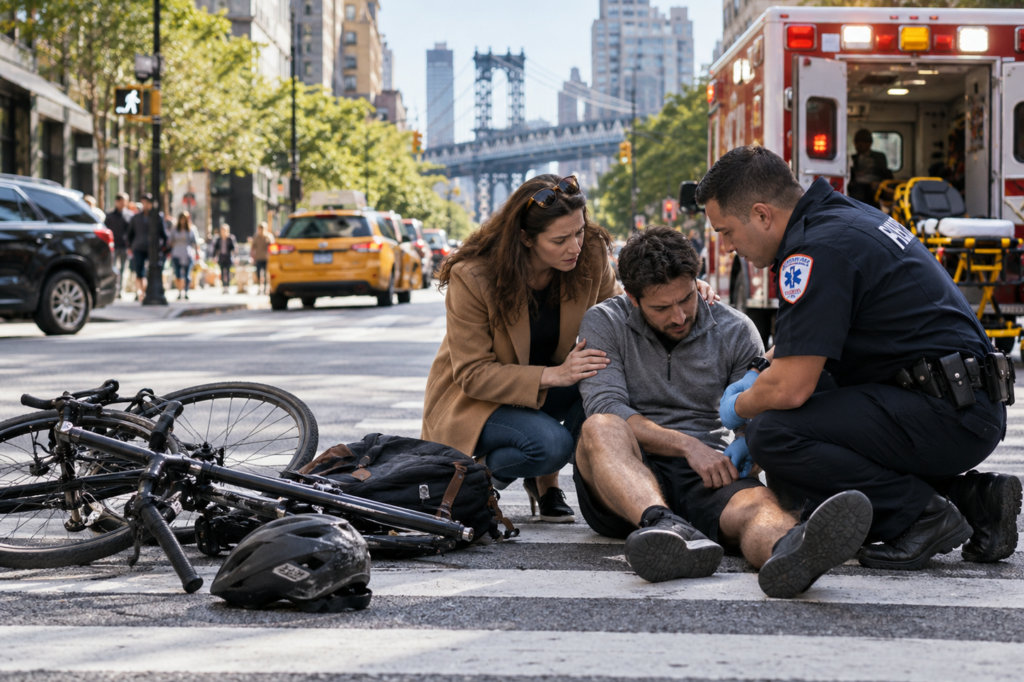
Car, pedestrian, and bicycle accidents
Motor vehicle claims can arise from distracted driving, speeding, left-turn collisions, rear-end crashes, unsafe lane changes, impaired driving, or failure to yield. Pedestrians and cyclists may be injured at crosswalks, intersections, bike lanes, and driveways. The responsible insurance policy and New York’s no-fault rules vary with the injured person’s status and the vehicles involved. Read Tokov Law’s New York car accident guidance and Queens car accident resource.
Truck and commercial vehicle collisions
Crashes with tractor-trailers, delivery trucks, and commercial vans can involve drivers, motor carriers, contractors, and multiple insurance policies. Time-sensitive proof may include dashcams, electronic driving records, dispatch messages, maintenance history, and vehicle data. Learn more from the New York truck accident lawyer page.
Motorcycle crashes
Motorcyclists face serious risks from left-turning vehicles, dooring, roadway hazards, and visibility disputes. Crucially, motorcycle operators and passengers generally fall outside New York’s standard first-party no-fault benefits, so their claim pathway is different from that of an ordinary car passenger. See the motorcycle accident lawyer guide and Insurance Law § 5102.
Uber, Lyft, and other rideshare accidents
When a rideshare vehicle crashes, insurance questions may depend on whether the driver had the app off, was waiting for a request, or had accepted a trip. NYC-regulated for-hire vehicles are subject to rules that differ from rideshare trips elsewhere in New York. Passengers, pedestrians, cyclists, and people in other vehicles may pursue different coverage routes. Explore the Uber and Lyft accident page.
Slip-and-fall and other property accidents
Wet floors, broken stairs, uneven walking surfaces, ice, poor lighting, or missing handrails can lead to premises-liability claims. A claim usually requires evidence that the defendant created the hazard or had actual or legally sufficient constructive notice, subject to the circumstances and any applicable special rules. Photographs, cleaning logs, maintenance requests, and witness information can be decisive. See Tokov Law’s slip-and-fall resource.
Construction and workplace injuries
Falls from ladders or scaffolds, falling objects, defective equipment, and unsafe job sites may implicate New York Labor Law §§ 200, 240(1), and 241(6), depending on the work and incident. Workers’ compensation and a possible lawsuit against a responsible third party are separate questions. Not every construction injury triggers every Labor Law protection. Read the New York construction accident lawyer page and New York Labor Law § 240.
School buses, serious injuries, and fatal accidents
A bus collision may involve a public school entity, private transportation contractor, maintenance provider, or negligent driver. Special public-entity notice rules can apply. Catastrophic injuries may involve brain or spinal trauma, extensive rehabilitation, or permanent disability. When a fatal injury occurs, eligible family members may need to consider a distinct wrongful-death claim. Read the school bus accident guide and wrongful death information.

How Do You Prove Negligence in a New York Personal Injury Claim?
Many injury cases involve four core issues: duty, breach, causation, and damages. A defendant must have owed an applicable duty of care, failed to meet it, caused the claimed injury in a legally relevant way, and produced compensable harm. Special statutes, product-liability theories, and other claims may have different elements.
For example, after a grocery-store fall, the central dispute may be whether the store had a reasonable opportunity to discover and address a spill. After a multi-vehicle crash, the dispute may focus on driver behavior, traffic signals, braking distances, and which conduct actually caused the impact. After a construction fall, contractual roles and statutory safety protections may matter more than ordinary premises evidence.
Evidence often includes contemporaneous photographs, videos, accident reports, medical evaluations, witness names, correspondence, inspection records, and employment or wage records. Preserve original files where possible; do not edit or annotate an original recording. If a business controls footage, it is sensible to seek appropriate preservation quickly because routine systems may overwrite it.
What Compensation Can an Injured Person Recover?
Personal injury damages aim to compensate for legally provable harm rather than impose an automatic payout for having an accident. Depending on the type of case, recoverable categories may include:
- Medical expenses: eligible emergency treatment, surgery, medications, therapy, rehabilitation, assistive devices, and future care costs.
- Lost income and earning capacity: documented time away from work and, where supported, reduced ability to earn income in the future.
- Pain and suffering: physical discomfort, emotional consequences, and loss of enjoyment of activities, when legally recoverable.
- Long-term needs: necessary accommodations, support services, or other documented losses attributable to a serious injury.
There is no universal New York settlement calculator. A diagnosis alone cannot determine value. Insurers and courts may examine the treatment course, medical prognosis, causation, prior conditions, evidence of fault, policy limits, future losses, and credibility. The availability of no-fault benefits or workers’ compensation can affect how particular categories are paid and whether reimbursement or liens become issues.
New York No-Fault Insurance and the 2026 Motor-Vehicle Rule Changes
New York’s no-fault system can provide up to $50,000 in basic economic-loss benefits to eligible people injured in qualifying motor vehicle accidents, subject to statutory conditions. It can cover certain medical expenses and wage losses without first establishing which driver was negligent. Eligibility is not universal; motorcycle riders, for example, are treated differently. Review the New York Department of Financial Services no-fault overview.
For many claims between covered persons arising from negligent vehicle operation, recovery of pain and suffering requires satisfying the applicable serious injury definition under Insurance Law § 5102(d) and § 5104. Important 2026 change: effective for actions and proceedings commenced on or after May 26, 2026, New York removed the former 90/180-day serious-injury category. Do not rely on older websites that still present that category as an available standalone route under the current statute.
The 2026 reforms also changed comparative fault for personal injury actions subject to Insurance Law Article 51: under CPLR § 1411(b), recovery can be barred when the claimant’s culpable conduct exceeds that attributed to the defendant or defendants combined. Outside that subsection, New York generally applies comparative-fault reduction rather than an automatic bar. These are materially different rules, so it is essential to identify the claim type and filing date. The NY Department of Financial Services’ July 2026 explanation describes the amendments.
How Long Do You Have to File a New York Injury Lawsuit?
Three years is common, but it is not a safe universal assumption. The general limitations period for many negligence-based injury actions is three years under CPLR § 214(5). Different rules may govern medical malpractice, intentional torts, wrongful death, particular public authorities, minors, and other situations. Insurance notification and benefit-application requirements may arise much sooner than a lawsuit deadline.
A claim involving a city, county, town, village, or public school district may require a notice of claim within 90 days under General Municipal Law § 50-e. Many municipal personal injury actions also have a one-year-and-90-day commencement limit under § 50-i. Claims against New York State are governed by different rules, including the Court of Claims Act. Whether any exception or toll applies requires individual review.
Waiting can also cost evidence. Video may be erased, hazards repaired, vehicles salvaged, and witnesses harder to locate. Discuss deadlines early—even if treatment is ongoing or an adjuster says the insurer is still investigating. Settlement discussions alone do not necessarily pause a limitations period.
What Should You Do After an Accident in New York?
First, protect your health. Seek emergency care when necessary and follow medical advice. Symptoms such as a concussion, neck injury, or internal damage may not be obvious immediately. If safe and appropriate, report the incident to the relevant police agency, building manager, employer, or transit operator.
Document where and how the injury happened. Photograph the scene, hazard, vehicles, weather or lighting conditions, visible injuries, and damaged personal items. Collect witness details without pressuring anyone to give a particular account. Keep medical visit summaries, bills, prescriptions, wage records, transportation receipts, and correspondence with insurers.
Be accurate when discussing what happened. Avoid guessing about speed, fault, or the extent of a diagnosis. Do not post speculative accounts of the accident online or sign an unfamiliar broad medical authorization or settlement release without understanding its consequences. If a government entity, commercial vehicle, or business-controlled camera may be involved, ask promptly whether records should be preserved.
How the Personal Injury Claims Process Works
A case review usually begins with an account of the accident, the injuries, available documents, treatment to date, and the identity of potentially responsible parties. Counsel can then consider deadlines, insurance sources, the evidence needed, and whether an immediate preservation letter or notice of claim is appropriate.
Next comes investigation and documentation. This may include obtaining records, interviewing witnesses, examining photos and video, evaluating medical causation, and identifying economic losses. A claim may be presented to an insurer for negotiation, but an offer is not necessarily a reliable measure of ultimate value. Some claims resolve through settlement; others require a lawsuit, document discovery, depositions, motions, mediation, or trial.
The duration and outcome of a case depend on disputed liability, injury progression, available coverage, court schedules, and whether parties can reach an agreement. You should understand the proposed settlement and any liens or deductions before deciding whether to accept it.
Personal Injury Representation Across NYC, Queens, Brooklyn, the Bronx, and Long Island
New York City and Manhattan
People searching for a personal injury lawyer nyc or personal injury attorney nyc may have claims arising in Manhattan, Queens, Brooklyn, the Bronx, or Staten Island. Each case turns on facts and applicable law, rather than the borough alone. For more geographically focused information, visit Tokov Law’s Manhattan personal injury lawyer page. That resource may also be useful to someone comparing a personal injury attorney new york City consultation with broader statewide guidance.
Queens
A queens personal injury lawyer may assess injuries sustained in a vehicle collision, apartment building, workplace, retail store, or public space. Someone looking for a personal injury attorney queens residents can contact should ask which evidence is controlled by a private business and whether a city agency is involved. For roadway incidents, see the Queens car accident lawyer page. The same planning questions apply when evaluating a queens personal injury attorney: claim type, deadlines, investigation, and communication.
Brooklyn and the Bronx
If you are looking for a brooklyn personal injury lawyer, see Tokov Law’s Brooklyn service area page and the Brooklyn car accident guide for collision-specific issues. Someone seeking a bronx personal injury lawyer can start with the Bronx location resource. Whether an injury happens on a busy intersection, residential sidewalk, or construction property, responsibility must be evaluated from the evidence rather than assumed from the location.
Nassau County and Long Island
A personal injury lawyer long island residents consider may help evaluate claims across Nassau and Suffolk counties. For local coverage and next steps, see Tokov Law’s Long Island personal injury attorney page. A long island personal injury lawyer can be relevant to collisions on major corridors, incidents in local stores or apartment buildings, and injuries involving county or town property.
Searchers looking for a nassau county personal injury lawyer may have accidents in Valley Stream, Hempstead, Garden City, Freeport, or surrounding communities. A suffolk county personal injury lawyer search may instead relate to incidents in Huntington, Islip, Brookhaven, or farther east. The applicable deadline may depend more on the owner or operator responsible for the accident than on the county boundary. If your goal is to speak with a personal injury attorney long island residents can consult, bring the incident date and available documents to the conversation.
How Do You Choose the Right Injury Attorney?
Search terms such as best personal injury lawyer nyc, best personal injury lawyer new york, and top personal injury attorney nyc reflect a reasonable desire for dependable legal representation, but search results and advertising labels are not reliable measures of who is best for a particular case. Ask about the relevant case type, who will handle communications, experience with similar legal issues, fee terms, litigation approach, and what information the attorney still needs before evaluating merits.
The same applies to someone comparing the best personal injury lawyer long island results. A useful consultation should provide understandable answers about potential defendants, immediate preservation steps, important deadlines, the role of medical records, and possible obstacles—not a guaranteed dollar figure. Consider verifying attorney registration and standing through the New York State court system’s attorney resources.
How Much Does a New York Personal Injury Lawyer Cost?
Many personal injury matters are handled under a written contingency-fee agreement, meaning the lawyer’s fee is a specified portion of any recovery, subject to the agreement and applicable rules. Case expenses, reimbursement obligations, and treatment-related liens deserve separate explanation. Tokov Law’s website advertises a free consultation and no legal fee unless recovery is obtained; confirm the actual terms in writing before retaining counsel.
A consultation is also an opportunity to ask whether the firm accepts the specific case type and has identified any urgent deadlines.
Frequently Asked Questions About New York Personal Injury Claims
Do I have a case if I was partly at fault?
Possibly. For claims outside the special motor-vehicle provision, CPLR § 1411(a) generally reduces recoverable damages by the claimant’s assigned share of fault. For personal injury actions subject to Insurance Law Article 51, the 2026 modified comparative-fault rule may bar recovery if the claimant is more at fault than the defendants combined. A case-specific analysis is essential.
Can I recover pain and suffering after a New York car accident?
Sometimes. In many claims involving covered persons, New York’s no-fault law requires a qualifying serious injury before pain-and-suffering damages can be recovered. The definition changed for actions commenced on or after May 26, 2026. See Insurance Law §§ 5102 and 5104.
Can I file a claim against a city agency or public school district?
Potentially, but shorter and more technical rules can apply. A notice of claim may be required within 90 days and a municipal lawsuit may need to begin within one year and 90 days. The responsible entity must be correctly identified, and special rules or exceptions may alter the analysis.
What if I have a preexisting injury?
A prior condition does not automatically eliminate a claim, but the evidence must separate preexisting problems from new injuries or a provable aggravation. Earlier records, current imaging, treating professionals’ opinions, and a clear treatment timeline may help explain the difference.
Do I have to go to court?
Not necessarily. Many claims are evaluated through insurance investigations and settlement negotiations. Where facts, medical causation, fault, or damages are disputed, a lawsuit may be needed. Even after filing, the parties may settle before trial.
How soon should I speak with a lawyer?
As soon as practical after urgent medical needs are addressed. Early review is particularly important where there is a public entity, surveillance footage, a commercial vehicle, a serious injury, or uncertainty about insurance deadlines. The ordinary three-year lawsuit period is not a reason to postpone evidence preservation.
Speak With Tokov Law About a New York Personal Injury Claim
An accident should not leave you guessing about what the law requires. Whether your concern is a car crash, unsafe property, commercial truck, construction injury, or bus accident, a clear assessment starts with the facts, the evidence, and the correct deadline. You can use the Tokov Law contact page to request a consultation.
Your next step: Gather the incident date, relevant reports, a treatment summary, photos, insurance correspondence, and the names of possible witnesses. Ask which claims may apply, whether records need urgent preservation, and what would be required to investigate further.
This page provides general information about New York law, not advice about any particular claim. Its legal content and firm-specific statements must be reviewed by a licensed New York attorney before publication. No outcome is guaranteed.