
Manhattan Car Accident Lawyer
Understand your options after a Manhattan car crash
A Manhattan car accident lawyer can investigate a collision, identify available insurance, preserve evidence, and evaluate compensation for injuries and financial losses. The right approach depends on how the crash happened, the medical evidence, the parties involved, and the deadlines governing each claim.
A crash near Penn Station, on Canal Street, or along the FDR Drive can disrupt far more than your commute. Medical appointments, missed work, damaged property, and unfamiliar insurance paperwork can arrive at once. This guide explains the practical questions to address after a Manhattan collision and what to discuss with a licensed New York attorney.
Start here: Get appropriate medical care, document the location and vehicles, preserve photographs and witness details, and promptly review insurance notice requirements. A police report, a no-fault claim, and a personal injury lawsuit are separate steps; completing one does not necessarily complete the others.
Explore the site's car accident questions and answers for related topics.
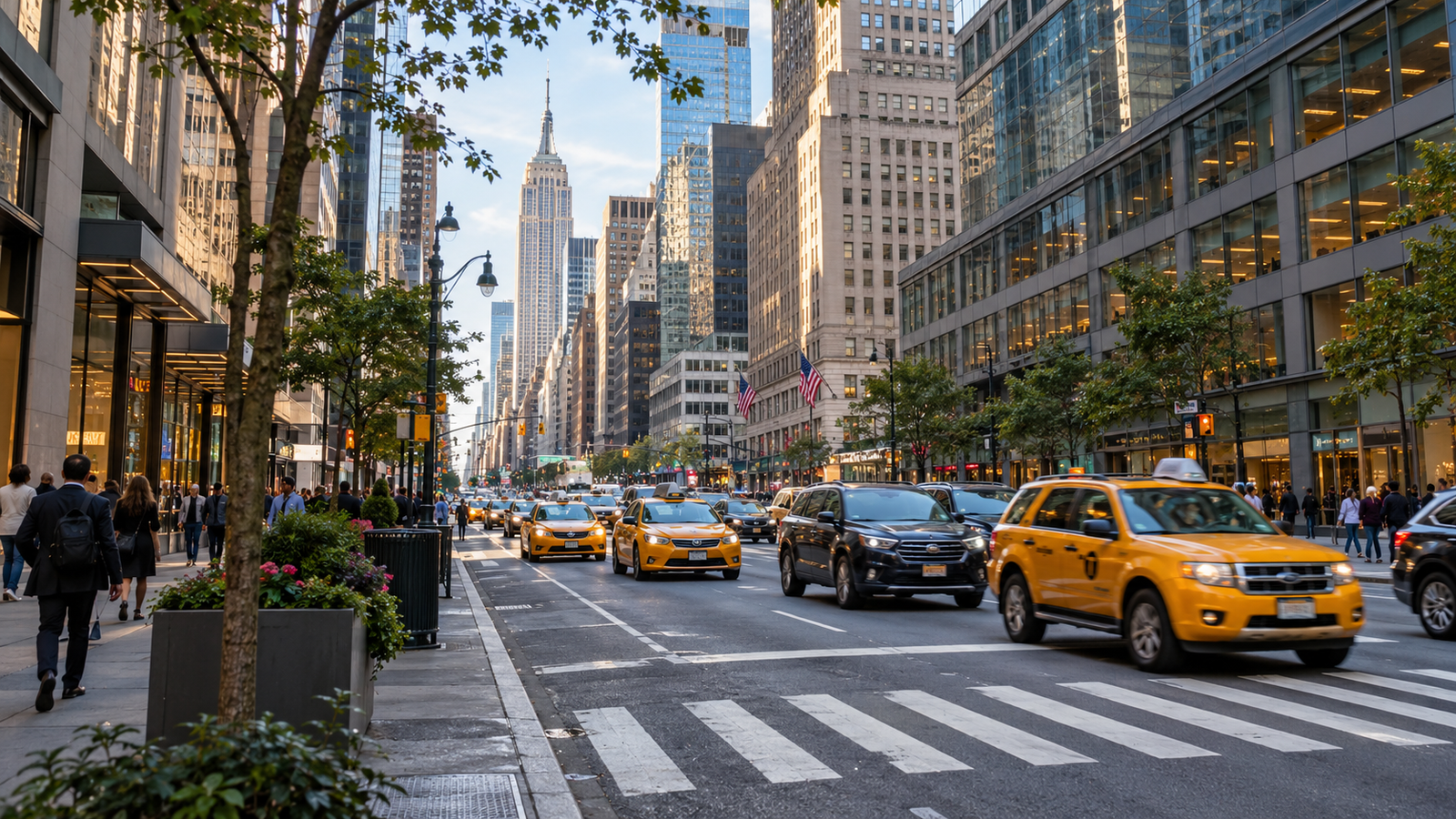
AI-generated illustration of Manhattan traffic; not a photograph of a reported collision.
What a Manhattan car accident attorney investigates
An effective investigation connects the driver's conduct to the collision and the collision to your documented losses. It should address the sequence of events rather than rely only on which vehicle looks more damaged.
- Rear-end collisions: Following distance, sudden stops, traffic conditions, and whether several impacts occurred.
- Intersection accidents: Traffic signals, turning movements, lane assignments, crosswalk markings, and sight lines.
- Sideswipes and lane-change crashes: Vehicle positions, blind spots, road markings, and available dashcam recordings.
- Taxi and rideshare collisions: Driver identity, vehicle ownership, trip records, and applicable insurance.
- Commercial vehicle crashes: Employer relationships, delivery records, maintenance issues, and business-held evidence.
A Manhattan auto accident attorney may also investigate a hit-and-run, a passenger injury, or a pedestrian struck by a turning vehicle. The relevant evidence changes with the facts. Write down what you remember while it is fresh, separating what you actually saw from assumptions made afterward.
Manhattan streets and locations that deserve close attention
Local detail matters because intersections, curb activity, traffic patterns, and camera locations can shape an investigation. Historical crash data helps explain a corridor's safety concerns, but it does not prove fault in an individual case or establish today's most dangerous intersection.
Canal Street, Chinatown, and the Tribeca–SoHo corridor
In its September 2025 Canal Street safety announcement, NYC DOT reported three deaths and 200 injuries, including 23 severe injuries, along Canal Street during 2020–2024. The proposed redesign covered West Street to Bowery. Those are corridor-wide historical figures, not counts for each intersection.
For a crash around Canal Street and Sixth Avenue, Mott Street, or the Bowery approach, record the precise cross street and direction of travel. Photograph turning lanes, pedestrian islands, curbside obstructions, and the point of impact when safe. A report that says only “Canal Street” may leave important questions unanswered.
Midtown: 34th Street, 42nd Street, and major avenues
NYC DOT's 2023 pedestrian safety action-plan update retains several Manhattan priority corridors, including 34th Street, 42nd Street, Eighth Avenue, and Seventh Avenue. The report evaluates historical pedestrian deaths and severe injuries; it is not a current ranking of all motor vehicle collisions.
Around Penn Station, Herald Square, Times Square, and the Port Authority Bus Terminal, a useful investigation distinguishes through traffic from vehicles turning, loading, or pulling toward the curb. Save a taxi receipt or rideshare trip record, identify the exact block, and note nearby businesses that might have relevant video. A landmark alone rarely identifies the full crash location.
Harlem: 125th Street and Lenox Avenue
The same DOT update includes 125th Street and Lenox Avenue among Manhattan's retained priority corridors. For a Harlem collision, document whether it occurred at an intersection, beside a bus stop, or during a turn across a pedestrian crossing.
Record both street names, the side of the roadway, and any temporary barriers or construction. These details help distinguish the layout on the collision date from later street conditions. Do not assume that a corridor's historical safety designation establishes negligence by a driver or the City.
FDR Drive, West Street, and neighborhood streets
For crashes on the FDR Drive, record the direction, nearest exit, and whether the impact occurred on a ramp or main roadway. On West Street, distinguish vehicle lanes from adjacent pedestrian and bicycle facilities. These are investigation pointers, not claims that either road has the borough's highest crash rate.
The same precision helps in Chelsea, the East Village, the Upper East Side, the Upper West Side, Washington Heights, and Inwood. Preserve the exact location even if you were visiting Manhattan and are unfamiliar with local streets.
What to do after a car accident in Manhattan
Put safety first. Call 911 when someone is injured or immediate help is needed. Follow emergency responders' directions. Do not enter traffic to photograph damage or retrieve an object.
Exchange and preserve information. When safe, collect driver, insurance, registration, and witness details. Photograph vehicle positions, visible damage, traffic controls, and the broader street layout. Keep original image files rather than only edited screenshots.
Address reporting requirements. New York's MV-104 crash report instructions require a report within 10 days for qualifying crashes involving death, injury, or damage exceeding $1,000 to any one person's property. Do not assume the other driver or insurer has completed your obligation.
Keep a recovery file. Save discharge instructions, bills, claim numbers, correspondence, and proof of missed work. Tell treating professionals accurately about symptoms and prior conditions. If access or cost prevents follow-up care, document the problem instead of leaving an unexplained gap.
Review communications before committing. Be accurate when reporting facts. Understand a release or settlement agreement before signing it, and distinguish your own insurer's cooperation requirements from requests made by another party's carrier.
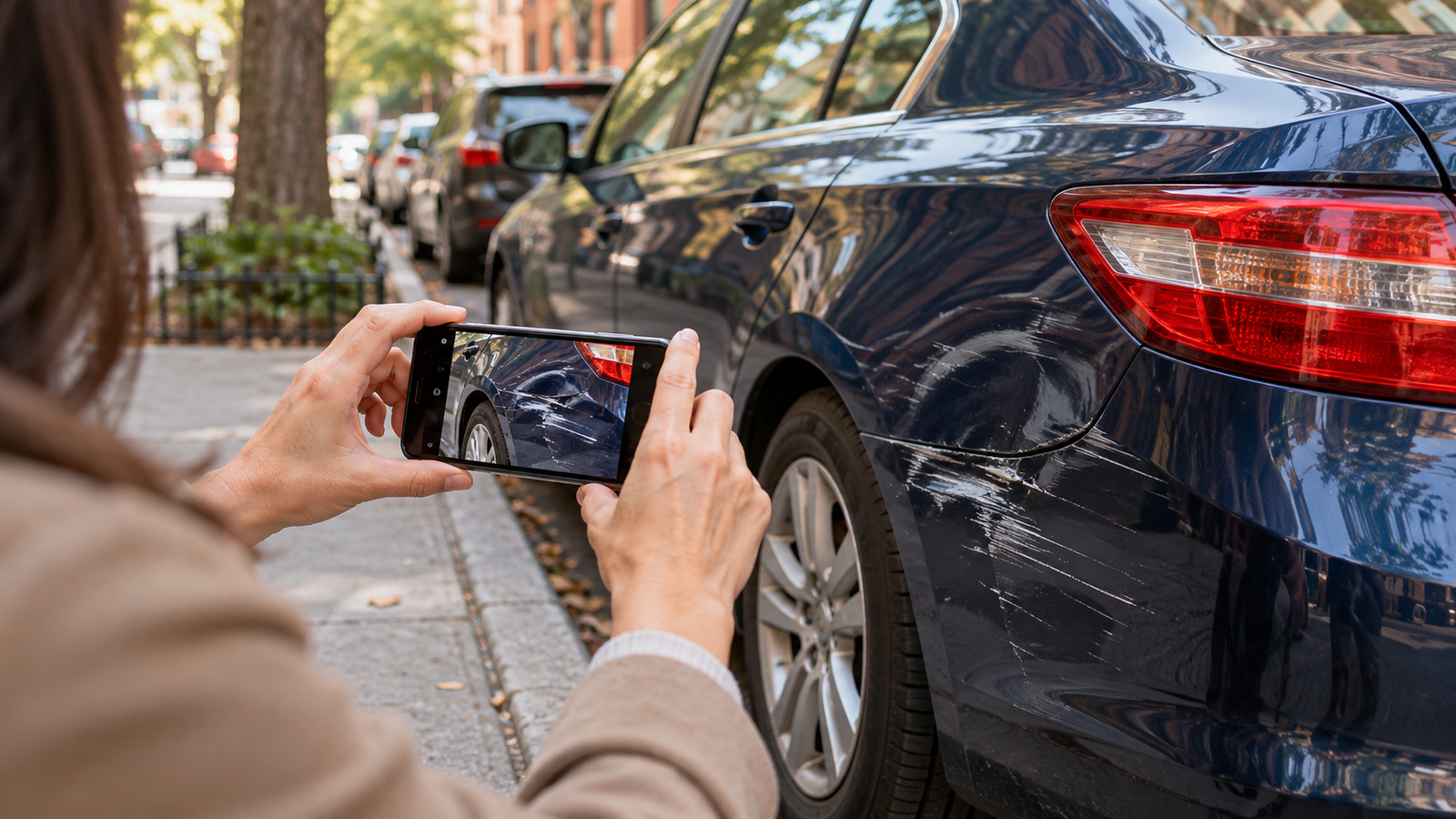
AI-generated illustration of documenting vehicle damage; not actual client evidence.
New York no-fault insurance: benefits and early deadlines
New York no-fault insurance, also called personal injury protection or PIP, can pay qualifying economic losses without first establishing another driver's negligence. Basic coverage generally provides up to $50,000 per eligible person for covered expenses, subject to statutory and policy rules. It does not compensate pain and suffering or repair your car. The New York Department of Financial Services insurance guide explains these distinctions.
According to the DFS no-fault claim FAQs, written notice generally must reach the appropriate insurer as soon as reasonably practicable and within 30 days, with a limited exception requiring a clear, reasonable written justification for delay. Occupants generally apply to the insurer of the vehicle they occupied; pedestrians generally apply to the insurer of the vehicle that struck them.
Identifying the correct carrier can be harder in a hit-and-run, an uninsured vehicle collision, or a crash involving multiple vehicles. Keep proof of delivery and copies of submissions. A phone call or police report should not be assumed to satisfy every insurance requirement. Other claim submissions can have separate deadlines.
Serious injuries and claims for pain and suffering
For covered motor vehicle claims, Insurance Law § 5104 generally limits recovery for non-economic loss to cases involving a legally qualifying serious injury. A painful injury and a statutory serious injury are not automatically the same thing.
The current definition in Insurance Law § 5102 includes categories such as fractures, significant disfigurement, and specified permanent or significant limitations. The applicable version of the law and the medical evidence need review for the individual claim.
For a neck, back, or head injury claim, useful records may include imaging, examination findings, treatment history, and documented functional restrictions. A diagnosis alone may not answer questions about causation or lasting effects. Be candid about earlier injuries: a careful assessment distinguishes a new condition from an aggravation of an existing problem rather than pretending prior records do not exist.
Compensation and disputed fault
Potential recovery may address eligible medical costs, lost earnings, future financial losses, property damage, and, where permitted, pain and suffering. Which losses are recoverable depends on proof, insurance coverage, applicable statutory restrictions, and amounts already compensated. A policy limit is not a promised settlement.
There is no reliable Manhattan car accident settlement calculator that can value a case from a diagnosis and ZIP code. A meaningful assessment considers treatment needs, work limitations, liability evidence, and the practical ability to collect a judgment or settlement.
Shared fault also matters. The current CPLR § 1411 reduces damages based on claimant fault and includes a specific bar for Article 51 personal injury actions when the claimant's culpable conduct exceeds that of the defendant or combined defendants. Have counsel determine which version and rules apply to the accident. Do not rely on a blanket statement that every New York crash claim follows unrestricted pure comparative negligence.
Taxi, Uber, Lyft, truck, and pedestrian accident claims
For a Manhattan taxi accident, preserve the receipt, vehicle identifiers, and driver information. For an Uber or Lyft accident, save the trip receipt, app screenshots, pickup and drop-off details, and messages about the ride. The driver's activity at the time can matter to coverage. The site's Uber and Lyft accident guide covers related issues.
A delivery van or truck collision may require records held by a business, including dispatch information, vehicle maintenance documents, and onboard footage. The truck accident page provides additional context for commercial vehicle investigations.
Pedestrians and passengers should not assume that lacking a personal vehicle prevents a claim. A pedestrian accident lawyer can examine the signal phase, turning vehicle path, crossing location, and available coverage. Passengers should preserve information about every involved vehicle, particularly when drivers disagree about who caused the crash.
How long do you have to bring a claim?
For many ordinary negligence injury lawsuits, CPLR § 214 provides a three-year limitation period. That general rule does not replace shorter insurance deadlines or resolve every special circumstance.
Claims involving a municipal vehicle or a public entity can require earlier action. Where applicable, General Municipal Law § 50-e generally requires a notice of claim within 90 days, with statutory exceptions. Public authorities and particular defendants may have different procedural requirements.
A fatal collision raises separate estate, deadline, and damages questions; see the site's wrongful death information. Ask a lawyer to calculate dates from the actual events and parties involved. Waiting for an insurer to respond does not necessarily pause a deadline.

AI-generated illustration of a claim file; no real client records are shown.
Preparing for a lawyer consultation
Bring the police report number, accident date, exact location, photographs, insurance letters, and available medical records. Add a short timeline explaining the impact, initial symptoms, treatment, and work missed. You do not need a perfectly assembled file before seeking time-sensitive guidance.
Ask who would handle your case, how updates are provided, and what evidence needs immediate preservation. Request a written explanation of fees and expenses, including how costs are handled if no recovery occurs. Confirm the attorney's identity and credentials before sharing sensitive records or signing an agreement.
Keep a simple expense log with dates, descriptions, receipts, and reimbursement status. Track concrete changes in daily activities, such as difficulty commuting, lifting at work, or caring for children. Specific, accurate notes are more useful than exaggerated descriptions or guesses about a future settlement.
Manhattan car accident lawyer FAQs
Do I need a lawyer after a minor car accident?
Not every property-damage dispute requires representation. Legal advice becomes more useful when injuries, disputed fault, coverage problems, or short deadlines are involved. Before accepting a payment, confirm whether the release addresses only property damage or also resolves injury claims.
What if the driver left the scene?
Report the incident promptly and preserve descriptions, partial plate information, witness contacts, and nearby camera locations. Ask about applicable uninsured motorist or other available claim procedures. Do not chase the vehicle or assume that a missing driver makes every recovery route unavailable.
Can a tourist bring a Manhattan car accident claim?
Living outside New York does not by itself answer whether a claim exists. The crash circumstances, insurance, and applicable law need review. Keep travel receipts and arrange access to records from both New York treatment and follow-up care at home.
Will my case go to trial?
Some claims resolve through negotiation; others require litigation. The path depends on evidence, disputed issues, and settlement positions. Ask about the expected stages and decisions rather than relying on a guaranteed timetable or a promise that trial will never be necessary.
How do I get a copy of my crash report?
NYC311's vehicle accident report guide explains available request routes. Keep the collision date, location, and report number handy. Review the report for factual errors, but remember that it is one part of the investigation rather than a final determination of civil liability.
Take the next step with an organized record
Whether the collision happened in Midtown, Lower Manhattan, Harlem, or another neighborhood, useful next steps are the same: protect your health, preserve evidence, and get the relevant deadlines reviewed promptly. A licensed Manhattan car accident lawyer can assess the facts and explain which options fit your situation.
For website-related questions, use the Tokov Law contact page. Do not submit confidential case documents until you have verified the recipient and an appropriate secure process.