
Manhattan Slip and Fall Lawyer
Understanding a fall on someone else's property
A Manhattan slip and fall lawyer investigates whether a dangerous property condition caused an injury and whether a legally responsible party created the condition or had sufficient notice to address it. The investigation often begins with something very specific: a wet lobby tile, a broken stair edge, a raised sidewalk flag, or an unsecured entrance mat. Falling at a business does not automatically establish negligence, but evidence can explain why an otherwise ordinary walk became dangerous.
Manhattan adds practical complications. A storefront may occupy one portion of a larger building. A sidewalk may border several entrances. A station stairway can sit next to a privately maintained plaza. Identifying the precise location and who controlled it is often as important as describing the injury. A landmark helps orient the investigation; an address, entrance, floor, and photograph make that description usable.
This guide explains evidence, local context, deadlines, and questions to bring to a licensed New York attorney. Health needs come first. Once safe, preserve the condition and the timeline before a spill is cleaned, a floor mat is moved, or a recording is overwritten.
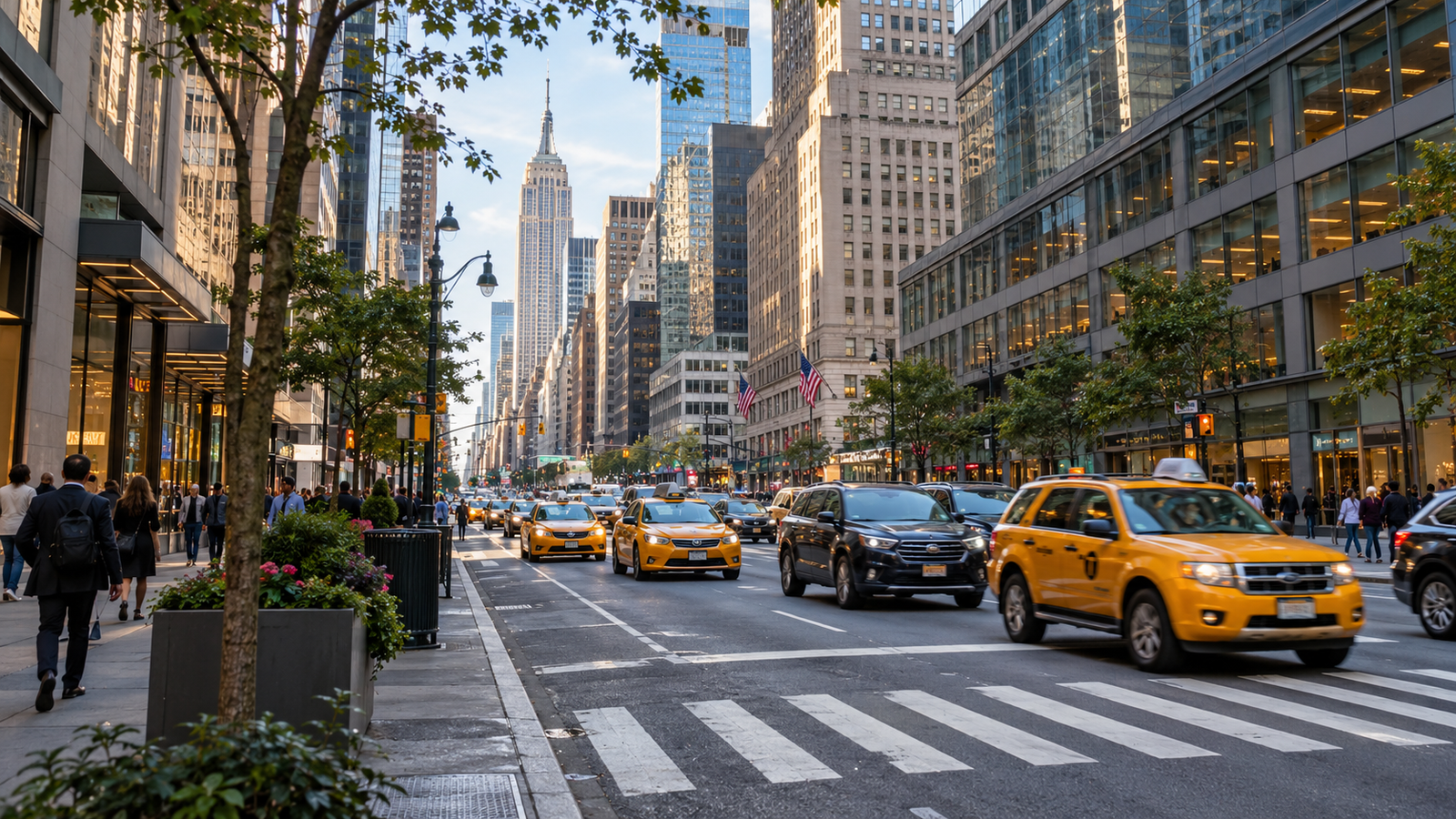
AI-generated area illustration; not a photograph of a reported accident.
Real Manhattan data: what the numbers establish
The New York State Department of Health's New York County indicator table reports 178.5 fall-related hospitalizations per 10,000 residents aged 65 or older for 2022–2024 in its total column. The table contains indicators from different periods, so the dates attached to this particular measure matter. It is a hospitalization rate, not a count of premises-liability lawsuits.
That figure provides public-health context for taking fall injuries seriously. It does not identify the location of each fall, the age of every injured visitor to Manhattan, or whether a property owner acted negligently. A neighborhood should not be labeled a dangerous slip-and-fall hotspot from this countywide measure. For an individual claim, evidence must connect a particular condition to a particular injury.
There is also a practical lesson for families helping an older adult: document changes in mobility and independence without assuming every limitation resulted from the fall. Medical professionals can assess what is new, what existed beforehand, and what assistance is needed. Accurate records are more persuasive than an unsupported claim that a fall changed everything.
Manhattan locations and the evidence they require
Midtown offices, hotels, and retail entrances
Near Penn Station, Herald Square, and Grand Central, the relevant question may be which entrance a person used rather than which destination they were visiting. An office tower can have separate public, employee, retail, and loading entrances. Photograph the door and surrounding address markers. Save a receipt, meeting invitation, or reservation if it helps establish the time and location.
A lobby incident can raise questions about cleaning schedules, entrance mats, weather-related tracking, and the placement of warning signs. Record whether a sign was visible from your actual approach. A photograph taken after someone repositioned it may not show what you encountered. Do not move a sign or mat to recreate the scene; preserve the original situation if safely possible.
Upper West Side and Upper East Side apartment buildings
In an apartment building, distinguish a private unit from a common stairwell, vestibule, elevator landing, or exterior walkway. Identify the floor and the particular step where the event occurred. A building's managing agent, owner, cooperative corporation, condominium association, or contractor may hold different records. Their legal responsibilities require investigation rather than assumptions based on a name on the lobby directory.
Preserve repair requests and messages sent before the accident if you already have them. A complaint about a specific recurring leak can be more informative than a general statement that the building is old. Do not ask neighbors to adopt your description; ask what they independently observed and when they observed it.
Harlem, Washington Heights, and neighborhood storefronts
On Broadway, West 125th Street, or St. Nicholas Avenue, identify the actual business entrance and the adjoining pavement. A delivery ramp, cellar door, curb, and sidewalk flag may sit close together but raise different control and maintenance questions. Record the point where your foot contacted the condition and the direction you were walking.
These streets are examples of local investigation settings, not allegations that particular businesses or blocks have unusually high fall rates. If a nearby camera may have recorded the event, note its location promptly. A camera's presence does not establish that it was operating, faced the relevant area, or retained a recording.
Downtown plazas, waterfront walks, and transit connections
Around the Financial District, Battery Park, and transit connections, a public-looking space can have a different owner or operator from the adjacent building. Preserve a map pin and photographs showing boundaries, signs, railings, and entrances. A fall near a station does not necessarily mean the transit operator controlled the location.
Public entities and authorities can have special procedures. Tell counsel about possible government involvement early rather than deciding on your own that a location is private. An ordinary incident report to a station employee or property manager is not necessarily the formal notice required for a legal claim.
What must be shown in a premises-liability claim?
A claim generally requires a supported duty, unsafe condition, causal connection, and resulting loss. Notice is often disputed. In Gordon v. American Museum of Natural History, the Court of Appeals addressed when a condition's visibility and duration can support constructive notice. A spill's existence alone does not establish how long it was there.
Consider the difference between a fresh spill and a repeatedly reported leak. The first may require evidence about when it appeared and the last inspection. The second may lead to maintenance requests, prior photographs, or accounts from people who saw earlier occurrences. Neither example automatically wins or defeats a claim; each identifies a different evidence path.
Creating the condition, receiving an actual complaint, and having a reasonable opportunity to discover it are separate questions. An attorney may review cleaning logs, employee accounts, work orders, inspection records, and video. A missing log is not itself proof of negligence, and a completed checklist is not necessarily the entire story.
Sidewalk falls: identify the surface and responsible party
NYC Administrative Code § 7-210 places sidewalk duties on many adjoining owners, with an exception for qualifying owner-occupied one-, two-, or three-family residential property. Coverage and other potential duties depend on the facts.
Record whether the condition was in the sidewalk, curb, tree area, metal cover, driveway crossing, or roadway. Those distinctions can affect the legal analysis. Photograph enough surrounding area to locate the defect relative to the property. A close-up without an address or wider view may leave uncertainty about which segment is involved.
Do not assume that every small elevation difference is legally actionable or that a defect must exceed one universal measurement. In Hutchinson v. Sheridan Hill House, the Court of Appeals examined the defect together with surrounding circumstances. Lighting, appearance, and context can matter alongside dimensions.

AI-generated premises-safety illustration; no actual property is accused of a hazard.
Rain, snow, ice, and recurring indoor moisture
Weather cases require a timeline. Record whether precipitation was ongoing, when you arrived, and what you actually saw on the surface. Preserve photographs taken at the time and any reliable weather records later obtained. A recollection that it was a cold week does not establish when a particular patch of ice formed.
New York's storm-in-progress principles can affect the time allowed to address weather-related accumulation; Solazzo v. New York City Transit Authority illustrates the issue. Application depends on the condition and timing, not simply the season.
An indoor leak may raise different questions from precipitation tracked through an entrance. Note whether water came from a ceiling, plumbing fixture, cleaning operation, or an unknown source. Do not assign a source you did not see. If you noticed a bucket, stained ceiling, or repeated maintenance activity, preserve that observation without turning it into a conclusion about fault.
A useful first-day evidence checklist
Seek appropriate medical attention and report the incident to the relevant manager or staff member when practical. Give a factual description. Ask for an incident number or copy, but do not assume staff must immediately provide every internal document. Write down whom you spoke with and when.
Preserve wide and close photographs, original videos, witness contact details, footwear, and relevant receipts. Avoid altering the only copy of a file. If footwear may matter, keep it in its post-incident condition rather than discarding or repairing it before discussing preservation. Do not put yourself at risk to take measurements or revisit an unsafe area.
Make a short account of your route and what happened. Distinguish seeing a substance before the fall from noticing it afterward. If you do not know the cause, say so. Guessing at a cause to complete a form can create a dispute later, particularly when better evidence becomes available.
Medical records and the practical effect of an injury
Treatment records can help explain diagnosis, symptoms, causation, and functional restrictions. Describe prior injuries and conditions honestly. A person may have a preexisting knee problem and still experience a new injury or aggravation, but the medical evidence should address the distinction. Do not assume every finding on an image was caused by the incident.
Keep records of missed work, appointments, transportation expenses, and assistance needed for ordinary tasks. For a Manhattan resident, difficulty managing apartment stairs or commuting may be significant even when a job is primarily desk-based. Explain the actual limitation rather than relying only on a broad phrase such as “unable to function.”
If treatment is interrupted, document the reason and discuss it with the provider or adviser. Insurance issues, access, work, and family duties may affect attendance. Your health decisions should follow appropriate medical advice, not a strategy intended to make a claim look larger.

AI-generated records illustration; no real client documents are shown.
Deadlines, compensation, and shared responsibility
CPLR § 214 generally provides three years for ordinary negligence injury actions. Applicable public-entity claims may require a 90-day notice under General Municipal Law § 50-e. Other limits and exceptions need individual review.
For ordinary premises claims, CPLR § 1411(a) generally reduces damages in proportion to claimant fault. An insurer's allegation about attention, footwear, or route choice should be assessed against evidence rather than accepted automatically.
Potential damages may include medical expenses, lost income, future financial effects, and legally available pain-and-suffering damages. There is no reliable settlement average that values a particular Manhattan fall. The extent of injury, proof of liability, medical causation, coverage, and other circumstances all affect an assessment.
Before resolving a claim, understand any outstanding bills, reimbursement interests, fees, expenses, and the scope of the release. A settlement figure is not necessarily the amount received after deductions. A quick offer may require careful review if future care or work restrictions remain uncertain.
Manhattan slip and fall questions
Can I have a claim if no one witnessed the fall?
Possibly. Photographs, video, the condition itself, medical records, and accounts of what happened immediately afterward may be relevant. A witness is useful but is not the only form of evidence. Preserve what exists rather than assuming a claim is impossible because nobody saw the exact moment.
Does a warning sign automatically protect a business?
A sign is one fact. Its placement, visibility from your route, and relationship to the actual condition may matter. Describe what you saw and preserve photographs. Do not assume that a sign elsewhere in a lobby warned of every hazard or that the absence of a sign alone establishes negligence.
What if I was visiting Manhattan from another state?
Retain hotel, travel, and purchase records that help establish timing and location. Obtain appropriate care and preserve the property details before leaving. Your residence does not eliminate the need to examine New York rules and the particular defendant. Ask about handling records and communications after you return home.
Should I give a recorded statement immediately?
Identify who is requesting it, whom they represent, and whether any policy obligation applies. Be accurate and avoid speculation. If you are unsure about the request or its consequences, seek advice before providing a detailed account. Do not ignore a genuine deadline merely because another party has contacted you.
How should I prepare for a lawyer consultation?
Bring the date, exact address, photographs, report details, correspondence, and treatment information already available. Ask about evidence preservation, parties, deadlines, fees, and communication. You need not wait for every document. Verify the professional's identity and review a written agreement before assuming representation has begun.
From an incident report to a supported claim
An early investigation often produces an incomplete picture. The business may know which employee was present but not the building owner's legal name. A photograph may show the defect but not its dimensions. A medical record may document pain without answering whether a limitation will persist. A useful claim assessment identifies these gaps rather than treating the first set of documents as the final answer.
An attorney may seek ownership records, leases, maintenance contracts, and relevant insurance information. Different documents address different questions: a lease can allocate responsibilities between parties, while actual control and applicable law may affect duties to an injured visitor. The name on a storefront is not necessarily the entity to name in a lawsuit. Preserve business receipts and correspondence because they can help identify the organizations involved.
If a claim proceeds into litigation, the parties may exchange documents and testimony through discovery. A deposition is an opportunity to give an accurate account under questioning, not to fill gaps with guesses. Before any formal statement, review your own records and distinguish present recollection from information learned from someone else. Corrections should be made openly through the appropriate process.
Settlement discussions can occur at different stages, but timing should reflect the evidence and the person's circumstances. A medical prognosis, disputed control of the property, or missing recording can materially affect evaluation. A lawyer should explain what further investigation might resolve and what uncertainty may remain even after extensive work. That explanation helps a person weigh a proposed resolution without relying on an advertised settlement number from an unrelated case.
Related Manhattan injury information
The site's Manhattan personal injury guide discusses broader claim types, while the slip and fall FAQs address additional questions. If a vehicle caused the event, the Manhattan car accident page may be relevant. For website questions, use the contact page.