Manhattan Personal Injury Lawyer
If you or a loved one suffered an injury because of someone else’s negligence in Manhattan, understanding your legal rights is an important first step toward protecting your future. A Manhattan personal injury lawyer can help you evaluate whether you have a claim, identify potentially responsible parties, and pursue compensation for qualifying medical expenses, lost income, pain and suffering, and other damages.
From car accidents near Times Square to construction injuries in Midtown and slip-and-fall accidents in the Financial District, personal injury cases in Manhattan can involve complicated liability questions, multiple insurance policies, and strict filing deadlines.
New York law allows injured individuals to seek compensation when another party’s negligence causes harm. However, establishing liability requires more than proving that an accident occurred. The available evidence, nature of the injuries, applicable insurance coverage, and circumstances surrounding the incident all influence whether a claim may succeed.
If you have been injured in Manhattan, seeking medical attention and obtaining timely legal guidance can help preserve evidence and protect your ability to pursue compensation.
Personal Injury Cases in Manhattan, New York
Manhattan is one of the busiest urban environments in the country. Its combination of crowded intersections, commercial properties, residential buildings, subway stations, delivery vehicles, and active construction sites creates a wide range of situations in which preventable injuries may occur.
A personal injury attorney in Manhattan may evaluate claims involving negligent drivers, unsafe property conditions, workplace accidents, defective equipment, and other circumstances involving potential legal responsibility.
Common types of Manhattan personal injury cases include:
- Car, taxi, and rideshare accidents
- Pedestrian and bicycle accidents
- Truck and commercial vehicle collisions
- Construction and workplace injuries
- Slip-and-fall and trip-and-fall accidents
- Unsafe sidewalks, stairways, and building entrances
- Bus and public transportation injuries
- Motorcycle accidents
- Serious injuries involving negligent property maintenance
- Wrongful death claims arising from another party’s misconduct
Each type of accident involves different legal standards, evidence requirements, and potential defendants. Identifying the correct legal basis for a claim is particularly important in Manhattan, where private businesses, building owners, contractors, transportation companies, and government entities may all be involved in the same incident.
Manhattan Car Accident Lawyer
Car accidents are a common reason injured individuals seek legal assistance. Manhattan’s dense traffic, commercial delivery activity, pedestrian crossings, and frequent turning movements can make determining responsibility more complicated than in less congested areas.
A Manhattan car accident lawyer can examine the circumstances of a collision and determine whether another driver’s negligence contributed to the injuries.
Potential causes of vehicle accidents include distracted driving, unsafe lane changes, speeding, failure to yield, impaired driving, following too closely, and violations of traffic signals.
Car Accidents Near Midtown and Times Square
Midtown Manhattan includes heavily traveled streets around Times Square, Grand Central Terminal, Penn Station, and the Port Authority Bus Terminal.
Intersections along Broadway, Seventh Avenue, Eighth Avenue, and 42nd Street bring together passenger vehicles, taxis, buses, cyclists, delivery workers, and pedestrians.
After an accident in these areas, relevant evidence may include:
- Traffic camera or nearby business surveillance footage
- Police collision reports
- Vehicle damage photographs
- Witness statements
- Taxi or rideshare trip records
- Traffic signal and intersection information
- Medical documentation connecting injuries to the collision
A crash near Grand Central Terminal may require examining turning vehicles and pedestrian signals, while a collision involving multiple vehicles near the Lincoln Tunnel approaches may raise different questions about lane changes, traffic congestion, and comparative fault.
Taxi, Uber, and Lyft Accidents
Rideshare vehicles and taxis are a significant part of Manhattan transportation.
An accident involving an Uber, Lyft, yellow taxi, or other for-hire vehicle may require identifying the driver’s employment or operating status, applicable insurance coverage, and whether a rideshare trip was active when the collision occurred.
The availability of particular insurance benefits depends on the vehicle, driver, policy, and facts of the accident.
Manhattan Pedestrian and Bicycle Accidents
Pedestrians and cyclists share Manhattan’s streets with thousands of vehicles traveling through intersections, loading zones, bus lanes, and bicycle facilities.
Pedestrian accidents may occur when drivers fail to yield while turning, disregard traffic signals, drive carelessly near crosswalks, or fail to observe people entering the roadway.
Bicycle accidents may involve vehicles turning across designated bicycle lanes, opening car doors into cyclists’ paths, unsafe passing, or collisions at intersections.
Second Avenue and Manhattan Street Safety
Second Avenue is an important north-south corridor used by buses, cyclists, pedestrians, and commercial vehicles.
The New York City Department of Transportation has implemented bicycle lane, bus lane, and pedestrian safety improvements along portions of Second Avenue, including the area between East 30th Street and East 59th Street.
These improvements reflect the importance of managing conflicts among different roadway users. They do not establish negligence in any particular accident.
Other Manhattan corridors where accident investigations may involve complex traffic conditions include:
- Canal Street near Chinatown and SoHo
- Broadway near Union Square
- Amsterdam Avenue and Columbus Avenue on the Upper West Side
- West 125th Street in Harlem
- West Street along the Hudson River waterfront
- Delancey Street on the Lower East Side
- The approaches to the FDR Drive and West Side Highway
In pedestrian and bicycle accident claims, identifying the precise intersection, direction of travel, traffic signals, and movements of each party can be essential.
Manhattan Slip and Fall Accident Lawyer
Property owners and other responsible parties may have legal obligations to maintain reasonably safe premises under the circumstances.
A Manhattan slip and fall lawyer can investigate whether a dangerous property condition contributed to an injury and whether a legally responsible party created the condition or had actual or constructive notice of it, when notice is required.
Slip-and-fall and trip-and-fall accidents may involve:
- Wet or slippery commercial floors
- Broken or uneven stairs
- Loose carpeting or damaged flooring
- Poorly maintained building entrances
- Inadequate lighting
- Unaddressed snow or ice
- Unsafe sidewalks and walking surfaces
- Missing or defective stairway handrails
- Building maintenance hazards
For example, a fall inside a Midtown office building may involve the property owner’s maintenance responsibilities, cleaning procedures, and inspection records.
A fall on a sidewalk in Chelsea may raise separate questions about ownership, maintenance obligations, the nature of the defect, and whether an applicable statutory exception affects liability.
Proving a Dangerous Property Condition
Not every fall creates a valid personal injury claim.
An injured person generally must establish an applicable duty of care, a breach of that duty, and a connection between the dangerous condition and the resulting injury.
Evidence may include maintenance records, prior complaints, photographs, surveillance footage, witness accounts, and information about how long the dangerous condition existed.
Prompt documentation is particularly important because spills may be cleaned, temporary hazards removed, and surveillance footage overwritten.
Manhattan Construction Accident Lawyer
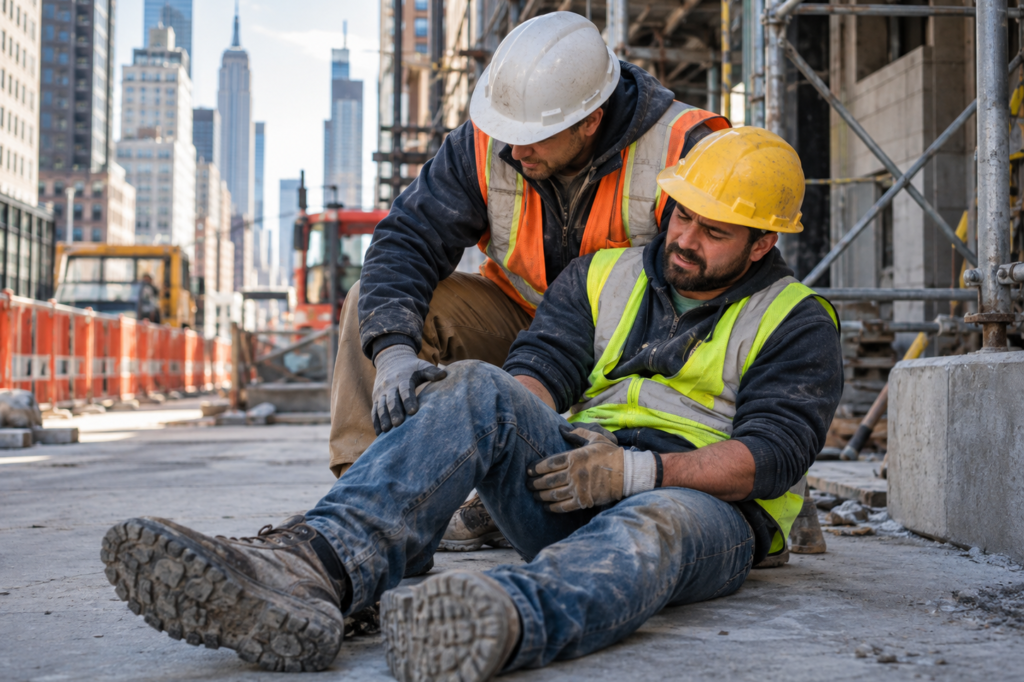
Construction and renovation projects are visible throughout Manhattan, including Midtown, Chelsea, Hudson Yards, the Financial District, and the Upper East Side.
Workers on these projects may face risks involving scaffolds, ladders, elevated platforms, falling materials, electrical equipment, excavation areas, and unsafe worksite conditions.
A Manhattan construction accident lawyer can evaluate whether a worker’s injuries may support a personal injury claim against a responsible third party.
Potentially relevant New York laws include Labor Law Sections 200, 240, and 241.
Scaffold and Ladder Accidents
New York Labor Law Section 240(1), commonly called the Scaffold Law, provides specific protections for qualifying elevation-related construction hazards.
Depending on the work being performed and the circumstances of the injury, the law may apply to certain falls from elevated work areas or injuries involving falling objects.
However, not every construction accident falls within Section 240.
Liability depends on the statutory requirements, the worker’s activity, the equipment involved, and the relationship of the potentially responsible parties to the project.
Construction Site Injuries and Third-Party Claims
Workers’ compensation may provide benefits for qualifying job-related injuries.
In some circumstances, injured construction workers may also have separate claims against negligent third parties, including certain contractors, owners, or other entities.
Determining whether a third-party claim exists requires reviewing the worker’s employment relationship, job duties, applicable laws, and the events that caused the accident.
Truck and Commercial Vehicle Accidents in Manhattan
Commercial trucks and delivery vehicles frequently travel through Manhattan to serve office buildings, restaurants, construction sites, retail stores, and residential properties.
Truck accident claims may involve more than the driver.
Depending on the circumstances, potentially responsible parties could include vehicle owners, employers, maintenance companies, or other entities whose negligence contributed to the collision.
An investigation may examine driver conduct, commercial vehicle records, maintenance history, loading practices, employment relationships, and available electronic data.
Commercial vehicle claims can become particularly complicated when several companies are involved in the operation or maintenance of one vehicle.
Subway, Bus, and Public Transportation Injuries
Manhattan commuters rely on subway stations, city buses, commuter rail services, and other public transportation facilities.
Injuries may occur during boarding, while exiting vehicles, on station stairs or platforms, or in collisions involving transit vehicles.
Possible claims depend on the cause of the injury and the identity of the responsible entity.
A transportation-related accident does not automatically create liability against the MTA or the City of New York.
Some transportation claims are governed by specialized notice requirements and statutes of limitations that differ from those applicable to private defendants.
Anyone injured in a transit-related incident should identify the proper entity and investigate the applicable deadlines as early as possible.
Manhattan Neighborhoods Served
Personal injury claims arise in many different parts of Manhattan. Each neighborhood has distinct transportation patterns, building conditions, and commercial activity that may affect an accident investigation.
Midtown Manhattan and Hell’s Kitchen
Midtown contains office towers, hotels, restaurants, major transit terminals, and busy commercial streets. Accidents may involve taxis, rideshare vehicles, delivery trucks, pedestrian crossings, or hazards inside commercial properties.
Financial District and Tribeca
Lower Manhattan includes office buildings, historic properties, construction activity, narrow streets, and busy pedestrian routes near Fulton Street, Wall Street, Broadway, and the World Trade Center area.
Upper East Side and Upper West Side
Residential buildings, retail properties, medical facilities, delivery activity, and heavily used intersections may be relevant to accidents along Lexington Avenue, Third Avenue, Columbus Avenue, Amsterdam Avenue, and surrounding streets.
Harlem and East Harlem
Accident investigations in Harlem may involve commercial corridors such as 125th Street, residential properties, intersections near major transit routes, or active construction sites.
Chelsea, Greenwich Village, and SoHo
These neighborhoods contain a mixture of residential buildings, retail establishments, restaurants, construction projects, and crowded streets. Potential claims may involve pedestrian accidents, bicycle collisions, and unsafe property conditions.
Washington Heights and Inwood
Northern Manhattan includes major roadways, apartment buildings, transit stations, hills, stairs, and busy neighborhood shopping areas. Relevant accident evidence may depend on the specific street, building, or transportation facility involved.
Additional Manhattan communities include the East Village, Lower East Side, Chinatown, Kips Bay, Murray Hill, Gramercy, Morningside Heights, and Battery Park City.
The location of an accident alone does not prove negligence. Its importance lies in identifying potential witnesses, responsible parties, roadway conditions, property records, and sources of evidence.
What Must Be Proven in a Manhattan Personal Injury Case?
Most negligence-based personal injury claims require establishing four legal elements.
1. Duty of care: The defendant owed the injured person an applicable legal duty.
2. Breach of duty: The defendant failed to satisfy the required standard of care.
3. Causation: The defendant’s conduct was both a factual and legally sufficient cause of the injury.
4. Damages: The injured person sustained compensable harm.
For example, a driver who disregards a traffic signal may breach a duty of reasonable care. However, liability still depends on the evidence establishing how that conduct contributed to the accident and injuries.
Similarly, a dangerous condition inside a Manhattan building may support a claim only when the applicable legal standards for responsibility, notice, causation, and damages are satisfied.
What Compensation May Be Available After a Personal Injury?
The potential value of a personal injury claim depends on the severity of the injuries, available evidence, applicable law, insurance coverage, and other case-specific circumstances.
Depending on the claim, recoverable damages may include:
- Past and future medical expenses
- Lost wages and reduced earning capacity
- Rehabilitation and necessary ongoing treatment
- Physical pain and suffering
- Emotional distress and loss of enjoyment of life
- Other legally recognized financial and nonfinancial losses
Not every category is available in every case.
For example, motor vehicle claims governed by New York’s no-fault insurance system have specific rules governing economic benefits and the recovery of noneconomic damages.
There is no reliable universal settlement amount for a Manhattan personal injury case. Two accidents involving similar injuries can produce different outcomes because of differences in liability, medical evidence, long-term impairment, and insurance coverage.

New York No-Fault Insurance and the Serious Injury Threshold
New York’s no-fault insurance system generally provides qualifying first-party benefits for certain injuries arising from motor vehicle accidents, regardless of who caused the collision.
Depending on eligibility and policy terms, benefits may cover portions of medical expenses, lost earnings, and other qualifying costs.
An initial written no-fault notice generally must be submitted within 30 days of the accident, subject to the applicable rules and recognized justifications for late notice.
No-fault benefits are different from a liability lawsuit seeking compensation from a negligent party.
Important 2026 Changes to New York Motor Vehicle Injury Law
New York amended Insurance Law Sections 5102 and 5104 in May 2026.
For actions commenced on or after May 26, 2026, the statutory definition of serious injury no longer includes the former category based on a qualifying nonpermanent impairment preventing substantially all usual activities for at least 90 of the first 180 days.
Other serious-injury categories remain, including certain fractures, significant disfigurement, permanent consequential limitations, and significant limitations of bodily functions or systems.
Determining whether an injury satisfies the applicable statutory threshold requires consideration of medical evidence, the facts of the accident, and the law governing the action.
Can You Recover Compensation if You Were Partially at Fault?
Responsibility for an accident is not always assigned entirely to one party.
New York’s comparative negligence rules address situations in which an injured person and one or more defendants share responsibility.
Under the general rule in CPLR Section 1411(a), a claimant’s comparative fault ordinarily reduces recoverable damages proportionately rather than automatically preventing recovery.
However, a 2026 amendment added a different rule for certain motor vehicle personal injury actions governed by Insurance Law Article 51.
For actions commenced on or after May 26, 2026, CPLR Section 1411(b) generally bars recovery in covered claims when the claimant’s culpable conduct exceeds the culpable conduct of the defendant or the combined culpable conduct of the defendants.
The applicable rule depends on the type of claim and when the action was commenced.
Because these distinctions can materially affect a motor vehicle injury case, fault allocation should be evaluated under the correct statutory framework.
How Long Do You Have to File a Personal Injury Claim in Manhattan?
New York has strict filing deadlines, and different rules apply depending on the nature of the claim and the defendant.
General Personal Injury Deadline
Under CPLR Section 214(5), many negligence-based personal injury lawsuits against private parties generally must be commenced within three years of the injury.
However, shorter deadlines and other exceptions may apply.
Claims Against New York City
Certain negligence claims against New York City and other covered municipal entities generally require a notice of claim within 90 days.
Under General Municipal Law Section 50-i, covered municipal personal injury lawsuits generally must be commenced within one year and 90 days of the event.
A notice of claim is a distinct legal requirement and should not be confused with an ordinary insurance report.
Wrongful Death Claims
New York wrongful death actions generally have a two-year limitations period measured from the date of death, although additional rules may apply depending on the defendant and circumstances.
Other Important Deadlines
Transit authorities, state agencies, public-benefit corporations, medical malpractice defendants, and other parties may be subject to different legal requirements.
The deadline should never be determined solely by assuming that every Manhattan personal injury claim has three years to be filed.
What Should You Do After an Accident in Manhattan?
Taking appropriate steps after an accident can help protect your health and preserve important information.
1. Seek medical attention. Obtain prompt assessment of your injuries and follow appropriate medical recommendations. Some symptoms may become more apparent after the initial accident.
2. Report the incident. Depending on the circumstances, notify police, a property manager, employer, or other appropriate party. Request available identifying information for the report.
3. Document the accident scene. Preserve photographs of vehicles, roadway conditions, property hazards, injuries, and surrounding features when it is safe to do so.
4. Identify witnesses. Obtain contact information from individuals who observed the incident.
5. Preserve financial and medical records. Keep records of medical visits, missed work, transportation expenses, insurance correspondence, and other relevant costs.
6. Identify potential surveillance footage. Nearby businesses, buildings, vehicles, and transportation facilities may have recordings that are automatically deleted after a limited period.
7. Review applicable deadlines promptly. Insurance forms, municipal notices, and lawsuit filing deadlines can arise well before a person has completed medical treatment.
8. Obtain legal guidance before resolving disputed claims. An agreement or release may affect the ability to pursue additional compensation.
These steps do not guarantee a successful personal injury claim, but they may reduce the risk that important information becomes unavailable.
How Does a Manhattan Personal Injury Claim Work?
Although every case is different, many personal injury matters follow several general stages.
Initial Case Evaluation
The circumstances of the accident, available documentation, injuries, possible defendants, and applicable filing deadlines are reviewed.
Investigation and Evidence Collection
Relevant records may include police reports, medical documentation, photographs, witness information, surveillance video, maintenance records, or commercial vehicle data.
Insurance Claims and Negotiations
Where appropriate, claims may be presented to insurers or other responsible parties. Discussions may address liability, damages, medical expenses, and the possibility of settlement.
Filing a Lawsuit
If the matter cannot be resolved through negotiations or circumstances otherwise warrant litigation, a civil lawsuit may be commenced within the applicable legal deadline.
Discovery and Case Preparation
The parties may exchange relevant documents, conduct depositions, obtain expert opinions, and challenge legal or factual issues through motions.
Settlement or Trial
Some cases settle before litigation. Others settle during discovery, after motions, or closer to trial. Cases that cannot be resolved may proceed to a court determination.
The length of the process depends on the facts, disputed issues, court schedule, medical condition, and willingness of the parties to resolve the matter.
Where Are Manhattan Personal Injury Lawsuits Filed?
Many significant civil personal injury cases involving Manhattan are filed in the New York State Supreme Court, New York County, when the applicable jurisdictional and venue rules are satisfied.
The principal New York County Supreme Court courthouse is located at 60 Centre Street in Lower Manhattan, near Foley Square.
However, not every accident occurring in Manhattan must be litigated in that courthouse.
The appropriate court and county depend on jurisdiction, the parties, venue rules, and the nature of the claim.
Many New York civil cases are filed electronically through the New York State Courts Electronic Filing system.
Understanding which court has jurisdiction and whether particular pre-suit notices are necessary is an important part of preparing an injury claim.
Frequently Asked Questions About Manhattan Personal Injury Claims
How much does a Manhattan personal injury lawyer cost?
Many personal injury matters are handled under contingency-fee arrangements, in which attorney compensation is tied to a qualifying recovery. The exact percentage, responsibility for expenses, and other financial terms depend on the written agreement and applicable rules.
Do I have a personal injury case if there was no police report?
Possibly. A police report can provide useful documentation, but other evidence may establish how an accident occurred. Witness statements, photographs, medical records, surveillance footage, and other relevant information may help support a claim.
What if the person responsible for my injury denies fault?
A denial of responsibility does not automatically eliminate a claim. Liability may be evaluated using independent evidence, applicable legal duties, and the circumstances of the incident.
Can I file a claim for a slip-and-fall accident in Manhattan?
Potentially. A valid claim depends on whether a legally responsible party failed to satisfy an applicable duty and whether that failure caused compensable injuries. Notice requirements and responsibility for the dangerous condition can be important.
Can I sue after being injured in a Manhattan construction accident?
Certain construction injuries may support third-party personal injury claims in addition to workers’ compensation benefits. The availability of a separate claim depends on the work being performed, responsible parties, applicable statutes, and the facts.
What if I was injured by a taxi or rideshare vehicle?
The appropriate insurance coverage and possible defendants depend on the type of vehicle, circumstances of the accident, and operating status of the driver. Different rules may apply to taxis, rideshare vehicles, and privately owned cars.
What if a Manhattan accident involved a city vehicle or public sidewalk?
Claims involving public entities may be subject to special notice and filing rules. Responsibility depends on the entity involved and the applicable law. The fact that an accident happened on public property does not automatically make the city liable.
How long does a personal injury settlement take in Manhattan?
There is no fixed timeline. Settlement may depend on the severity of injuries, availability of medical records, insurance coverage, disputed liability, negotiations, and whether litigation becomes necessary.
How much is my Manhattan personal injury case worth?
Case value depends on the available damages, severity and permanence of injuries, evidence of liability, applicable insurance, comparative fault rules, and other legal limitations. A meaningful evaluation requires examining the specific facts rather than relying on general settlement averages.
Can I pursue compensation if I live outside Manhattan?
Potentially. Residence outside Manhattan does not automatically prevent someone from pursuing a claim arising from an accident there. Jurisdiction, venue, applicable law, and the facts determine where and how a claim may proceed.
What happens if I was partly responsible for my accident?
Partial responsibility may reduce recovery or, in certain motor vehicle personal injury actions governed by the 2026 changes to CPLR Section 1411, bar recovery when the claimant’s culpability exceeds the applicable statutory threshold.
Should I wait until I finish medical treatment before seeking legal guidance?
Not necessarily. Evidence can disappear and filing requirements can arise while treatment is ongoing. Obtaining timely information about deadlines and evidence preservation can be useful even when the full extent of an injury is not yet known.
Related legal guides
These guides address issues that may overlap with personal injury matters in Manhattan. Review the guide that fits the facts of your situation.
- Contact Tokov Law — ask about the information and documents relevant to your matter.
- New York Personal Injury Lawyer: Accident Claims in NYC and Long Island — evidence, responsibility, and injury claims.
- Manhattan Car Accident Lawyer — collision evidence and insurance questions.
- Manhattan Pedestrian Accident Lawyer — injuries involving people on foot.
- Manhattan Truck Accident Lawyer — commercial vehicle evidence and liability.
- Manhattan Motorcycle Accident Lawyer — motorcycle crashes and rider injuries.
- Manhattan Uber & Lyft Accident Lawyer — rideshare coverage and driver status.
- Manhattan Taxi Accident Lawyer — taxi passengers and insurance coverage.
Official resources and further reading
Use these resources to review the underlying rules, locate records, or understand the relevant agency process. Check the requirements and current instructions for the particular document or process you need.
- CPLR 1411: comparative fault
- CPLR 214: time limits for specified civil claims
- General Municipal Law 50-e: municipal notice of claim
- DFS auto insurance guide
- NY Department of Financial Services' July 2026 explanation
Match a Manhattan business name to the place where the injury occurred
A Manhattan receipt may show a trading name while a building directory lists a different business or suite. A Manhattan personal injury lawyer can use those details to investigate the actual location and participants. The name on a payment statement should not automatically be treated as the property owner, employer, or operator responsible for the area involved.
Keep the receipt, appointment confirmation, entrance photograph, and floor or suite information where available. Explain whether the incident occurred inside the business, in a shared lobby, or along the route to the entrance. If several businesses share an address, a street number alone may leave an important gap.
For a personal injury investigation, a clear location record helps direct requests to the correct source. A tenant may hold useful footage without controlling the relevant common area. A building manager may know the maintenance contractor while having no firsthand knowledge of the event. Establishing those roles is more useful than assuming every name associated with the address has the same responsibility.
Speak With Tokov Law About a Manhattan Personal Injury Claim
An unexpected injury can affect your health, employment, finances, and daily responsibilities. Understanding the legal requirements involved in a potential claim can help you make informed decisions during an already difficult period.
Whether an accident occurred near Times Square, in Midtown, along Second Avenue, inside a Financial District building, at a Manhattan construction site, or elsewhere in New York County, the relevant questions are similar: What caused the injury, who may be legally responsible, what evidence is available, and which deadlines apply?
If you believe another party’s negligence caused your injuries, contact Tokov Law to inquire about a case evaluation and discuss the next steps that may be available.
Request a personal injury consultation to learn more about your legal options.
This page provides general information about New York personal injury law and does not establish an attorney-client relationship or guarantee a particular outcome.