
New York Truck Accident Lawyer
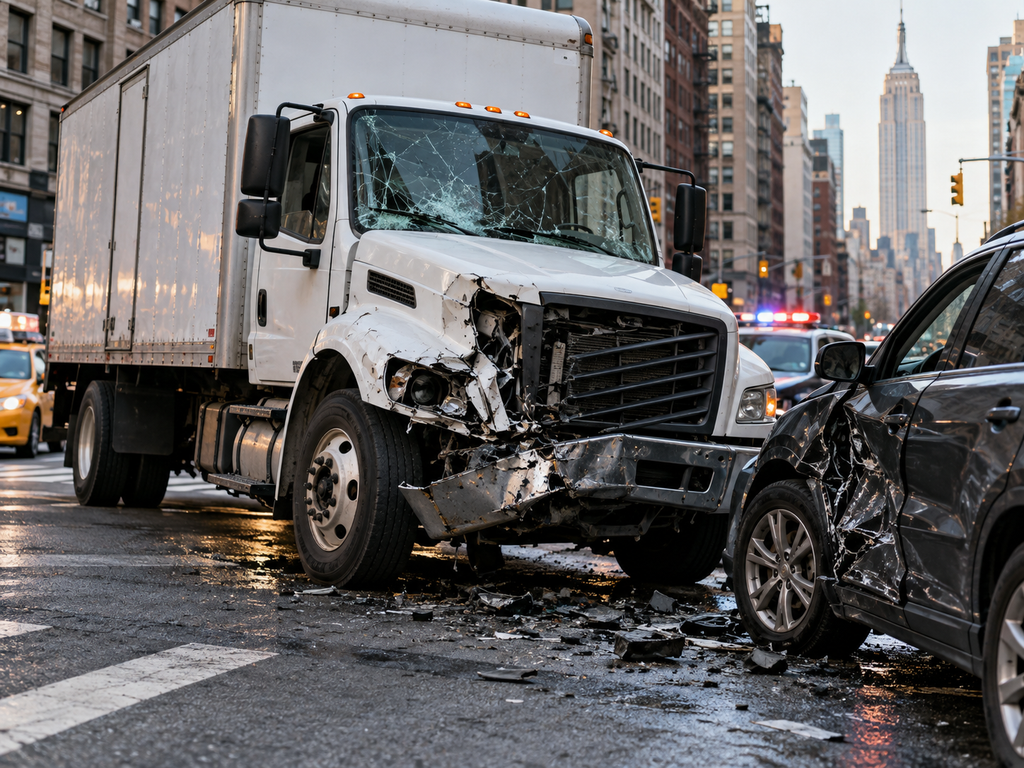
Injured in a crash involving an 18-wheeler, delivery truck, box truck, or other commercial vehicle? A truck accident can leave you facing serious injuries, medical bills, missed work, and an insurance company that has already begun investigating the scene. You deserve to understand who may be responsible, which evidence matters, and what your options are under New York law.
At Tokov Law, we help people understand claims arising from serious motor vehicle collisions throughout New York City and the surrounding region. A New York truck accident lawyer can evaluate the actions of the driver, the trucking company, and other businesses involved in putting the truck on the road. Commercial trucking cases often involve evidence that ordinary car accident claims do not, including electronic driving logs, dispatch records, maintenance files, onboard cameras, and cargo documentation.
The most important first step is often preserving that evidence. If you or someone you love was hurt by a commercial truck, contact Tokov Law to discuss the circumstances of the collision and the legal deadlines that may apply.
Why Truck Accident Claims Are Different From Car Accident Cases
A passenger car and a fully loaded tractor-trailer present very different risks. Large trucks have substantial blind spots, require more distance to stop, and may be affected by shifting cargo, worn components, or driver fatigue. The consequences can be devastating for occupants of smaller vehicles, motorcyclists, pedestrians, and cyclists.
The legal issues are also more complex. A truck crash may involve a commercial driver’s employer, a company operating under a federal motor carrier registration, an independent maintenance vendor, a shipping company, and multiple layers of insurance. Some evidence is held by the trucking business rather than the injured person. State driving laws may intersect with federal safety regulations, depending on the truck and operation involved.
An experienced truck accident attorney in New York focuses on identifying each potentially responsible party rather than assuming the driver is the only defendant. To learn how these cases relate to other injury claims, explore our [personal injury practice](/personal-injury/) and New York car accident pages.
Types of Commercial Truck Accidents We Evaluate
Not every truck accident involves an interstate 18-wheeler. New York’s streets and highways carry commercial vehicles of many sizes. The vehicle classification, ownership, trip purpose, and applicable regulations can change the investigation.
Semi-Truck and Tractor-Trailer Collisions
A semi truck accident lawyer in New York may investigate braking distance, trailer movement, improper turns, unsafe lane changes, and hours-of-service records. Tractor-trailers can cause underride, rollover, jackknife, and multi-vehicle collisions; a jackknife accident attorney may examine braking, traction, and trailer control. The trailer and tractor may even have different owners or insurance arrangements.
Box Truck and Moving Truck Accidents
A box truck accident lawyer may examine the driver’s licensing requirements, rental agreements, vehicle maintenance, cargo placement, and company operating policies. Moving trucks, furniture trucks, and commercial vans can cause serious injuries despite being smaller than tractor-trailers.
Delivery Truck and Amazon-Related Crashes
A delivery truck accident lawyer can investigate collisions involving parcel carriers, grocery delivery vehicles, and local distribution fleets. If you are searching for an Amazon delivery truck accident lawyer in NY, understand that the name displayed on a vehicle does not automatically establish who employed its driver or who legally controlled the work. Delivery service partners, fleet owners, and other entities may have different roles; liability requires a fact-specific review.

Who Can Be Liable for a Truck Accident in New York?
Truck accident liability is not necessarily limited to the person behind the wheel. A meaningful investigation follows the decisions that contributed to the crash and asks whether they breached a legal duty.
The truck driver. A driver may be responsible for speeding, distraction, intoxication, unsafe passing, following too closely, improper turns, or failing to account for blind spots. Witnesses, roadway evidence, video, and electronic records can help reconstruct the driver’s actions.
The motor carrier or trucking company. Depending on the relationship and facts, a company may face responsibility for its driver’s negligence or for its own conduct, including inadequate training, negligent hiring, unreasonable dispatch expectations, or disregard of known maintenance concerns. Corporate relationships and insurance contracts should be reviewed rather than presumed.
The freight broker or logistics intermediary. Some shipments involve brokers that arrange transportation without operating the truck. Whether a broker owed a relevant duty, and whether a claim survives applicable federal preemption defenses, depends on the circumstances and controlling law. A broker is not automatically liable simply because its name appears on a load confirmation.
The cargo loading or shipping company. Improperly distributed or unsecured freight may contribute to a rollover, shifting load, or debris on the roadway. Bills of lading, scale tickets, loading photographs, and contracts may identify the entity responsible for the cargo.
The maintenance contractor or equipment supplier. If defective brakes, tires, steering, lights, or other components contributed to the collision, repair records and equipment examinations may support a claim against a maintenance provider or, when supported, a manufacturer or seller.
Identifying all viable defendants is important because businesses may have separate insurance, legal defenses, and responsibilities for producing evidence.
Federal Trucking Regulations: What FMCSA Rules Mean for Your Claim
The Federal Motor Carrier Safety Administration (FMCSA) establishes safety rules for many commercial motor carriers and drivers. A lawyer familiar with FMCSA requirements can evaluate whether a relevant rule was violated and whether that violation contributed to the collision. Not every delivery van or local vehicle is subject to every federal rule; applicability must be confirmed.
The principal federal rules include 49 CFR Parts 390–396. They cover general motor carrier requirements, driver qualifications, driving rules, vehicle equipment, hours of service, and inspection or maintenance obligations.
Hours-of-service restrictions, Part 395. Fatigue can impair judgment and reaction time. Depending on the operation and available exceptions, investigators may examine duty status, driving time, required breaks, rest periods, and supporting documents. Dispatch instructions, delivery deadlines, and phone records may reveal information that an electronic log alone does not.
Driver qualifications, Part 391. A motor carrier may be required to keep records concerning a driver’s qualifications. Relevant questions can include licensing, medical certification, driving history, and whether the carrier completed required checks.
Inspection and maintenance, Part 396. Carriers have obligations concerning the inspection, repair, and maintenance of covered vehicles. Records may show unresolved brake issues, repeated tire defects, or a failure to address a reported mechanical problem.
Safe driving and equipment, Parts 392 and 393. These provisions address commercial vehicle operation and certain equipment requirements. A documented regulatory violation can become important evidence, but it does not automatically resolve negligence, causation, or damages.
New York traffic rules also matter. For example, Vehicle and Traffic Law § 1129 addresses following too closely, while other provisions govern turns, signals, speed, and safe roadway operation.
Preserving ELD Logs, Black Box Data, and Dashcam Footage
Digital evidence can disappear quickly after a commercial truck crash. Electronic logging devices (ELDs) generally track a driver’s duty status, while an event data recorder (EDR), when present, may store certain vehicle-performance or crash-related data. These are different systems. Not every truck has accessible EDR information, and the precise data varies by vehicle and equipment.
Other potential evidence includes engine control module information, GPS location history, dispatch messages, onboard camera footage, collision-avoidance alerts, maintenance records, inspection reports, driver qualification files, load paperwork, cell phone records, and post-crash photographs.
An FMCSA lawyer familiar with commercial safety records may send formal preservation or spoliation letters promptly to carriers, drivers, fleet owners, camera vendors, repair facilities, and other custodians. These notices identify categories of potentially relevant materials and request that ordinary deletion or overwriting stop. In appropriate cases, counsel may seek court intervention or expert inspection to protect evidence.
The urgency is real: FMCSA guidance states that carriers must generally retain required records of duty status and supporting documents for six months, while other evidence may be overwritten far sooner or retained under different rules. See the FMCSA’s ELD retention guidance.
A preservation letter does not guarantee that all evidence exists or will be produced. It can, however, create an important record of an early request and help prevent avoidable loss. Never attempt to download, alter, or access a commercial vehicle’s systems without authorization.
Serious Injuries Caused by Large Truck Collisions
Truck crashes can produce traumatic brain injuries, concussions, spinal cord injuries, herniated discs, broken bones, crush injuries, internal bleeding, burns, amputations, and permanent mobility limitations. Some people require surgery, rehabilitation, home modifications, or long-term assistance. Others experience pain, anxiety, or difficulty returning to work despite less visible injuries.
A claim should reflect the actual medical picture, not just the first emergency room diagnosis. Symptoms can develop or become clearer after the crash. Keep follow-up appointments, discuss worsening symptoms with medical professionals, and save records of prescriptions, rehabilitation, transportation expenses, and missed employment.
In the most tragic cases, surviving family members may need to explore a wrongful death claim. Those cases involve separate procedural, estate, and damages questions. A lawyer can explain who is authorized to act and what deadlines may apply.
What Compensation May Be Available?
Potential damages in a New York truck accident claim may include medical expenses not otherwise compensated, future medical care, lost wages, diminished earning capacity, and other provable financial losses. Depending on the claim and applicable rules, recovery may also include pain and suffering, loss of enjoyment of life, and the effects of lasting disability.
New York’s no-fault system can affect which medical and wage losses are paid first and when a lawsuit can recover non-economic damages. Whether the serious injury rules apply depends on the status of the parties and the relevant statutory definitions. These issues are not resolved merely because the negligent vehicle was a commercial truck.
No responsible NYC truck accident lawyer can promise a settlement amount without understanding the injuries, liability evidence, insurance, medical prognosis, and any applicable limitations. An early low offer may not account for ongoing treatment or future work restrictions. Conversely, the presence of a large commercial insurance policy does not guarantee recovery of its limits.
Insurance Company Defenses and Disputed Fault
Motor carriers and insurers may argue that the truck driver was not negligent, that another driver made an unexpected maneuver, or that an equipment problem could not have been anticipated. They may also dispute the extent of an injury or point to prior medical conditions. This is why contemporaneous video, independently recorded data, and medical documentation are especially valuable.
New York’s comparative-fault laws can affect a claimant’s recovery. The precise rule should be reviewed under the current text of CPLR § 1411, particularly when a claim is subject to Insurance Law Article 51. Do not assume an insurer’s percentage-of-fault assessment is correct or that a traffic citation alone determines civil liability.

What to Do After a Truck Accident in NYC or New York State
First, obtain emergency medical assistance when necessary and follow professional care instructions. If possible without putting yourself in danger, report the crash, photograph the roadway and vehicles, obtain witnesses’ contact information, and identify company names or USDOT numbers visible on the truck. Preserve damaged property and your own photos or dashcam video.
Next, keep a written timeline of what you remember, including changes in symptoms and communications with insurers. Avoid speculating about fault in recorded statements or signing a broad release without understanding its scope. Notice deadlines under no-fault policies may be short, and government-vehicle cases can involve additional requirements.
For most ordinary New York personal injury negligence actions, CPLR § 214 provides a three-year limitation period, but shorter deadlines or different rules may apply to particular defendants and claims. Waiting for that deadline can also mean losing video or business records needed to prove the case.
Frequently Asked Questions About New York Truck Accidents
How is a truck accident claim different from a regular car accident?
Truck cases may involve federal safety regulations, commercial insurance, electronic logs, maintenance documents, and several businesses. Many of these materials are under the defendants’ control, making early preservation especially important. An attorney also has to determine which federal rules actually apply to the truck involved.
Can I sue the trucking company as well as the driver?
Possibly. Depending on the employment relationship and evidence, a carrier may be responsible for a driver’s conduct or for its own negligent decisions about hiring, supervision, training, or maintenance. An independent contractor label does not, by itself, answer every liability question.
How soon should black box and ELD evidence be preserved?
As soon as practicable. Some electronic files and onboard camera footage can be overwritten during normal operations. FMCSA requires retention of certain driver duty-status records for six months, but that does not mean every useful piece of evidence will remain available for that long.
Are Amazon delivery truck accidents handled differently?
They can be. The delivery brand, registered vehicle owner, driver employer, and company controlling dispatch may be different entities. A crash investigation should establish those relationships rather than assuming the brand on the truck is automatically the legal employer.
What if I was partly responsible for the collision?
Do not assume you have no claim. Fault allocation depends on the evidence and applicable New York statutes, including rules that may differ for cases governed by the state’s no-fault law. A lawyer can evaluate how your conduct and the truck driver’s actions may affect recovery.
How long do I have to file a New York truck accident lawsuit?
A common negligence deadline is three years, but claims involving municipalities, public agencies, wrongful death, or other circumstances can have different rules. Insurance notice requirements can arrive much sooner. Have the dates reviewed promptly.
Speak With a New York Truck Accident Lawyer
If you were injured in a commercial truck crash in Manhattan, Brooklyn, Queens, the Bronx, Staten Island, Long Island, or elsewhere in New York, you may have more than one potential claim—and less time than you think to preserve the evidence. Tokov Law to discuss the accident, your injuries, and the next appropriate steps.
This page provides general legal information, not legal advice. An attorney-client relationship is not created by reading this page or submitting a form. Results depend on individual facts and applicable law.