
Brooklyn Construction Accident Lawyer
A Brooklyn construction accident may occur on a high-rise project, inside a brownstone renovation, at a warehouse conversion, or on a roof above an occupied storefront. Those settings create different evidence questions. Before anyone can responsibly assess a claim, the work, the accident mechanism, and the roles of the people involved must be understood.
Someone searching for a Brooklyn construction accident lawyer often needs two things at once: help understanding benefits while unable to work, and an assessment of whether another party may be legally responsible. This guide explains the information that supports those conversations. It covers site preservation, Labor Law issues, medical and wage documentation, and practical decisions that arise before a claim is ready for settlement.

A documented Brooklyn construction safety figure
Brooklyn had 77 construction-related injuries in the NYC Department of Buildings’ 2025 safety report. The report covers building work, not road or transit projects. It does not establish individual liability.
That number should not be converted into a claim that a named neighborhood or contractor is especially dangerous. Different projects involve different exposure, tasks, and reporting circumstances. The value of the data is that it documents an actual local safety issue while leaving the cause of any particular injury to investigation.
For a worker, an exact description of the accident is more useful than a broad comparison between boroughs. Was the worker installing something overhead, walking through a demolition area, unloading a truck, or moving between floors? The answer shapes the evidence request and the legal analysis.
Brooklyn project types require different questions
Downtown Brooklyn and high-rise work
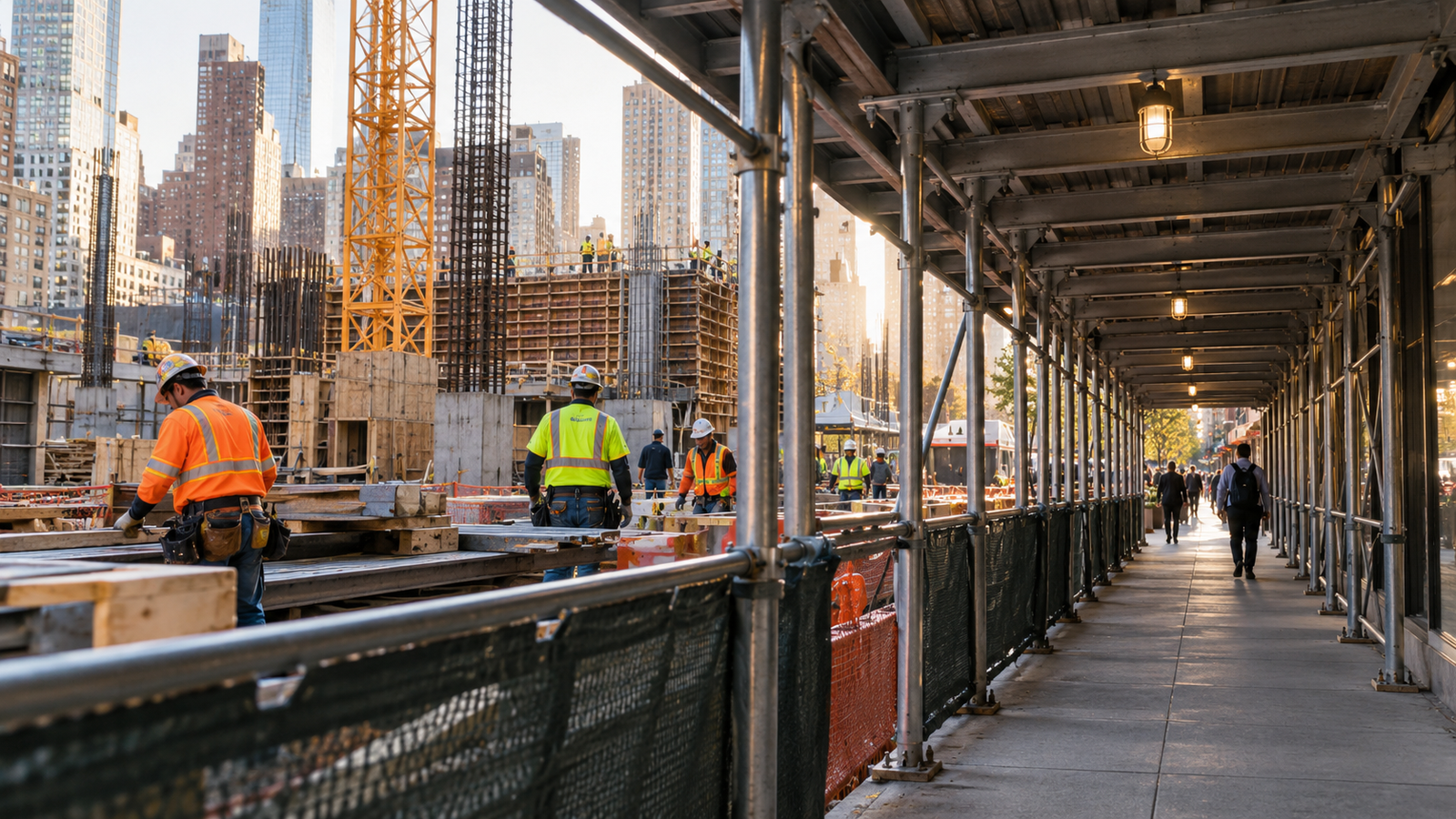
Around Flatbush Avenue, Jay Street, and the approaches to the Brooklyn and Manhattan bridges, project access can involve loading bays, temporary walkways, and several vertical transportation systems. Identify the building, floor, work area, and route used to reach it. A street address may encompass multiple phases or towers.
For an injury while moving material, trace the sequence. Who unloaded it? Where was it stored? Who moved it to the floor? Who directed the final lift? The point is to identify responsibility through evidence, not to assume that the largest contractor controlled every movement.
If several trades were working overhead and below, preserve what you know about the schedule and their locations. Your own work assignment can help establish why you were in the area. A coworker may remember an earlier delivery or warning even without witnessing the actual impact.
Brownstones and attached-house renovations
In Bedford-Stuyvesant, Park Slope, Carroll Gardens, and similar neighborhoods, renovation work may pass through narrow stairways, rear yards, and cellar entrances. Record the route used to carry tools and debris. An injury at the back of a property may be difficult to understand from a front-street photograph alone.
Building type and ownership should be documented accurately. Do not describe a house as commercial simply because a contractor worked there, or assume an owner was uninvolved because they were absent on the accident date. Contracts, messages, instructions, and the work history may clarify the owner’s actual role.
Waterfront and industrial conversions
Red Hook, Sunset Park, and the Gowanus area include sites where older industrial spaces are altered for new uses. Floor openings, temporary access, material handling, and changing work zones can require close factual review. An old condition may coexist with a new construction hazard.
If an opening was covered before the accident, identify the covering and what you understood it to be. If an object fell from stored material, describe its previous position and the task underway. Do not make unsupported assumptions about structural failure, engineering requirements, or the cause of a collapse.
Roof and exterior work across southern Brooklyn
In Bay Ridge, Bensonhurst, Gravesend, and Sheepshead Bay, roofing and façade jobs may involve small crews and short project schedules. A crew can leave quickly after the work ends, making early preservation important. Keep estimates, assignment messages, and supplier information alongside more formal paperwork.
Record the access point, roof level, and task without returning to a dangerous position. For an exterior scaffold, note what you can reliably recall about the platform, supports, and equipment. A formal inspection may be necessary; an injured worker should not attempt to perform one personally.
Immediate reporting and treatment
Address medical needs first. Explain the event to your provider using ordinary language and identify all affected areas. If an injury initially seemed minor but worsened, describe that progression honestly. Do not change the chronology to make it appear that every symptom was obvious immediately.
Under Workers’ Compensation Board guidance, employer notice is due within 30 days, with a claim generally due within two years. Prompt advice helps address exceptions or disputes.
Keep the notice and any response. If a supervisor prepared an incident report, request a copy and check whether it matches what you said. A report should not substitute someone else’s conclusion for your observations. If you do not understand a document, seek an explanation before signing it.
Preserve contact details for witnesses and coworkers who know the setup. Ask them to retain their own photographs or messages rather than sending edited versions. Do not pressure anyone to agree with your recollection. Independent accounts may differ in minor details while still providing useful evidence.
Separating benefits from a third-party claim
A construction worker’s employer, building owner, general contractor, and equipment supplier may be different legal entities. Knowing those relationships helps distinguish a workers’ compensation matter from a possible lawsuit. Neither route should be dismissed merely because the other has begun.
Workers’ Compensation Law §29 addresses claims against third parties and recovery coordination. Liens and settlement approvals can affect the result, requiring review before agreement.
An injury investigation should therefore begin with a party map: who paid you, who supervised the task, who owned the property, and who supplied the relevant equipment. Mark uncertain identities as uncertain. A trade name on a truck may differ from the legal name on a contract or insurance policy.
Ask whether the same lawyer will handle both proceedings. If separate counsel are involved, understand how they will exchange relevant information and avoid inconsistent submissions. A medical restriction, wage calculation, or settlement proposal may matter in more than one process.
Labor Law and the physical cause of the accident
Labor Law §240 addresses protective devices for covered elevation-related work. Coverage and exceptions require analysis; neither a ladder nor a fall guarantees a successful claim.
The physical sequence matters. Did a ladder shift while you were reaching for an assigned installation? Did material descend while being lifted? Was a platform needed to reach the work? Record the task and available equipment before debating labels such as “scaffold law case.”
Labor Law §241 concerns safety during construction, excavation, and demolition. Counsel considers which specific requirements apply to the work and condition.
For a debris-related injury, the route and type of material may matter. Was it a work passage, an active demolition area, or storage space? Who used the route and when? A wide-angle photograph or plan may explain the condition better than a close-up showing a single loose object.
Labor Law §200 sets a general workplace safety duty. The condition, work methods, and parties’ responsibilities need factual evaluation.
The strongest initial account does not try to decide every legal issue. It supplies the details a lawyer needs to distinguish a property condition from the way work was performed. If both may have contributed, describe both without forcing the event into one category.
Preserving evidence during a changing renovation
Renovations can alter the scene daily. Walls disappear, temporary stairs move, and debris is removed. A photograph taken a week later may show a different workspace. Preserve the dates of all images and explain whether they show the original condition or a later stage of work.
Save work orders, text conversations, delivery receipts, and any safety meeting information you possess. If you were told to use a particular route or device, identify who gave the instruction and when. If the instruction was verbal, write down your recollection without inventing exact wording you cannot remember.
For tool or equipment injuries, identify the manufacturer, model, owner, and rental company if known. Do not test a damaged tool to see whether it still works. Altering equipment can create safety risks and complicate later analysis. Tell counsel where the item is and whether it may be repaired, returned, or discarded.
Potential video sources include building entrances, loading areas, adjoining shops, and project cameras. Footage may establish timing or movements even when the accident itself is outside the frame. Prompt preservation requests may be important because routine deletion can occur before a claim is fully investigated.
A useful record of injury and lost earnings
Construction work is physically specific. A wrist limitation can affect a tile installer differently from a machine operator, and a knee injury may prevent ladder use even when walking improves. Explain the tasks your trade actually requires, including weights, frequency, posture, and work at height.
Keep medical instructions and restrictions together. When a proposed return-to-work position differs from your regular duties, ask for a written task description and discuss it with the treating professional. “Light duty” can mean different things to different people; the physical requirements are what need evaluation.
For earnings, preserve records across enough time to show the pattern. Overtime, multiple employers, gaps between projects, and union benefits may require more than the last paycheck. Distinguish confirmed lost work from uncertain future opportunities. An honest estimate should be labeled as an estimate until supporting records are available.
Record household assistance and expenses as they occur. If relatives help with stairs, meals, transportation, or childcare, note what changed and for how long. Avoid a diary written only in absolute terms. Recovery often varies, and accurate notes should reflect both limitations and progress.
Filing deadlines and the need for early review
Ordinary personal-injury actions generally carry a three-year limit under CPLR §214. Special claims and parties may require earlier steps.
Work at a public school, housing development, bridge approach, or government facility deserves immediate procedural review. A public location does not identify the proper defendant by itself. Counsel should determine which entity owned or controlled the relevant area and what notice rules apply.
Do not assume a project investigation, compensation payment, or informal settlement conversation extends a deadline. Ask for the important dates in writing. If the lawyer cannot yet identify every party, ask what is being done to resolve that uncertainty while preserving possible claims.
When neighboring property becomes part of the evidence
An attached-building renovation can affect a work area through a rear yard, shared wall, or adjoining roof. If the accident involved access from another property, identify that route precisely. Do not assume the owner of the building where you landed is the same person who arranged the work or controlled the starting point.
For example, a hypothetical worker carrying supplies through a neighboring courtyard may encounter a temporary walkway installed for the renovation. Useful records could include access arrangements, photographs of the route, and instructions about where workers were permitted to walk. Those facts may explain why the worker was there and which organizations knew about the passage.
Preserve any communications you lawfully possess about access or restrictions. If a neighbor photographed the area, obtain contact information and let counsel consider an appropriate request. Do not enter the neighboring property to retrieve evidence without permission. The need for documentation does not authorize trespass or unsafe inspection.
This issue is distinct from proving the injury itself. Medical records may establish harm while leaving the route and control questions unanswered. A complete investigation addresses both. In a Brooklyn renovation with several adjoining parcels, an accurate site sketch marked with entrances and directions can help a lawyer ask the right questions without confusing one property’s role with another’s.

Making a consultation useful
Prepare a short account with the address, project type, task, equipment, accident sequence, first report, and treatment. Attach the records you have rather than waiting for a perfect file. A list of missing documents can itself help focus the investigation.
Ask a prospective Brooklyn construction injury attorney what evidence is needed to test the claim. Questions about ownership, supervision, equipment, and preservation are more informative than a generic prediction about settlement value. The lawyer should explain uncertainties as well as possible strengths.
Discuss the written fee agreement, litigation expenses, communication arrangements, and coordination with workers’ compensation counsel. Clarify how you will receive updates when no hearing or court date is imminent. A serious injury can involve a long recovery, so practical communication matters throughout the process.
Related reading includes the New York construction accident guide, construction accident FAQs, and Brooklyn personal injury page. These resources provide background for an individual legal consultation.
Brooklyn construction injury FAQs
Can an injury during demolition involve more than one claim?
Potentially, but the task, employment relationship, responsible parties, and cause must be assessed. Describe whether you were removing material, carrying debris, operating equipment, or passing through the area. The word “demolition” alone does not establish which legal provisions apply.
What if the owner says the contractor was responsible for everything?
Preserve the statement and provide the underlying facts to counsel. Contracts and statutory duties may require separate analysis. A party’s description of its own responsibility is not the final legal answer, just as a worker’s assumption does not establish liability.
Are photographs of the building exterior enough?
They can identify the site, but they may not explain an interior accident. Floor, room, access route, equipment, and timing may be more important. Do not risk injury to obtain more photographs; identify gaps so lawful inspection or record requests can be considered.
What if I had a previous injury to the same body part?
Tell your treating provider and lawyer. Prior records can help distinguish earlier symptoms from changes after the accident. Hiding a relevant history can make evaluation harder. Describe your actual abilities before the event rather than claiming an unrealistic history of perfect health.
How long will a construction accident case take?
The answer depends on disputed facts, medical development, available records, the parties, and court scheduling. Ask what can be done now and what must wait. A timeline should be explained as an estimate, not a promise.
Where can I ask about an error on this page?
Use the website contact page for content questions. For your own injury, consult an independent licensed attorney promptly and provide the specific facts and dates needed for a legal assessment.