
Brooklyn Car Accident Lawyer
Clear next steps after a Brooklyn collision
A Brooklyn car accident lawyer evaluates fault, insurance coverage, injury documentation, and filing deadlines after a collision. That work can include preserving camera footage, identifying a commercial vehicle's owner, documenting lost income, and assessing whether an injury claim can proceed beyond no-fault benefits.
A collision near Atlantic Terminal can raise different evidence questions from a crash on the Belt Parkway or a turning accident in Sunset Park. The starting point is a clear account of what happened: the precise block, direction of travel, vehicles involved, and symptoms that followed. Neighborhood knowledge helps organize those facts; it does not replace proof.
This guide explains Brooklyn-specific investigation issues and practical questions to bring to a licensed New York attorney. Seek appropriate medical care, preserve original records, and address insurance notices promptly. Do not wait until every medical bill arrives before checking the deadlines that affect your options.
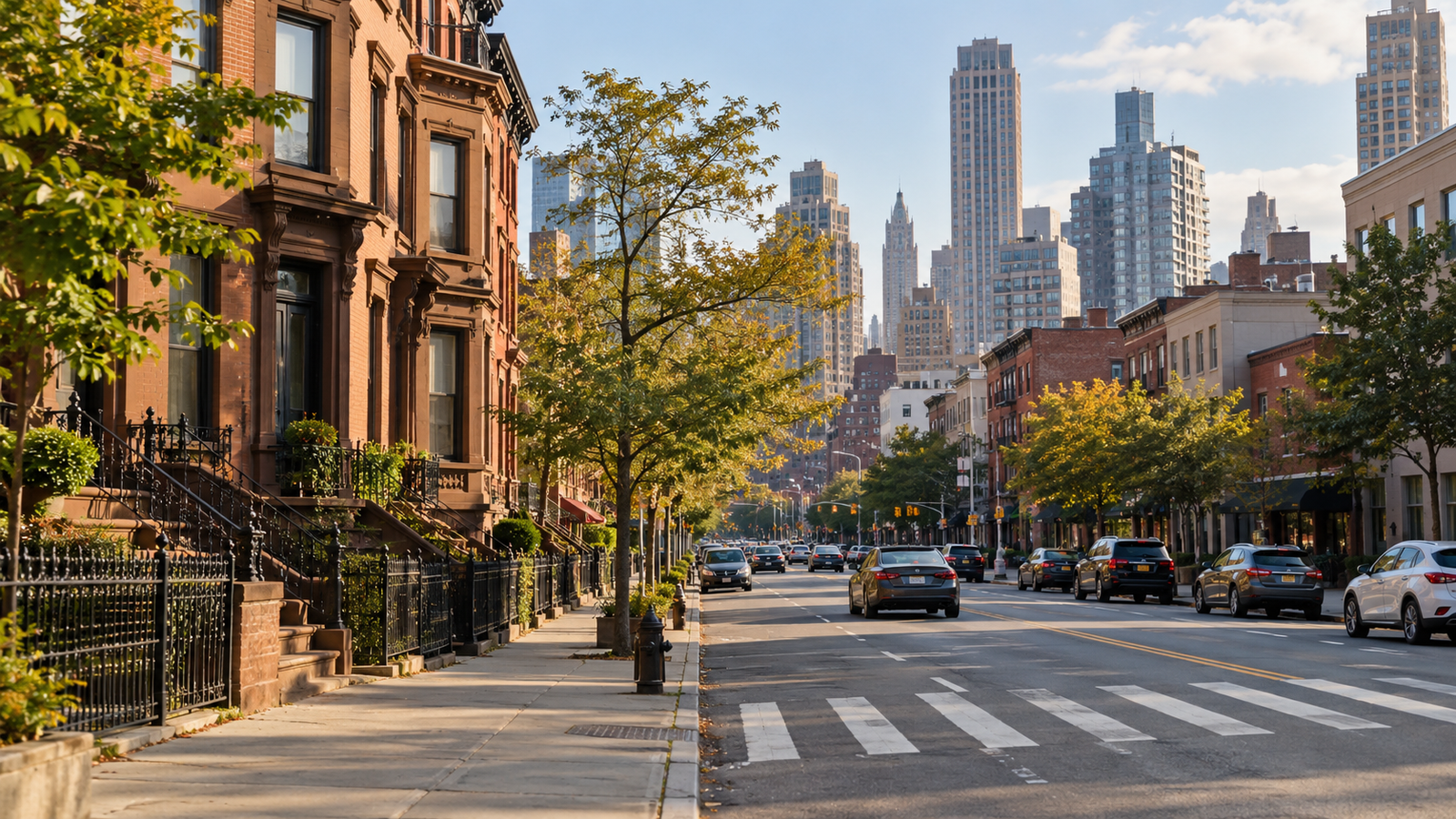
AI-generated Brooklyn-inspired illustration; not a photograph of a particular collision.
Brooklyn roads, intersections, and local safety context
Atlantic Avenue: Court Street, Columbia Street, and the waterfront
NYC DOT's July 2024 Atlantic Avenue safety announcement identified projects including revised lane markings at Court Street, pedestrian islands at Columbia Street, and additional crossings between Court, Clinton, and Henry streets. These documented safety interventions are useful context, not a finding that every collision there has the same cause.
After a crash along western Atlantic Avenue, record whether a vehicle was turning, approaching a crossing, or entering a loading area. Photograph the signals and markings that existed on the collision date. Distinguish the street from nearby Brooklyn-Queens Expressway ramps; describing the scene simply as “near Brooklyn Bridge Park” can leave the actual roadway uncertain.
Central Brooklyn: Atlantic Avenue and Bedford Avenue
The City's 2025 Atlantic Avenue planning announcement included a major capital commitment to redesign the corridor and near-term measures such as visibility improvements and curb extensions. A planned improvement is not evidence that construction was completed before your crash.
For collisions near Bedford Avenue, Nostrand Avenue, or Franklin Avenue, note temporary barriers, parked delivery vehicles, and sight lines. In Crown Heights and Bedford-Stuyvesant, a storefront camera may capture an approach from an angle that a traffic signal camera does not. Identify potential footage early without assuming anyone recorded the incident or must release it immediately.
Flatbush Avenue, Downtown Brooklyn, and the Barclays Center area
Around Flatbush Avenue and Atlantic Avenue, document the particular crossing, lane, and turn involved. Nearby destinations such as Barclays Center and Atlantic Terminal can help you remember the location, but a claim needs more precise information than the name of an attraction.
If a taxi or rideshare was collecting passengers, preserve the trip receipt and pickup pin. If a bus affected visibility, record its direction and position rather than assuming its operator caused the crash. These are investigative considerations, not claims that an event venue or transit facility is responsible for every nearby accident.
Belt Parkway, BQE, and neighborhood connections
For a highway collision, note the roadway, travel direction, nearest exit, and whether the first impact happened on the main road or a ramp. A chain-reaction crash may involve several impacts separated by seconds. Your account should distinguish the first impact you felt from later vehicle movements.
On local streets in Bay Ridge, Bensonhurst, Williamsburg, Bushwick, Canarsie, or East New York, record both street names and the side of the intersection. The same street name can cover a long distance. Do not assign a “most dangerous” label to an intersection without a defined dataset and time period.
What to do at the scene and during the first days
Safety and medical needs come first. Request emergency assistance when necessary, follow responders' directions, and avoid stepping into moving traffic to obtain photographs. An unsafe vehicle should not be driven merely to save towing costs.
When it is safe, exchange identifying and insurance information and obtain witness contact details. Photograph a wide view of the location as well as individual damage. A close-up of a dent may show impact damage but omit a signal, lane marking, obstruction, or vehicle position needed to explain how it occurred.
New York's MV-104 instructions require reporting qualifying crashes within 10 days when there is death, injury, or damage exceeding $1,000 to any one person's property. Reporting to an insurer does not necessarily complete the motorist's reporting obligation.
At home, create a folder for claim correspondence, medical paperwork, photographs, towing documents, and repair estimates. Record who called, which insurer they represent, and what they requested. Accurate notes make it easier to distinguish an urgent coverage request from an optional conversation with another party's adjuster.
Building evidence before it disappears
A Brooklyn auto accident attorney may look beyond the police report to reconstruct the crash. Useful evidence can include dashcam files, nearby business footage, witness accounts, vehicle damage, and contemporaneous photographs. Each source has limits: a camera may face the wrong direction, while a witness may have seen only what happened after impact.
Preserve original files with their timestamps. Do not crop away context, overwrite a memory card, or annotate the only copy. If you share a screenshot for convenience, retain the underlying video or photograph separately. Record the approximate time accurately enough to help a business locate the right recording.
For a delivery vehicle, note the company name displayed, license plate, and any fleet identifier. Branding alone may not establish who employed the driver. For a rideshare, retain the app's record of the driver and trip. Your lawyer can evaluate appropriate preservation requests and any lawful process needed to obtain evidence.
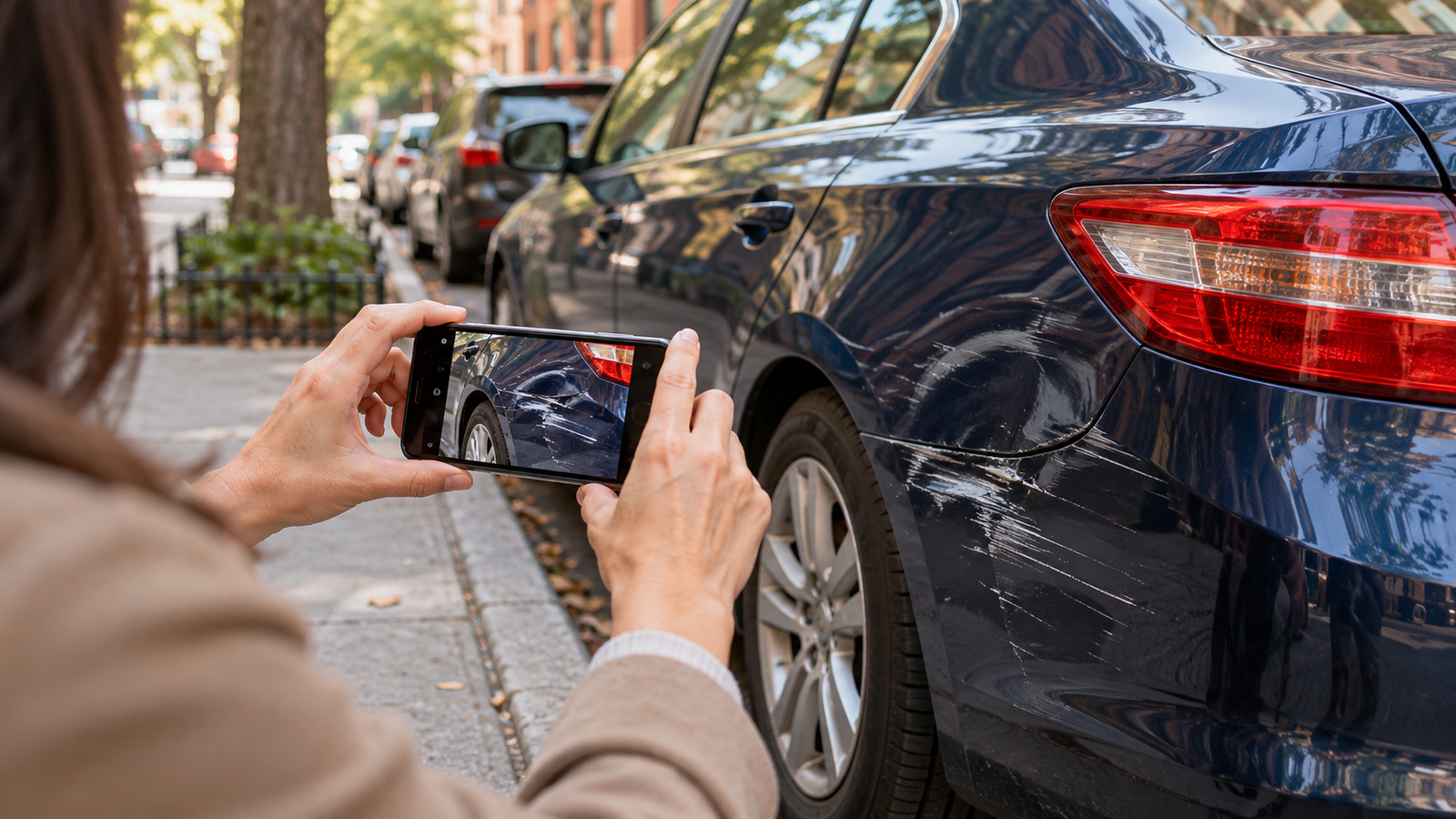
AI-generated illustration of documenting damage; not actual case evidence.
No-fault coverage and the separate injury claim
New York no-fault insurance generally provides up to $50,000 in basic benefits for eligible economic losses, subject to coverage rules. It is separate from vehicle repairs and pain-and-suffering damages. The DFS auto insurance guide explains the coverage categories.
Written no-fault notice generally is due within 30 days, subject to a limited justified-delay exception. See the DFS no-fault FAQs. Identify the appropriate insurer promptly and keep submission records.
A practical claim file should show which expenses were submitted, whether payment was made, and whether additional information was requested. If a letter is confusing, do not discard it or assume a medical provider has handled every issue. A request for records and a formal denial may require different responses.
Separately, a liability claim asks whether another party's conduct caused compensable harm. The fact that no-fault benefits paid a bill does not settle fault. Conversely, an insurer's agreement that its driver caused a collision does not automatically resolve medical causation, the legal injury threshold, or the value of a claim.
Injuries, treatment records, and the serious-injury requirement
Insurance Law § 5104 generally requires a qualifying serious injury for covered motor vehicle claims seeking non-economic damages. The categories appear in § 5102; counsel should review the applicable version and evidence.
The practical task is to document what changed after the collision. Medical records may explain symptoms, examination findings, imaging, treatment recommendations, and functional restrictions. A person whose work requires lifting may face different limitations from someone whose main difficulty is sitting through a commute.
Tell treating professionals about prior symptoms or injuries. A preexisting condition should be evaluated honestly, including whether the crash aggravated it. Do not assume that a scan alone proves when an abnormality began or that normal initial imaging rules out every injury.
Keep follow-up appointments where possible. If insurance, transportation, work schedules, or another obstacle interrupts treatment, record what happened and discuss it with the appropriate provider or adviser. The record should reflect actual care and actual limitations, not treatment undertaken merely to increase a claim's apparent value.
Who may be responsible for a Brooklyn crash?
The investigation can begin with a driver's speed, attention, turning movement, following distance, or compliance with signals. It may then examine ownership, employment, maintenance, or another party's conduct. The goal is to identify a supported legal basis for responsibility, not to name every business visible in a photograph.
Commercial vehicle cases can involve records held by an employer or fleet operator. Read the site's truck accident guide for related evidence issues. For app-based rides, the Uber and Lyft accident page provides additional context.
Fault attributed to an injured person can reduce recovery. The current CPLR § 1411 also contains an Article 51 personal injury recovery bar when claimant fault exceeds the combined fault of the defendant or defendants. Applicability depends on the claim and governing law.
What can affect compensation?
An assessment may consider unreimbursed medical costs, lost earnings, future financial effects, property damage, and legally available non-economic damages. There is no dependable Brooklyn car accident settlement average that can substitute for the facts of your case.
Documentation matters as much as the category of loss. Wage records can show earnings before the accident and time missed afterward. A self-employed person may need contracts, invoices, and records distinguishing gross revenue from actual lost income. Keep receipts for relevant expenses and note whether another source reimbursed them.
Before signing a settlement release, understand which claims it resolves and whether outstanding bills, reimbursement interests, legal fees, and expenses affect the net amount. A fast payment is not necessarily a complete recovery plan. Equally, a large insurance policy does not guarantee a large settlement.

AI-generated illustration of organized records; no real client documents are shown.
Deadlines and preparing for a consultation
CPLR § 214 generally allows three years for ordinary negligence injury actions. Where applicable, General Municipal Law § 50-e generally requires a notice of claim within 90 days. Exceptions and other deadlines require individual review.
Bring the accident date, exact location, report number, insurance correspondence, and available treatment information to a consultation. Ask which deadlines are running, what information is missing, and what evidence should be preserved immediately. You need not wait until the file is complete to ask those questions.
Ask who will handle communications and how fees and case expenses work under a written agreement. Verify the lawyer's identity and credentials. The site's Brooklyn personal injury information and car accident FAQs cover related topics, but an actual claim needs individualized legal advice.
Brooklyn car accident questions
What if I was hurt as a passenger?
Preserve details for the vehicle you occupied and the other involved vehicles. A passenger's account may help establish the sequence of impacts, but passenger status does not automatically identify the responsible insurer or resolve every coverage question. Save any taxi or rideshare receipt.
Can I bring a claim if the crash happened near my home?
The distance from home does not determine fault or injury severity. A collision during a short school run or neighborhood errand can still require a careful investigation. Describe the actual roadway and vehicle movements rather than assuming everyone knows the intersection.
Should I post photographs of the accident online?
Preserve evidence privately and be accurate in any communications. Public posts can omit context and create unnecessary disputes. Do not delete existing material to conceal it; ask counsel how to preserve relevant accounts and records if a claim is being considered.
What if I cannot find the other driver's insurer?
Keep the plate information, report number, and any exchange documents. A lawyer can review appropriate ways to identify available coverage. In a hit-and-run, prompt reporting and preservation are especially important; the absence of a named driver does not answer every coverage question.
Does a traffic ticket settle my case?
No single document necessarily answers all civil issues. A citation, crash report, video, medical record, and witness statement may address different questions. Fault, causation, damages, and coverage each need attention, even when one part of the record initially seems straightforward.
Organize your next step
From a BQE collision to a turning accident on Atlantic Avenue, a useful starting point is a precise timeline and a preserved set of records. Review health needs and deadlines first, then obtain advice about the evidence and insurance relevant to your circumstances. For website questions, use the Tokov Law contact page.