
Manhattan Construction Accident Lawyer
A construction injury in Manhattan can interrupt much more than a workday. A carpenter may lose the ability to climb, an electrician may need months of hand therapy, or a laborer may face medical appointments while the next project begins without them. Understanding what happened, who controlled the work, and which benefits or legal claims may apply is the starting point for an informed discussion with a Manhattan construction accident lawyer.
This guide explains how to organize a Manhattan construction injury claim involving scaffolds, ladders, falling materials, renovation work, or unsafe access routes. It addresses the practical differences between workers’ compensation and a possible third-party lawsuit, and the evidence that matters on a crowded urban site. Every claim depends on its facts; an injury does not by itself establish that a particular owner or contractor is liable.

Manhattan construction safety in actual numbers
NYC’s 2025 Construction Safety Report records 147 Manhattan construction-related injuries. The building-work dataset excludes road and transit projects. These figures describe reported events, not findings of negligence.
That distinction matters when comparing a tower project with subway work or a street excavation. Different reporting systems cover different activities. A small recorded category does not prove that a particular job was safe, and a large borough total does not prove that a contractor caused an accident. A useful investigation works from the actual task, equipment, and site conditions rather than a headline statistic.
For the injured worker, the immediate questions are concrete: Which floor? Which entrance? Which trade was operating nearby? Was the work an interior fit-out, exterior restoration, structural alteration, or routine service? Those details can direct a lawyer toward the right documents and away from unrelated records for the same building.
Where Manhattan jobsite details become important
Midtown towers and interior alterations
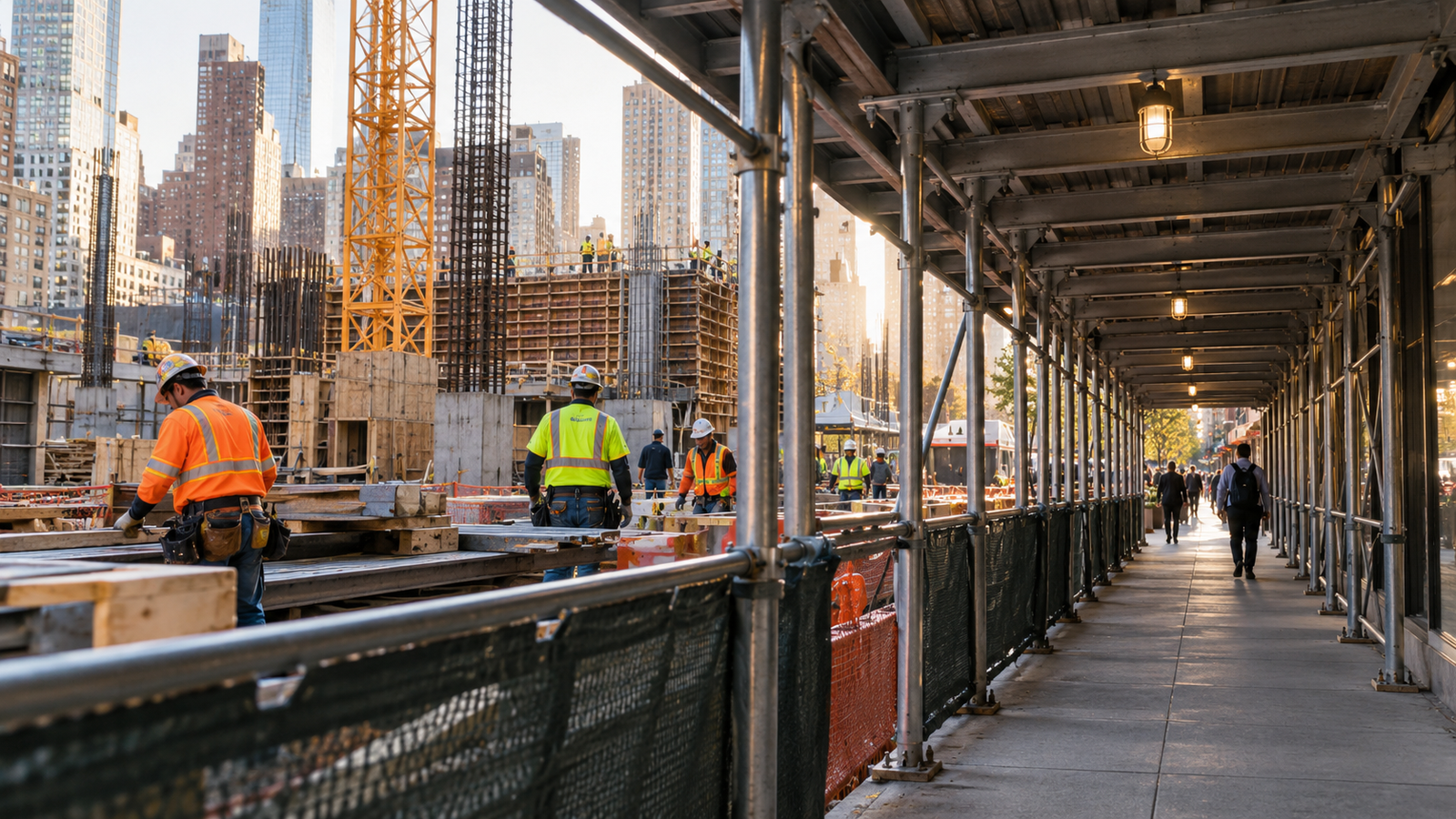
Around Sixth Avenue, Park Avenue, and the East 40s and 50s, a worker may enter through a loading dock while tenants use a separate lobby. Record the service entrance, freight-elevator bank, floor, suite, and contractor sign-in point. The public address alone may not identify where the incident occurred.
For a ceiling installation, describe the working height and why that position was necessary. If a mobile scaffold moved, note its configuration, the floor surface, and who last positioned it. If materials were being hoisted through an opening, distinguish the material’s starting point from the place where it struck the worker. These are factual questions, not an invitation to reconstruct the scene after equipment has been changed.
West Side development and material deliveries
Hudson Yards, Chelsea, and the West 30s combine large buildings with sidewalks, loading areas, and vehicle access. A delivery-related injury may involve a truck, a subcontractor, and site personnel performing different functions. Preserve delivery tickets and dispatch messages alongside the construction incident report.
A worker struck while guiding a load should identify who gave the signal, where the operator could see, and whether other people were directing movements. A pedestrian outside the site may have a different legal relationship to the project. The distinction between a worker performing assigned construction duties and a passerby affects how the incident should be evaluated.
Upper Manhattan renovations and occupied buildings
In Harlem, Washington Heights, and Inwood, a project may proceed while residents still occupy neighboring apartments. Stairways, roofs, courtyards, and basement passages can become shared routes. For an accident on a stair landing, describe what was being carried, whether another route was available, and which contractor used the landing for storage.
An existing defect and a temporary construction condition are not necessarily the same problem. A broken permanent stair tread may require building-maintenance records; loose demolition debris may point toward work sequencing and cleanup. Recording both possibilities allows later investigation without prematurely choosing a theory.
The first actions after a serious construction injury
Get emergency assistance when necessary and follow medical advice. Give the treating professional a clear description of the work activity and all affected body areas. If symptoms develop later, report them accurately rather than trying to make every medical entry sound identical. Consistency means being truthful about the sequence, including uncertainty.
Notify the employer and keep a copy. New York’s Workers’ Compensation Board filing guidance calls for employer notice within 30 days and a claim generally within two years. Obtain individualized advice about exceptions and disputed dates.
If it is safe and permitted, preserve photographs already available to you. Do not enter an unsafe floor, move a load, or climb back onto equipment to document the accident. A coworker’s original photograph may be more useful than a later recreation. Keep the full file, not only a cropped screenshot sent through a messaging app.
Write a short chronology while events are fresh. Include the scheduled task, the instruction received, the equipment used, the incident, the first report, and medical treatment. Identify what you personally observed separately from what someone told you afterward. A precise account can be brief; it does not need legal terminology.
Workers’ compensation and a separate construction lawsuit
The compensation process and a civil claim answer different questions. A benefits claim concerns the work-related injury and eligibility for benefits. A potential third-party claim examines whether someone outside the employment relationship bears legal responsibility. Neither should be assumed to replace the other.
New York’s Workers’ Compensation Law §29 addresses third-party claims and compensation liens. A settlement should be reviewed for benefit consequences and required approvals before acceptance.
For example, the company named on a pay stub may differ from the general contractor listed on the site sign. An equipment supplier may be a separate business again. An investigation needs the correct legal identities and each participant’s role, rather than a list of every company whose logo appeared at the project.
Ask prospective counsel who will handle the compensation proceeding and who will evaluate the civil case. If different lawyers are involved, they should be able to coordinate medical records, statements, litigation dates, and potential settlement effects. Repeating the same history to several people is difficult after an injury, so maintaining one accurate chronology helps.
New York Labor Law issues a lawyer may evaluate
Labor Law §240 addresses protective devices for covered elevated work. Coverage, causation, and statutory exceptions require individual analysis; a fall alone does not establish liability.
The useful factual question is not simply whether someone fell. What task was underway? What was the elevation difference? What device was supplied? Was the worker expected to reach, lift, lower, or secure something? A ladder accident lawyer may need photographs of both the ladder and the surrounding workspace to understand why the device was positioned that way.
Labor Law §241 concerns construction, excavation, and demolition safety. Counsel examines the applicable safety provisions and their relationship to the injury.
That analysis should identify an actual condition. “The site was unsafe” is less informative than “a temporary passage was blocked by bundled pipe while workers carried material through the only open doorway.” A photograph showing the overall layout can provide context that a close-up of the injury cannot.
Labor Law §200 states a general workplace safety duty. Responsibility depends on the relevant condition, work arrangements, and facts.
These legal routes can overlap, but they are not interchangeable. A well-prepared review explains which theory fits the evidence and which remains uncertain. It should not promise a result merely because the accident involved a scaffold or because a building owner carried insurance.
Evidence specific to a Manhattan construction site
Start with records that identify the project: the address, permit number if known, site signage, employer name, and any subcontractor information. Add your work assignment and the supervisor who gave it. Access-card logs, delivery records, and daily sign-in sheets may help place people and equipment at a particular location and time.
For a scaffold injury, useful details may include the platform type, wheels or supports, guardrails, access method, and where materials were stored. For a falling-object injury, preserve the object’s identity, approximate original position, and any lifting or securing operation. For an electrical event, do not touch or test the equipment; record who was working on the system and whether a shutdown had been discussed.
Digital evidence can disappear even when a project continues. Ask counsel promptly about preserving security video, construction-management messages, inspection photographs, and incident communications. A camera in a neighboring lobby may show a delivery or departure without showing the accident itself. That limited evidence can still help establish timing.
Keep originals and avoid editing files to add blame labels. A neutral filename such as “east service entrance, morning” is more useful than a conclusion about a defendant. Do not delete an earlier message because it contains an estimate that later proved wrong. Explain the correction and retain the history.
Describing injury, work capacity, and financial loss
A diagnosis explains part of the harm, but construction work demands specific physical abilities. Tell your clinician whether your trade requires overhead reaching, carrying materials, kneeling, climbing, precision grip, or prolonged standing. A restriction that sounds modest in an office setting may have a very different effect on an ironworker or drywall installer.
Preserve pay records, overtime history, union information if relevant, and documentation of other jobs. Distinguish wages you actually lost from assignments you hoped to obtain. If work is seasonal or project-based, several months of records may explain earnings more accurately than a single paycheck.
Document practical changes at home without exaggeration. A shoulder injury may interfere with dressing, cooking, or carrying a child; a leg injury may complicate stairs in a walk-up apartment. Brief dated notes can help you remember the pattern. They should describe actual limitations and improvement, including days when you could do more.
Future losses require support rather than a calculator on a marketing page. Medical prognosis, vocational demands, available accommodations, and the progression of recovery all matter. Settlement value also depends on responsibility, evidence, insurance, and other case-specific issues. No borough-wide average can determine what a particular claim is worth.
Deadlines and public projects
Many ordinary personal-injury lawsuits have a three-year limit under CPLR §214. Different claims and defendants can require earlier action.
A project near a school, public housing development, subway facility, or municipal building should prompt careful identification of the involved entities. Location does not automatically make the City the responsible defendant. A public authority, private contractor, property owner, or other organization may have a distinct role and distinct procedural requirements.
Ask for a written deadline assessment that covers both benefits and civil claims. Do not assume an accident report, an agency complaint, or an insurer’s ongoing investigation stops the legal clock. If a lawyer needs additional records to evaluate the claim, clarify what will happen while those records are being obtained.
A service-elevator example: separating two possible causes
Consider a hypothetical worker carrying installation materials from a freight elevator to a tenant floor. The worker trips where a temporary ramp meets the corridor. One explanation might concern how the ramp was positioned; another might concern material left across the route. A useful investigation would not choose between those explanations from the injury photograph alone.
The worker’s account should identify the direction of travel, the load being carried, visibility, and whether the ramp had been used earlier that day. A coworker might know who installed it. Building records might identify the contractor permitted to use the freight elevator. A delivery timestamp could establish when the materials arrived. Each item answers a different question.
If the worker initially said only “I fell getting off the elevator,” that shorthand does not necessarily explain the complete mechanism. A later detailed account should clarify the original statement without pretending that uncertain details are certain. Measurements, inspection, and witness interviews may resolve the remaining gaps.
This example is not a reported case or a prediction of liability. It illustrates why a Manhattan jobsite injury review should reconstruct the work route as well as the accident point. A responsible assessment considers competing explanations and identifies what evidence could distinguish them before recommending a legal strategy.

Preparing for a Manhattan construction accident consultation
Bring a manageable packet: the chronology, incident paperwork, medical provider list, employer details, photographs, witness contacts, and wage records. A phone folder is acceptable if that is what you have. Label missing information rather than delaying the consultation until every record has arrived.
Ask the lawyer to explain the proposed investigation in ordinary language. Which parties need to be identified? What equipment should be preserved? Does the claim involve a disputed work method, a property condition, or both? What factual gap is most important? A clear answer should separate established evidence from possibilities.
Discuss communication and accessibility as well. Construction injuries may make travel painful, and work crews may speak several languages. Clarify who will communicate with you, how documents can be shared securely, and whether interpretation is available. Request an explanation of the engagement agreement, fees, and case expenses before signing it.
For background, read the New York construction accident overview, construction accident FAQs, and Manhattan personal injury guide. These materials can help you organize questions for an independent licensed attorney.
Manhattan construction accident questions
Does a ladder fall automatically qualify for a lawsuit?
No. The work being performed, the equipment, the cause of the fall, the parties’ roles, and statutory coverage all require review. Describe the ladder’s placement and the task honestly, including whether anyone witnessed the incident or changed the equipment afterward.
What if I live outside Manhattan?
Your home address does not erase the importance of where the work occurred. Bring both your residence information and the complete jobsite address. Counsel can evaluate jurisdiction, venue, applicable benefits, and the practical arrangements for treatment or appointments.
Should I sign the company’s accident statement?
Read it carefully and make sure it accurately records your account. Do not sign a statement you cannot understand or one that presents guesses as facts. Request a copy and legal advice when needed, particularly if the document includes a release or settlement language.
Can I document the scene after returning to work?
Only if doing so is safe and authorized. Conditions may have changed, so label later photographs with their actual date. Never present a later image as a picture of the original scene. A lawyer may arrange formal preservation or inspection when appropriate.
How should I handle a return-to-work offer?
Give the proposed duties to your treating professional and discuss restrictions through the appropriate claim process. Keep written descriptions of hours, lifting, climbing, and other demands. The title “light duty” does not explain what the job actually requires.
What is the most useful first step?
After addressing urgent medical needs, create a factual timeline and seek individualized advice promptly. Good records make it easier to assess both benefits and possible liability without relying on assumptions. Website corrections or general content questions can be sent through the contact page.