
Long Island Pedestrian Accident Lawyer
A pedestrian injured on Long Island may have been crossing an arterial road, walking from a train station, passing a shopping-center driveway, or approaching a neighborhood destination. The investigation needs to identify that precise setting and the vehicle's movement. A general description of a road as busy cannot establish which person or organization was responsible.
This guide uses Long Island to mean Nassau and Suffolk counties. It explains practical questions to discuss with a Long Island pedestrian accident lawyer, including evidence, insurance, medical proof, current New York rules, and deadlines. Brooklyn and Queens have separate regional guides because their local settings and records can differ.

A verified Nassau and Suffolk pedestrian figure
New York DMV reported 58 pedestrian deaths across Nassau and Suffolk counties in 2024. This is a combined regional total, not a count for a specific town, road, or type of vehicle. DMV's July 2025 safety announcement.
The figure provides dated context for pedestrian safety without deciding fault in an individual case. It does not show which crossing controls applied, what a driver could see, or whether a condition contributed to a particular injury. Those issues require event-specific evidence.
Local road references below help frame useful investigation questions. They are not unsupported hotspot rankings. A precise intersection, entrance, or route can guide a records request far more effectively than a broad claim about the danger of an entire county.
Nassau commercial corridors and the actual crossing point
For an event near Hempstead Turnpike, Sunrise Highway, Northern Boulevard, or another major Nassau road, identify the cross street and direction of walking. Preserve whether the pedestrian crossed at an intersection, passed a driveway, or followed another route. Those descriptions should reflect the facts rather than a label chosen after hearing an insurer's position.
If the crossing occurred in stages, record the order and any pause. A witness may have seen only one segment. Another person may have observed the vehicle before the pedestrian noticed it. Keeping the accounts separate helps an investigator understand their different contributions.
A nearby business address can orient the location while leaving the contact point unresolved. Distinguish the pedestrian's destination from where the injury occurred. A receipt may establish an earlier purchase but not prove the exact time or place of impact.
Where a map is used, identify which details come from memory and which were reconstructed later. A useful sketch need not pretend to be a measured engineering diagram. Technical questions about distances and visibility can be addressed through appropriate investigation.
Station-area walks in Mineola, Hicksville, and other Nassau communities
A pedestrian leaving a station may cross a road, parking access, or pickup area before reaching the next destination. Preserve the station exit, side of the tracks, and actual route. A station name alone may refer to several possible locations.
Transportation records can help narrow the time window, but arrival and collision are separate events. Explain any wait, errand, or walk between them. A reliable timeline may combine several sources without treating any one transaction as a complete account.
If a taxi or another pickup vehicle was involved, record whether the pedestrian had just exited it or was unrelated to the ride. The activity can affect the factual and insurance analysis. The Long Island taxi accident guide discusses hired-vehicle identification in more detail.
A station operator or nearby business may possess evidence without controlling the driver. Counsel should distinguish a useful records source from a party alleged to be liable. Proximity alone does not establish the relevant legal duty.
Suffolk destinations and longer walking connections
In Huntington, Babylon, Patchogue, Ronkonkoma, Riverhead, and other Suffolk communities, a walking trip may connect transit, medical care, work, or shopping. Record the actual street and entrance rather than relying only on the town name. The same destination can be reached by several routes with different vehicle movements.
For a collision involving a turn, identify the pedestrian's starting position and the first observed vehicle movement. Do not invent an earlier approach that was outside the witness's view. Video or another witness may be needed to establish that interval.
If contact occurred after a vehicle left a parking area, preserve the driveway location and direction of travel. A driver's operation and a claimed property condition are separate questions. A property owner is not automatically responsible for every vehicle entering or leaving the premises.
Photographs taken on a later visit should be labeled accordingly. Parking, deliveries, vegetation, or temporary activity may have changed. A later image can illustrate the layout without proving every condition present on the incident day.
Parking areas, driveways, and backing vehicles
A pedestrian injury in a parking area may involve a reversing vehicle, turning movement, or conflict near an entrance. Describe where the pedestrian was walking and where the vehicle began. A broad statement that the event happened “in the lot” can leave the essential geometry unclear.
If a warning was heard or seen, preserve the observation without assuming its source. If none was noticed, say that rather than claiming no warning equipment existed. Technical questions about equipment or visibility may require records and qualified evaluation.
Identify any alleged condition separately from the collision itself. A sign, obstruction, or surface feature needs a demonstrated connection to the event. A photograph of something nearby does not alone prove that it caused the injury or identify who was responsible for it.
Avoid recreating the event in an active driveway or parking lane. Safe documentation and appropriate requests can preserve evidence without exposing an injured person or helper to another collision.
Residential streets and routes without a familiar landmark
A pedestrian may not know the road name immediately after an event, especially when visiting an unfamiliar community. Preserve reliable landmarks, direction, and the intended destination. Later map assistance can be useful if clearly identified as reconstruction rather than original recollection.
If the route involved a shoulder, driveway, or another area outside a conventional intersection, describe it accurately. Do not accept an automatic conclusion about the claim based only on that label. The applicable duties and conduct need individual legal analysis.
A companion's location should be recorded as carefully as the pedestrian's. Someone ahead may not have seen the same vehicle movement as someone behind. Their separate accounts can help explain the sequence without being forced into identical wording.
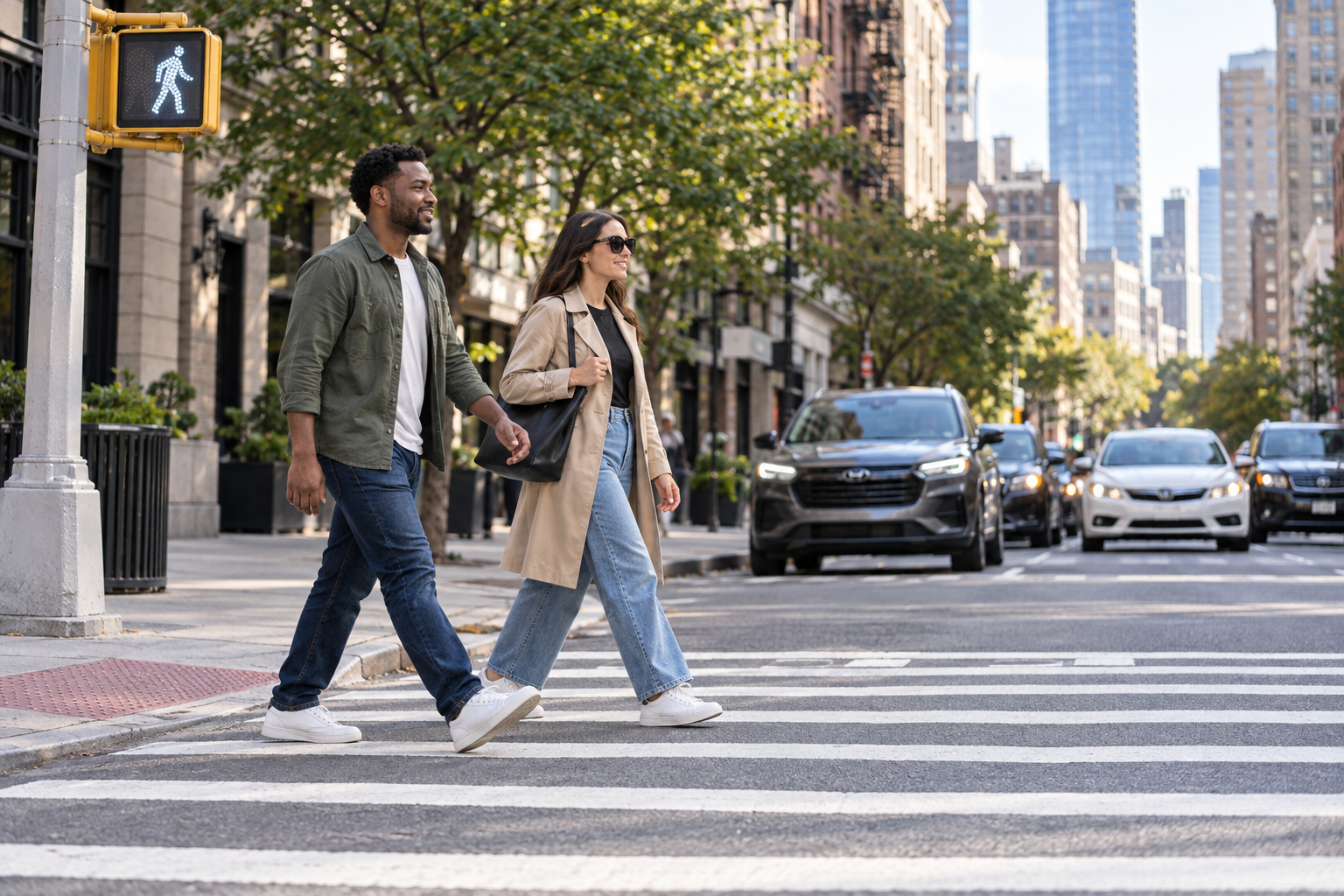
Right-of-way and due care depend on the circumstances
Vehicle and Traffic Law §1151 addresses crosswalk yielding when signals are absent or inoperative, including limits on sudden entry. Counsel should identify the rules governing the actual crossing.
Drivers' due-care obligation appears in Vehicle and Traffic Law §1146. A driver or pedestrian's assertion of priority does not replace evidence about the movement, visibility, and controls.
For a signalized intersection, ask which signal each witness observed and when. A later photograph may show the arrangement without establishing the phase during contact. Records or footage may be needed where timing or operation is disputed.
A witness who missed the signal can still provide useful evidence about a turn, approach, or immediate statement. Preserve the actual observation and its limits. A complete-sounding account is not more reliable if it includes details the person never saw.
Medical care and the initial history
Seek appropriate healthcare and explain the physical sequence as remembered. Identify the contact, fall, or body movement rather than substituting an unverified conclusion about fault. If a witness supplied part of the account afterward, make that source clear.
Disclose relevant prior conditions and treatment. The assessment may require comparing baseline function with new symptoms or restrictions. An earlier condition is part of the history, not a reason to omit a newly reported problem.
Keep treatment instructions and communications about activity. If scheduling or transportation affects follow-up, document the real reason. Medical decisions should serve care needs rather than an attempt to shape the appearance of a claim.
Evidence that can connect an incomplete account
Preserve report information, vehicle identifiers, witness contacts, and original photographs. A partial plate should remain marked as partial. Overstating certainty can direct an investigation toward the wrong vehicle, while an honest fragment may still be useful with other evidence.
Identify possible recordings by the view they could provide. A camera might show an approach, departure, or parking movement without capturing impact. Availability, retention, and relevance need verification rather than assumptions based on a camera's presence.
Keep complete recordings and the identity of the person supplying them. Use copies for annotations or excerpts. A short edited clip can omit context needed to understand the event, so preserve the original whenever available.
Relevant damaged clothing, footwear, or equipment should be photographed and discussed with counsel before disposal where practical. Such items may answer a particular question without proving every detail of the mechanism. Their significance should be evaluated carefully.
Insurance and current New York motor-vehicle law
The DFS no-fault FAQ generally directs pedestrians to the striking vehicle's insurer. Written notice is generally due within 30 days, with a reasonable-justification exception; individual eligibility and unusual circumstances require review.
Certain non-economic claims depend on the current serious-injury provisions of Insurance Law §5102 and §5104. Counsel should connect the medical proof to the applicable text.
Current CPLR §1411 can bar an Article 51 personal-injury claim if claimant fault exceeds defendants' combined fault. Applicability and effective dates need assessment for the event.
Keep benefits and settlement correspondence distinguishable. An insurer's allegation is a position to evaluate, and a payment addressing one issue does not necessarily resolve all rights. Preserve the full documents and response deadlines instead of relying solely on a summary of a call.
If the driver leaves or the vehicle is unidentified
Do not pursue the vehicle. Record the last direction seen, approximate time, markings, and partial identifiers from a safe place. These details may help connect witnesses or recordings even when no one has a complete plate number.
Explain what was reported and when to independent counsel. Potential insurance or other avenues may have specific eligibility and procedural requirements. Missing identity should prompt a careful review without a promise that a particular program will pay.
A later sighting of a similar vehicle is a lead, not necessarily identification. Timing, route, and additional features may be needed to establish the connection. An investigation should test that connection before treating it as a proven fact.
Work, transportation, and household consequences
An injury may affect walking, driving, train access, standing at work, or caregiving. Describe the actual task and the reason it changed. A diagnosis or general statement of hardship may not explain why a particular form of help became necessary.
For employment, retain expected schedules, earnings information, and communications about absences or modified duties. Self-employed workers should distinguish revenue from earnings after expenses. Estimates should remain identified as estimates until the supporting records are available.
Record the purpose of additional transportation expenses. A ride to treatment, a replacement commute, and an unrelated trip may present different questions. Counsel can assess recoverability after the factual record is clear.
Household assistance should identify the helper, task, duration, and actual cost where one exists. Include improvement and tasks still possible. A balanced account explains a changing recovery more credibly than a fixed description repeated regardless of daily function.

Several public bodies may have different roles
On Long Island, a responding police department, road owner, and maintenance authority may be different entities. A report heading does not determine responsibility for a signal, pavement, or other alleged condition. Counsel should verify the relevant role if a public-entity claim is genuinely being considered.
For an event near a municipal boundary, preserve the exact intersection, direction, and available address information. An online map label can orient the discussion without conclusively establishing legal jurisdiction. A small location error can send a request to the wrong office.
Keep agency responses and referrals. They may identify a useful records source, but should not be assumed to extend a deadline or satisfy notice requirements. The factual location, alleged duty, and required procedure need to be connected deliberately.
Deadlines and consultation priorities
Ordinary negligence actions generally have a three-year limitation under CPLR §214, with exceptions. Public-entity claims may require earlier notice under General Municipal Law §50-e.
A police report, request for a safer crossing, or insurer negotiation should not be assumed to protect every claim. Ask for an individualized deadline assessment, including any special authority or procedure when the injured person cannot manage the process independently.
Bring a chronology, available identifiers, medical information, and letters requiring a response. Ask about preservation priorities, unresolved facts, communication, and fee terms. The Long Island car accident guide, Long Island personal injury page, and New York pedestrian overview provide related context.
Keep billing records from being counted twice
Medical paperwork can include an original charge, an insurer's explanation, a payment, and a remaining balance for the same service. Preserve the complete documents and identify what each amount represents. Adding every figure together can overstate the expense and make the claim harder to evaluate.
The same principle applies to work records. Unpaid time, paid leave used, reduced hours, and modified duties describe different consequences. Keep the employer's explanation and underlying payroll information rather than combining them into a single unsupported total.
A clear record helps counsel assess the available damages and any related obligations. The aim is to explain the actual financial effect accurately, with enough detail to distinguish separate losses from repeated descriptions of one expense.
Long Island pedestrian accident FAQs
Does the nearest business address identify where the collision happened?
It may help orient the location but should not replace the exact contact point. Preserve the pedestrian's route and vehicle movement. A driveway, intersection, and parking area near the same address can raise different factual questions.
What if I was walking outside a marked crossing?
Describe the circumstances accurately and obtain legal advice. Crossing location is part of a broader analysis of duties and conduct. Avoid accepting a blanket statement that the claim automatically succeeds or fails based on that description alone.
Can a later photograph be used?
It can illustrate the location if its date and limitations are clear. Temporary obstructions or arrangements may have changed. Counsel should distinguish a later illustration from evidence of the exact conditions during the event.
Where can I ask about this page?
Use the contact page for editorial questions. An independent licensed attorney should assess personal claims, evidence, and deadlines.