
Queens Pedestrian Accident Lawyer
A pedestrian collision in Queens can occur during a short walk to a shop or a longer trip connecting several forms of transit. The relevant evidence may come from an intersection, service road, driveway, station entrance, or vehicle that continued elsewhere after contact. A useful investigation begins with those precise details rather than a general statement that the event happened on a busy road.
Someone seeking a Queens pedestrian accident lawyer should expect clear questions about the walking route, vehicle movement, medical history, insurance, and deadlines. This guide explains how to prepare that information and why different Queens settings can call for different records. It covers people struck by motor vehicles and flags situations that may require another legal or insurance analysis.

Queens pedestrian safety data in context
The DOT's 2023 borough safety plan records 145 pedestrian fatalities in Queens during 2017–2021. This historical five-year total is not a current annual figure or a count for a particular corridor. Official DOT plan.
A borough total helps describe the scope of the safety issue without establishing negligence in an individual claim. It does not show what a particular driver could see or whether a pedestrian's route complied with the applicable controls. Those questions require evidence about the event.
Local road names below identify useful investigation contexts. They are not an unsupported list of the most dangerous intersections. A precise location and dated source are more useful than an impressive-sounding ranking that cannot be checked.
Queens Boulevard: identify the crossing segment
For an event on Queens Boulevard, record the cross street, starting side, destination side, and the part of the crossing where contact occurred. If the pedestrian paused or changed direction, include that sequence. A broad description of “crossing the boulevard” may leave the relevant vehicle path unclear.
A witness may have watched only one portion of the crossing. Identify their position and what obstructed their view, if known. Another person may have seen the driver's approach while missing the pedestrian's first movement. The accounts should remain separate until the evidence is evaluated.
Preserve which signal was observed and when. A later photograph of the intersection may show its layout without proving the signal phase during the event. Counsel may need records or footage to resolve a dispute about timing or operation.
If a map is used to explain the route, label it as a reconstruction based on memory. It can orient the discussion while leaving measurements and technical conclusions to appropriate investigation.
Northern Boulevard and commercial driveways
Along Northern Boulevard and nearby commercial streets, distinguish a vehicle traveling along the road from one entering or leaving a property. A pedestrian continuing across a driveway may encounter a different movement from someone crossing an intersection. Describe the actual path rather than rely on the nearest business address.
If a parked vehicle, sign, or other object affected visibility, record what was observed and where it stood. Do not assume the object caused the event simply because it appears in a photograph. Its relevance depends on the sight lines and the movements under investigation.
A property owner is not automatically liable for every collision near an entrance. Counsel should identify the alleged condition or conduct, the relevant duty, and the causal connection. A business can also be an evidence source without being a defendant.
Images taken later should be identified as later images. Loading activity and temporary obstructions can change. An accurate account distinguishes the permanent layout from conditions believed to have existed only at the time of injury.
Jackson Heights, Elmhurst, and walking near transit
A route near Roosevelt Avenue or a transit entrance in Jackson Heights or Elmhurst may involve several decisions before reaching the crossing. Preserve the exit used, direction walked, and intended destination. A station name alone can cover more than one relevant location.
If the pedestrian was transferring between services, keep the transportation records that help establish the timeline. A transaction may narrow the time window without showing the exact moment of contact. Explain any interval between leaving transit and entering the street.
Companions should document their own observations. Someone walking ahead may have crossed before the event and may not know the signal state when another person began. The relationship between the witnesses does not make their viewpoints identical.
For a collision involving a bus, preserve the route and vehicle identifiers if safely available. Public and private operators can present different procedural questions. Do not assume the name of the nearby station identifies the vehicle's owner or every responsible party.
Flushing and Jamaica destination-specific evidence
In Flushing or Jamaica, a pedestrian may describe the event by a shopping destination, station, or major street. Narrow that description to the actual entrance, corner, and direction of travel. A business receipt can help with timing while leaving the contact location unresolved.
A turning vehicle may approach from a direction the pedestrian did not see. Record the first reliable observation rather than inventing an earlier route. Footage showing the approach may be particularly useful when the driver's and pedestrian's accounts address different moments.
If a driver stopped elsewhere after the collision, preserve both locations. Photographs of the later position can document identifiers and damage but should not be used as though they show the original alignment. Explain what moved and which observations came afterward.
Rockaway, airport-area, and less familiar walking routes
A pedestrian near an airport-related destination, the Rockaways, or another unfamiliar part of Queens may not know the road name. Record reliable landmarks, the intended destination, and the order of movements. A later map review should be identified as later assistance, not original memory.
If the route involved a pickup or drop-off, distinguish leaving the vehicle from the subsequent walk. A taxi door event, a pedestrian crossing after a ride, and a fall on a property can involve different factual and coverage questions. Describe the mechanism before selecting a legal label.
The Queens taxi accident guide provides related information for hired-vehicle events. Vehicle classification should be established from records rather than assumed from a passenger's casual description.
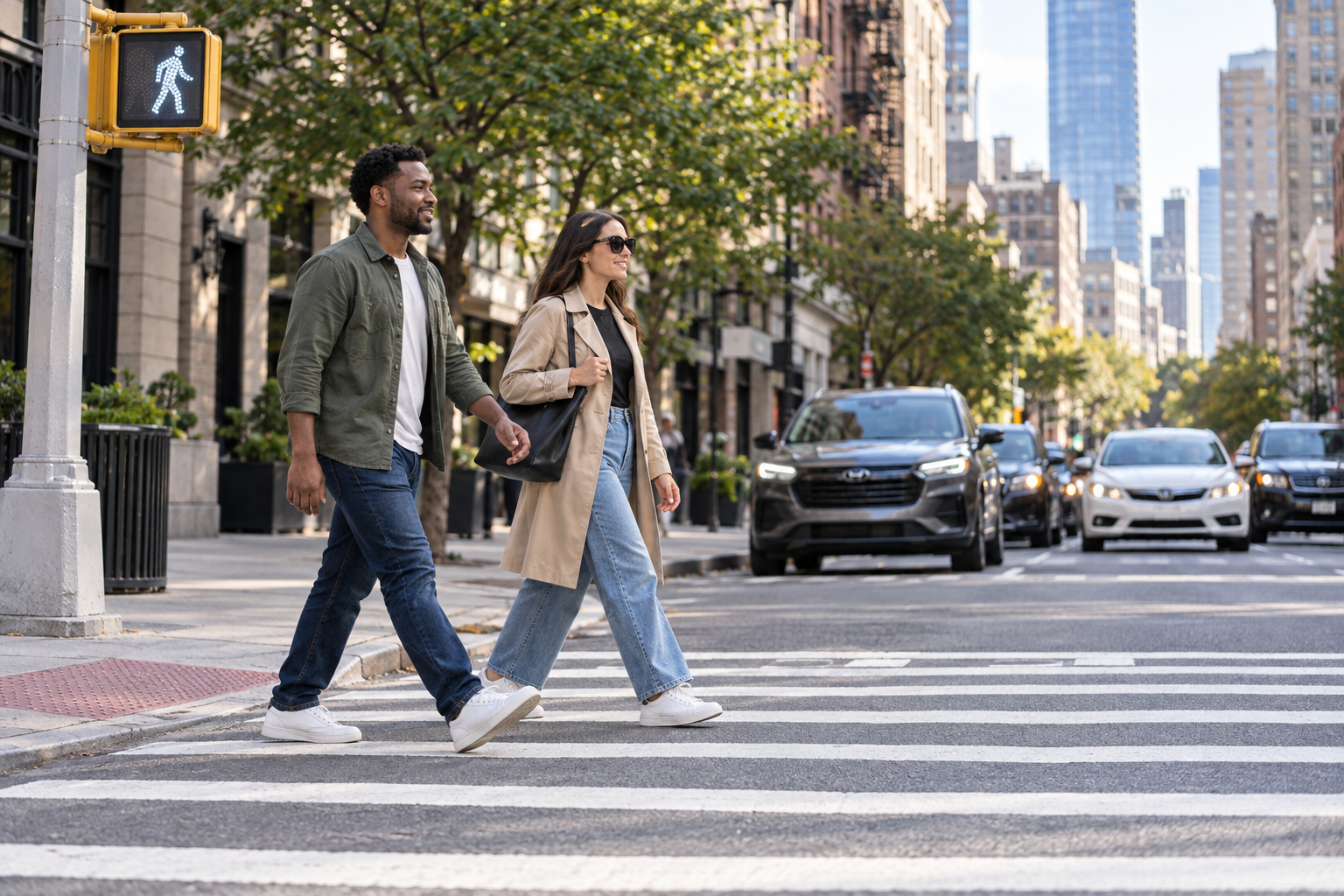
A dependable account of signals and vehicle conduct
Vehicle and Traffic Law §1151 addresses crosswalk yielding when signals are absent or inoperative, with limits on sudden entry. The rule should be applied to the actual crossing circumstances.
The driver's due-care obligation is addressed in Vehicle and Traffic Law §1146. A claim should not be resolved through a slogan that pedestrians always have priority or always lose outside marked lines.
Ask each witness which control they saw and at what moment. A person who observed a vehicle turn but did not see the pedestrian signal can still provide useful evidence. Their account should not be expanded to include an observation they never made.
Where the parties disagree, identify the fact that would distinguish the accounts. That might be the pedestrian's starting position, a vehicle's turn, or the timing of entry. This makes preservation requests more focused than collecting unrelated footage from an entire neighborhood.
Medical care and recording the mechanism
Seek appropriate healthcare and explain how the contact or fall occurred. Tell the clinician what you know directly and what another person later told you. The physical history should not be replaced by an unsupported conclusion about legal fault.
Provide relevant prior medical history. An earlier limitation may require comparison with the new symptoms and function. Omitting it can hinder treatment and make later causation questions harder to assess accurately.
Keep discharge instructions, appointment information, and communications about restrictions. If access, transportation, or scheduling affects treatment, document the actual reason. Do not create unnecessary treatment for claim purposes or disregard medical advice because the legal process is uncertain.
Witnesses, recordings, and original objects
Save contact information with a short description of each witness's viewpoint. A person who saw the aftermath may help identify a vehicle or immediate statement even without witnessing impact. State that limit clearly so their contribution is not overstated.
Preserve original video files and ask whether a complete recording exists when someone supplies an excerpt. Work from a duplicate if annotations are needed. A short clip may omit the preceding movement that explains what happened.
Clothing, footwear, bags, or mobility equipment may be relevant to a disputed mechanism or loss. Photograph their condition and discuss preservation before repair or disposal where practical. Their technical significance should be evaluated rather than assumed from appearance alone.
Insurance notices and the current claim framework
The DFS no-fault FAQ generally directs pedestrians to the striking vehicle's insurer. Written notice is generally due within 30 days, subject to the reasonable-justification exception; eligibility and unusual circumstances require review.
Certain non-economic claims depend on current Insurance Law §5102 and §5104. Counsel should connect the medical evidence to the applicable serious-injury requirements.
Current CPLR §1411 may bar an Article 51 personal-injury claim where claimant fault exceeds defendants' combined fault. Applicability and effective dates need individual assessment.
Keep each insurer's role clear. Benefits, property issues, and liability settlement discussions may proceed separately. A payment or denial in one process should not be assumed to settle every issue without reviewing the policy, documents, and governing procedure.
When the driver cannot immediately be identified
Do not pursue a departing vehicle. Preserve the direction, time, markings, and partial identifiers safely observed. The information may help locate additional evidence even if no witness has a complete plate number.
Tell counsel what was reported and when, and retain the report reference. Potential insurance or other avenues can have specific eligibility and procedural requirements. Missing identity should prompt review, not a promise that a particular program will pay or an assumption that nothing can be done.
A recording farther along the route may identify the vehicle without showing fault. Use it for the question it can answer. Combining evidence requires care so a later sighting is not mistakenly presented as proof of the collision itself.
Work and caregiving consequences in a Queens household
Document the actual duties affected by injury. A healthcare worker, restaurant employee, tradesperson, office worker, and caregiver may experience different limitations from similar diagnoses. A job title or general statement of pain may not explain those differences.
Preserve expected schedules and what occurred afterward, including modified duties or reduced hours. For self-employment, retain contracts and financial records needed to distinguish revenue from earnings. Identify estimates until the underlying documentation supports them.
Household assistance should be described by task and duration. Record who helped with children, shopping, appointments, or personal needs and any actual expense. An attorney can assess legal recoverability after the factual account is clear.
Include recovery progress and tasks that remain possible. This gives a more useful picture than an account that treats every day and activity as equally affected. Medical instructions should guide activity decisions rather than an effort to make the claim appear stronger.

Language support and accurate communication
An injured person should be able to explain the event in a language they understand well. Identify interpretation needs early for medical and legal discussions. Everyday fluency does not necessarily prepare a companion to translate technical terms or the effect of a release accurately.
Preserve the original version of a written statement alongside any translation. Note who translated it and whether an uncertain phrase needs clarification. Do not silently replace a tentative description with more definite wording because it sounds smoother in English.
A relative can help organize records while keeping their own observations separate from the pedestrian's account. Ask what authorization is required for obtaining or sharing private information. Assistance should support accurate communication without turning the helper into the apparent source of facts they did not witness.
Deadlines, public involvement, and consultation preparation
Ordinary negligence actions generally have a three-year period under CPLR §214, subject to exceptions. Public-entity claims may require earlier notice under General Municipal Law §50-e.
A police report or request for a safer crossing should not be assumed to satisfy a legal notice requirement. If a public vehicle, signal, or roadway condition is implicated, identify the issue promptly so counsel can examine the proper entity and procedure.
Bring a chronology, report information, medical documents, and letters requiring a response to an independent consultation. Ask which evidence needs immediate attention and how fees and expenses work. The Queens personal injury guide, Queens car accident page, and New York pedestrian overview provide related reading.
A clear file can distinguish several kinds of loss
An injured pedestrian may receive bills, benefit statements, and requests for payment that appear to describe the same treatment. Keep the full documents and identify whether each shows a charge, payment, adjustment, or balance. Adding every number together can double-count an expense and distort the record.
For work losses, distinguish an unpaid absence from paid leave used during recovery. Both may deserve discussion, but they should not be described as identical facts. Preserve the employer's explanation and the relevant payroll information rather than relying only on a personal calculation.
Similarly, a family member's time and a paid service invoice are different forms of evidence. Record what actually occurred before assigning a value. This organization helps counsel evaluate the available claim and avoids turning an understandable effort to document hardship into an unsupported total. Accuracy at this stage makes later questions easier to answer.
Queens pedestrian accident FAQs
What if the collision happened between two crossing segments?
Record the path, any pause, and the precise point of contact as accurately as possible. Different segments may involve different vehicle movements or controls. Counsel can evaluate the layout and applicable rules using the actual sequence.
Does a station camera necessarily show the street collision?
No. Its view, operation, and retention must be checked. A recording might show the pedestrian leaving a station without showing impact. That limited information can still help establish timing when its purpose is clearly explained.
Can an inaccurate early location estimate be corrected?
Yes, preserve the original estimate and identify the source of the correction. A receipt, witness, or recording may clarify the location. A transparent explanation is preferable to making the earlier account disappear without context.
Where can a reader ask about these sources?
Use the contact page for website editorial questions. An individual injury should be discussed with a licensed attorney who can assess the facts, evidence, and deadlines.