
New York Construction Accident Lawyer
New York construction accident lawyers at Tokov Law represent workers injured by unsafe job sites, heavy machinery, or falls from elevated areas. The firm investigates safety violations, identifies liable parties, and pursues compensation for medical expenses and lost wages. Over 100 cases have been resolved with millions recovered for clients.
Key Takeaways
New York’s Labor Law places absolute liability on property owners for many construction-related injuries.
The Scaffold Law NY imposes strict liability for gravity-related falls, removing the burden of proving negligence.
Labor Law 241(6) requires compliance with concrete safety rules in the New York State Industrial Code.
Over 100 cases have been resolved with millions recovered for injured construction workers.
What makes a New York construction accident lawyer essential?
Construction work ranks among the most dangerous occupations in New York. Daily hazards include heavy machinery, elevated work areas, and constantly changing job sites. A New York construction accident lawyer provides the legal framework injured workers need to recover compensation after a serious incident. Without skilled representation, workers risk absorbing medical costs and lost wages that should fall on responsible parties.
The legal landscape governing New York construction sites is uniquely complex. Property owners, contractors, and other parties must follow strict safety regulations designed to protect workers and the public. When those regulations are violated, the consequences for an injured worker are severe. Medical bills accumulate. Paychecks stop. Families face financial pressure that no workplace injury should create.
How does New York law protect injured construction workers?
New York’s Labor Law places absolute liability on property owners for many construction-related injuries. This statutory protection shifts the burden away from the worker. A NYC construction accident attorney uses these laws to build claims that hold owners and contractors accountable. The Scaffold Law NY imposes strict liability for gravity-related falls, making it one of the strongest worker protections in the country.
What does a construction accident attorney actually do after an injury?
The attorney investigates what went wrong on the job site. The firm identifies every responsible party, from property owners to subcontractors. Then the legal team pursues full compensation for medical expenses, lost income, and pain and suffering. This process requires gathering evidence, consulting safety experts, and navigating both workers’ compensation and potential third-party construction accident claim options. A construction site injury lawyer New York handles each of these steps while the injured worker focuses on recovery.
No confusion. No pressure. The firm’s approach centers on clear communication and strategic advocacy. Injured workers receive straightforward guidance about their rights under New York Labor Law 240, Labor Law 241(6), and Labor Law 200. These statutes create distinct paths to compensation depending on how the accident occurred. A scaffolding accident lawyer NYC or ladder fall attorney NY understands which law applies to each specific fall scenario. The firm also pursues construction negligence claim actions when safety violations cause harm. For answers to common questions about the claims process, the firm’s construction accident FAQs provide detailed guidance on liability and recovery options.
Your Case Deserves Attention. Every construction injury case demands thorough investigation and aggressive pursuit of available compensation. The firm delivers both.
How does New York Labor Law 240 protect workers?
New York Labor Law 240 imposes absolute liability on property owners and contractors for gravity-related injuries. The statute, commonly called the Scaffold Law NY, removes the burden of proving negligence when a worker falls from an elevated surface. Tokov Law applies this statute to secure compensation for injured construction workers across New York.
The law addresses a fundamental reality of construction work. Workers face daily exposure to hazardous job sites, heavy machinery, elevated work areas, and harmful materials. When safety equipment fails or is never provided, the consequences are severe. A New York construction accident lawyer at Tokov Law investigates what went wrong and identifies every responsible party.
What types of falls does Labor Law 240 cover?
The statute covers falls from ladders, scaffolds, roofs, and other elevated surfaces common on construction sites. A ladder fall attorney NY pursues claims under this law without requiring proof that an owner acted carelessly. The absence of proper safety devices creates liability on its own.
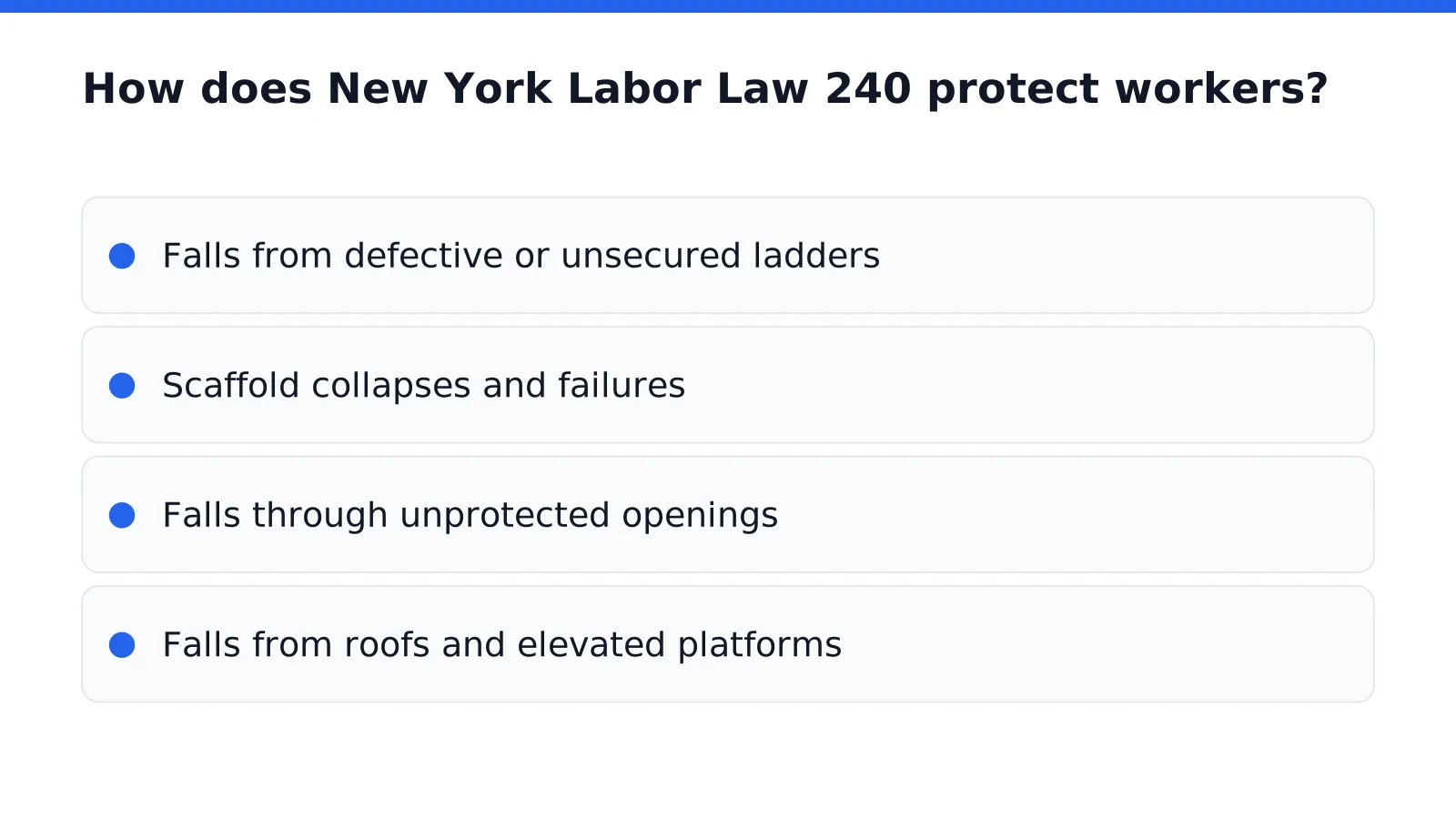
Falls from defective or unsecured ladders
Scaffold collapses and failures
Falls through unprotected openings
Falls from roofs and elevated platforms
How does absolute liability change a construction injury claim?
Absolute liability shifts the legal burden away from the injured worker. A scaffolding accident lawyer NYC does not need to demonstrate that a property owner knew about a hazard. The failure to provide adequate protection against elevation risks establishes the violation. Tokov Law pursues full compensation for medical expenses, lost income, and pain and suffering under this standard.
A fall from height attorney leverages this framework to hold owners and contractors strictly accountable. The investigation focuses on what safety equipment was missing, not on whether anyone acted negligently. This approach produces stronger claims and more meaningful recoveries for injured workers and their families.
What role does Labor Law 241(6) play in construction injury cases?
Labor Law 241(6) imposes a specific duty on property owners and general contractors to maintain a safe construction worksite. The statute requires compliance with concrete safety rules set out in the New York State Industrial Code. A violation of those rules creates a path to compensation that does not depend on proving common-law negligence.
The law targets the physical conditions of the job site. Industrial code violation 23 provisions cover hazards such as unguarded floor openings, inadequate lighting, and improper material storage. When a worker suffers harm because a contractor failed to meet one of these precise standards, the owner and contractor face liability. Tokov Law investigates each incident to identify which code provision was breached and which parties bear responsibility.
How does Labor Law 241(6) differ from the Scaffold Law?
The statute occupies a distinct legal position. New York Labor Law 240, known as the Scaffold Law NY, imposes absolute liability for elevation-related falls. Labor Law 200 requires proof of negligence. Labor Law 241(6) sits between them. A construction site injury lawyer New York uses this middle ground to hold owners and contractors accountable when a specific safety rule was broken, without needing to prove they knew about the hazard.
Who can be held liable under Labor Law 241(6)?
Multiple parties answer for violations. Property owners and general contractors bear primary responsibility. Subcontractors and their agents may also face liability when their conduct creates a dangerous condition. Tokov Law identifies every responsible party after a construction site safety violation NY and pursues full compensation from all available sources.
The firm’s approach is methodical. Attorneys examine site records, safety logs, and witness statements to establish which industrial code violation 23 provision applies. That evidence builds a claim for medical costs, lost wages, and pain and suffering. Injured workers gain a legal avenue that does not require proving fault in the traditional sense. The duty is fixed by statute. The remedy follows when the code is violated.
When does Labor Law 200 apply to a construction accident?
Labor Law 200 applies when a construction site injury results from a dangerous physical condition or unsafe means and methods of work. The statute codifies the common-law duty of property owners and general contractors to provide a reasonably safe workplace. New York’s Labor Law places absolute liability on property owners for many construction-related injuries, and Labor Law 200 is the provision that addresses construction negligence claim scenarios where fault must be proven.
A successful claim under this section requires evidence that the property owner or general contractor exercised supervision and control over the activity that caused the injury. The responsible party must have had actual or constructive notice of the hazardous condition. Without that showing, liability does not attach.
What types of hazards does Labor Law 200 cover?
The statute reaches a broad range of dangerous circumstances on job sites. Common triggers include:
Defective tools or malfunctioning equipment provided to workers
Unsafe work methods directed or permitted by a supervisor
Hazardous materials present without adequate warning or protection
Slip, trip, and fall hazards from debris, ice, or uneven surfaces
Inadequate lighting or ventilation in work areas
Construction workers face daily exposure to hazardous job sites, heavy machinery, elevated work areas, and harmful materials. When safety rules are ignored, Labor Law 200 becomes a critical path to recovery.
How does an OSHA violation strengthen a Labor Law 200 claim?
An OSHA violation lawyer often cites federal safety standards alongside Labor Law 200 to establish the standard of care. A violation of an Occupational Safety and Health Administration regulation serves as evidence that the owner or contractor failed to maintain a safe workplace. This dual approach strengthens a claim for construction injury compensation NY by demonstrating that recognized safety protocols were breached. Tokov Law investigates what went wrong, identifies responsible parties, and pursues the compensation injured workers need. The firm’s New York construction accident lawyer team examines site conditions, supervisory records, and safety compliance to build the evidentiary foundation these claims require.
What is the difference between workers compensation vs personal injury lawsuit?
Workers’ compensation provides medical coverage and partial wage replacement for injured construction workers in New York. A personal injury lawsuit pursues full damages, including pain and suffering, which workers’ compensation never covers. The distinction determines whether an injured worker recovers only basic benefits or complete compensation.
For injured construction workers in New York, workers’ compensation operates as a no-fault system. The worker receives benefits regardless of who caused the accident. However, those benefits exclude compensation for pain and suffering, permanent impairment, or diminished quality of life. A workers compensation vs personal injury lawsuit comparison reveals the core limitation: workers’ comp replaces only a portion of lost wages and covers medical treatment.
A third-party construction accident claim changes the recovery landscape entirely. When a property owner, general contractor, or equipment manufacturer bears responsibility for the injury, the worker may sue that party directly. The third party is not the worker’s direct employer, so the workers’ compensation bar does not apply.
Can an injured worker file both claims at the same time?
Yes. An injured construction worker in New York may receive workers’ compensation benefits while simultaneously pursuing a third-party lawsuit. The two claims proceed independently. Workers’ comp covers immediate medical bills and partial wages. The lawsuit targets additional damages from responsible third parties.
What damages does a personal injury lawsuit recover that workers’ comp does not?
A personal injury lawsuit under New York Labor Law recovers full damages including medical expenses, lost income, and pain and suffering. Workers’ compensation never includes pain and suffering. The lawsuit also addresses future medical costs and diminished earning capacity.
A New York construction accident lawyer evaluates whether a case qualifies as a third-party claim. Tokov Law investigates what went wrong, identifies responsible parties, and pursues the compensation needed after a serious workplace injury. The evaluation determines whether recovery extends beyond workers’ comp benefits. No confusion. No pressure. Your Case Deserves Attention.
How does a construction accident settlement New York work?
A construction accident settlement New York resolves an injury claim through negotiated compensation rather than a courtroom verdict. Tokov Law investigates the incident, identifies every responsible party, and pursues full financial recovery for injured workers across New York.
No confusion. No pressure. The firm handles insurance negotiations and litigation demands while the client focuses on medical recovery. Compensation targets three categories: medical expenses, lost income, and pain and suffering.
What damages does a settlement include?
Most injured workers overlook categories that sharply reduce the value of their claim. An experienced construction site injury lawyer New York calculates both immediate and long-term losses:
Emergency treatment, hospitalization, and surgical costs
Rehabilitation, physical therapy, and prescription medications
Wages lost during recovery and permanently diminished earning capacity
Future medical care required for chronic or degenerative conditions
Non-economic damages for physical pain and emotional distress
Leaving future costs unaccounted for leaves money on the table. Your Case Deserves Attention from a legal team that builds a complete damages picture before entering negotiations.
How long does the settlement process take?
Timelines vary by injury severity, liability disputes, and insurer cooperation. Straightforward claims with clear fault may resolve within months.
Complex cases involving multiple defendants or contested liability extend longer. A jobsite accident settlement requires patience. Tokov Law presses insurers toward resolution while preparing every case for trial if defendants refuse fair terms.
The firm operates on a contingency basis. No legal fees are paid unless a successful outcome is secured. For injured workers concerned about upfront costs, this arrangement removes financial risk from pursuing a construction accident claim.
What happens when a settlement is reached?
Accepting a settlement concludes the claim permanently. The injured worker signs a release waiving further legal action against the defendants in exchange for the agreed payment.
Tokov Law advises clients on whether an offer reflects true case value before any signature. Once accepted, the firm deducts its contingency fee and disburses the remaining funds. Medical liens and outstanding bills are resolved from the proceeds before the client receives net compensation.
Why choose a Long Island construction accident attorney?
A Long Island construction accident attorney provides localized legal knowledge that directly shapes case strategy and settlement value. Familiarity with Nassau and Suffolk County courthouses, judicial tendencies, and insurance carrier practices eliminates procedural delays that cost injured workers time and compensation.
Tokov Law operates from its Valley Stream headquarters, serving clients throughout Nassau County, Long Island, and the broader New York metropolitan area. The firm’s proximity to local venues means attorneys appear in person for conferences, motions, and settlement negotiations. That presence signals readiness to try a case, a factor adjusters weigh when calculating offers.
What does local representation actually change in a construction injury case?
Local counsel knows which judges strictly enforce New York Labor Law 240 and which defense firms routinely delay discovery. Tokov Law leverages that insight to anticipate opposition tactics and position claims for maximum recovery. The firm has resolved over 100 cases and recovered millions for clients, combining practical negotiation with courtroom experience when litigation becomes necessary.
A Valley Stream personal injury lawyer from the firm delivers attorney-led service with consistent communication. Clients receive timely updates on case progress, medical record reviews, and settlement discussions. No confusion. No pressure.
How does a Long Island attorney handle Nassau County construction claims differently?
Nassau County construction claims involve specific filing deadlines, local court rules, and a concentrated pool of defense counsel. Tokov Law navigates these requirements without missteps that jeopardize compensation. The firm’s disciplined, evidence-driven approach identifies every liable party, from general contractors to equipment manufacturers, strengthening the foundation for a third-party construction accident claim.
Your Case Deserves Attention. Injured workers receive direct access to an attorney who understands both the legal framework and the practical realities of Long Island job sites. That combination protects rights and accelerates the path to a construction accident settlement New York workers depend on to rebuild their lives.
How do I start a construction injury case with Tokov Law?
Starting a construction injury case requires a single step: a free consultation. Injured workers contact Tokov Law by phone, email, or online form to discuss the accident and explore legal options. The firm’s New York construction accident lawyer team reviews the details immediately. No confusion. No pressure.
The consultation establishes what happened on the job site and who bears responsibility. Construction accidents involve multiple parties. General contractors, subcontractors, property owners, and equipment manufacturers may all share liability. Tokov Law identifies every responsible party before filing any claim.
What happens during the first call with a construction accident attorney?
The initial conversation focuses on three areas. First, the attorney gathers facts about the accident: the date, location, equipment involved, and nature of the injuries. Second, the firm explains which New York labor laws apply. Statutes like New York Labor Law 240, known as the Scaffold Law NY, impose strict liability on property owners and contractors for gravity-related falls. Labor Law 241(6) and Labor Law 200 address specific safety violations and general negligence respectively. Third, Tokov Law outlines the path forward, whether through a third-party construction accident claim or a workers’ compensation proceeding.
Does language create a barrier to legal representation?
Language does not prevent an injured worker from securing representation. Tokov Law assists clients in English, Spanish, Hebrew, Russian, and additional languages. Clear communication drives every stage of the case. The firm provides timely updates so clients remain informed and in control of decisions throughout the case lifecycle.
After the consultation, the NYC construction accident attorney team gathers evidence. Photographs, safety logs, witness statements, and OSHA violation records build the foundation of the claim. For personal injury matters, no legal fees apply unless Tokov Law wins the case. This contingency structure ensures transparent, results-driven advocacy from start to resolution. Injured workers across New York receive the same disciplined approach that defines the firm’s broader legal practice. Your Case Deserves Attention.
FAQ
What makes New York’s Labor Law unique for construction accident claims?
New York’s Labor Law places absolute liability on property owners for many construction-related injuries, removing the burden of proving negligence.
How does Tokov Law handle construction accident cases?
Tokov Law investigates safety violations, identifies liable parties, and pursues compensation for medical expenses and lost wages with no fees unless they win.
What types of accidents does Tokov Law cover for construction workers?
Tokov Law represents workers injured by unsafe job sites, heavy machinery, falls from elevated areas, and gravity-related falls under the Scaffold Law NY.
Conclusion
Injured construction workers in New York face complex legal terrain where liability rules and procedural deadlines determine outcomes. The decision to pursue a claim requires counsel who understands local court practices. The strict liability standards governing job site injuries. A free consultation provides the opportunity to evaluate the facts, identify responsible parties, and establish a clear path forward without financial risk. Taking that first step positions the injured worker to secure the compensation New York law permits.