
After a sidewalk fall in New York City, get to safety, obtain appropriate medical care, and preserve the exact location and condition that caused the fall. Take photographs if you can do so safely, collect witness details, and keep your shoes and original records. Check legal deadlines promptly: a claim involving the City can require a notice of claim within 90 days, long before the deadline people commonly associate with a private-property injury lawsuit.
A public sidewalk does not automatically mean the City is responsible. The adjoining property, the type of surface, and who created or maintained the condition can change the investigation. This checklist explains what to save and which questions to raise after a sidewalk trip-and-fall accident in Manhattan, Queens, Brooklyn, the Bronx, or Staten Island.
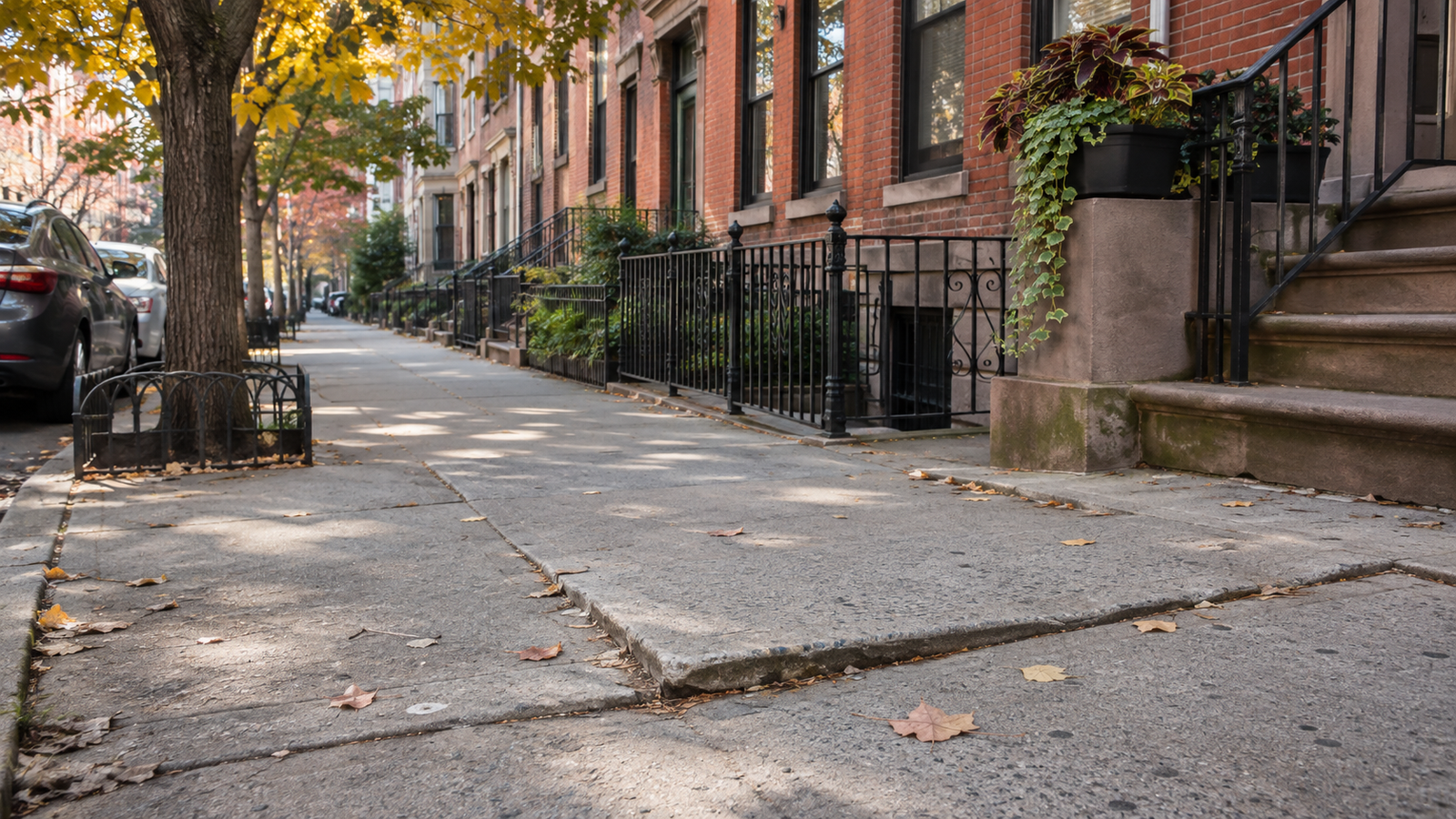
Start with safety, then record the location precisely
Do not remain in traffic or return to an unsafe area just to gather evidence. If urgent assistance is needed, call 911. If someone else can document the location safely while you obtain care, ask them to keep the original photographs and note when they took them. Explain the fall and your symptoms accurately to medical providers; do not guess about a diagnosis or minimize a change you have noticed.
Write down the nearest street address, cross street, side of the street, and direction you were walking. Identify a fixed landmark such as a doorway, driveway, pole, or building corner. “Near the subway” is less useful than an entrance, street corner, and the particular sidewalk slab. A map pin can supplement this description, but it may point to the middle of a block rather than the spot where your foot caught.
Distinguish the sidewalk from a curb, tree well, metal cover, cellar door, station stair, or private entrance. Photograph the transition between surfaces. These details help a reviewer investigate responsibility without assuming every feature outside a building belongs to the same owner.
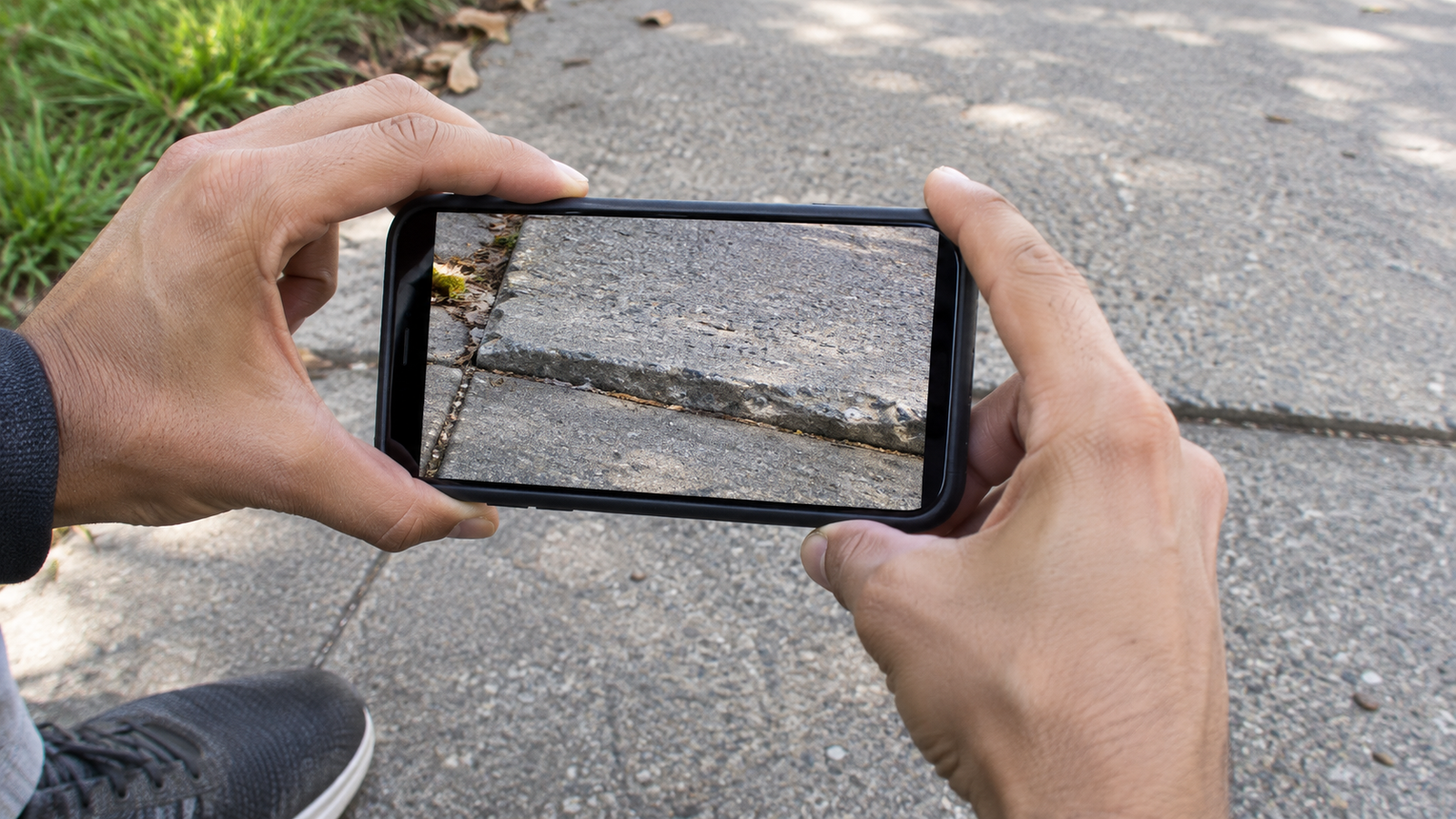
Take a sequence of photographs, not just one close-up
Useful photographs explain both where the fall happened and what the condition looked like. If you are able to take them safely, work from a wide view toward closer details:
- Wide view: the building frontage, sidewalk, and nearby intersection or fixed landmark.
- Walking route: the direction of approach and anything affecting visibility or available walking space.
- Condition: the uneven edge, opening, loose material, moisture, or other feature you observed.
- Surroundings: lighting, barriers, nearby work, signs, and the relationship to a curb or doorway.
Keep unedited originals. If you annotate a copy with an arrow, retain the original separately. Note whether photographs were taken immediately, later that day, or after a repair. Do not move debris, add water, recreate the accident, or change the condition to make the image clearer. A later photograph should never be presented as showing the scene at the moment of the fall.
A measurement can add context when obtained safely and accurately, but a number alone does not describe the whole condition. Do not risk another fall to measure a defect. Tell the person reviewing your file what you know, what you estimated, and what remains unknown. NYC DOT’s sidewalk guidance identifies common issues including uneven surfaces, collapsed sections, and raised hardware; it does not determine liability for an individual accident.
Identify witnesses and possible video promptly
Ask willing witnesses for a name and a way to contact them. Record whether each person saw the fall, saw the condition beforehand, or arrived afterward. Those are different kinds of information. Write your own account while the sequence is fresh, but do not ask someone to adopt your description or a conclusion about fault.
Look for nearby storefront, lobby, or building cameras without entering restricted areas. Note where cameras appear to face and the approximate time window involved. Ask counsel promptly about requesting preservation of relevant recordings, including footage before the fall. There is no universal retention period for every private camera, and a visible camera does not establish that usable footage exists.
If you report the incident to a business or property manager, ask for a copy or reference number. Record the recipient’s name, role, and the time. Preserve any response. An incident report can help document what was reported; it is not automatically an admission of liability or a substitute for formal legal notice.
Who may be responsible for a New York City sidewalk fall?
Under NYC Administrative Code § 7-210, adjoining property owners generally have a duty to keep sidewalks reasonably safe and may face liability for injuries caused by their failure to do so. The provision includes an exception from that liability rule for one-, two-, or three-family residential property that is partly or wholly owner-occupied and used exclusively for residential purposes. A storefront beneath apartments can therefore require a different analysis from an owner-occupied residential house.
The exception does not answer every question. Creating a defect or causing it through a special use can matter under common-law principles, as discussed in Brown v. City of New York. Contractors, utility work, and the particular surface may require additional investigation. The nearest business name is a starting point, not proof of the correct defendant.
Bring the address and photographs even if you do not know the owner. For more local context, see the Queens slip and fall guide, Brooklyn slip and fall guide, and Manhattan slip and fall guide. The useful question is who had a relevant duty concerning this condition—not simply which borough contains the sidewalk.
Keep three different notice and filing issues separate
A repair complaint: reporting a broken sidewalk through 311 can alert the City to a maintenance problem. Save the reference number. Do not assume this report starts an injury claim or satisfies the legal requirements for one.
A notice of claim: the NYC Comptroller’s personal injury FAQs explain the general 90-day notice requirement for claims against the City and the separate general deadline of one year and 90 days for filing the lawsuit. Formal service, hearing requirements, exceptions, and the correct public entity need individual review. Do not wait for an insurer’s response before checking them.
Prior written notice of a defect: this is a separate issue concerning the City’s knowledge before the accident. The Comptroller’s claim-filing guidance discusses the City’s prior-written-notice law. A complaint made after your fall does not by itself establish that the City received legally sufficient notice beforehand.
For an ordinary negligence injury action against a private defendant, CPLR § 214(5) generally provides three years. That is not a reason to delay identifying defendants or preserving evidence. Other defendants, claim types, and exceptions may change the applicable rules. Ask for the deadlines to be checked against the actual accident date and parties.
Build a small, usable record of the injury’s effects
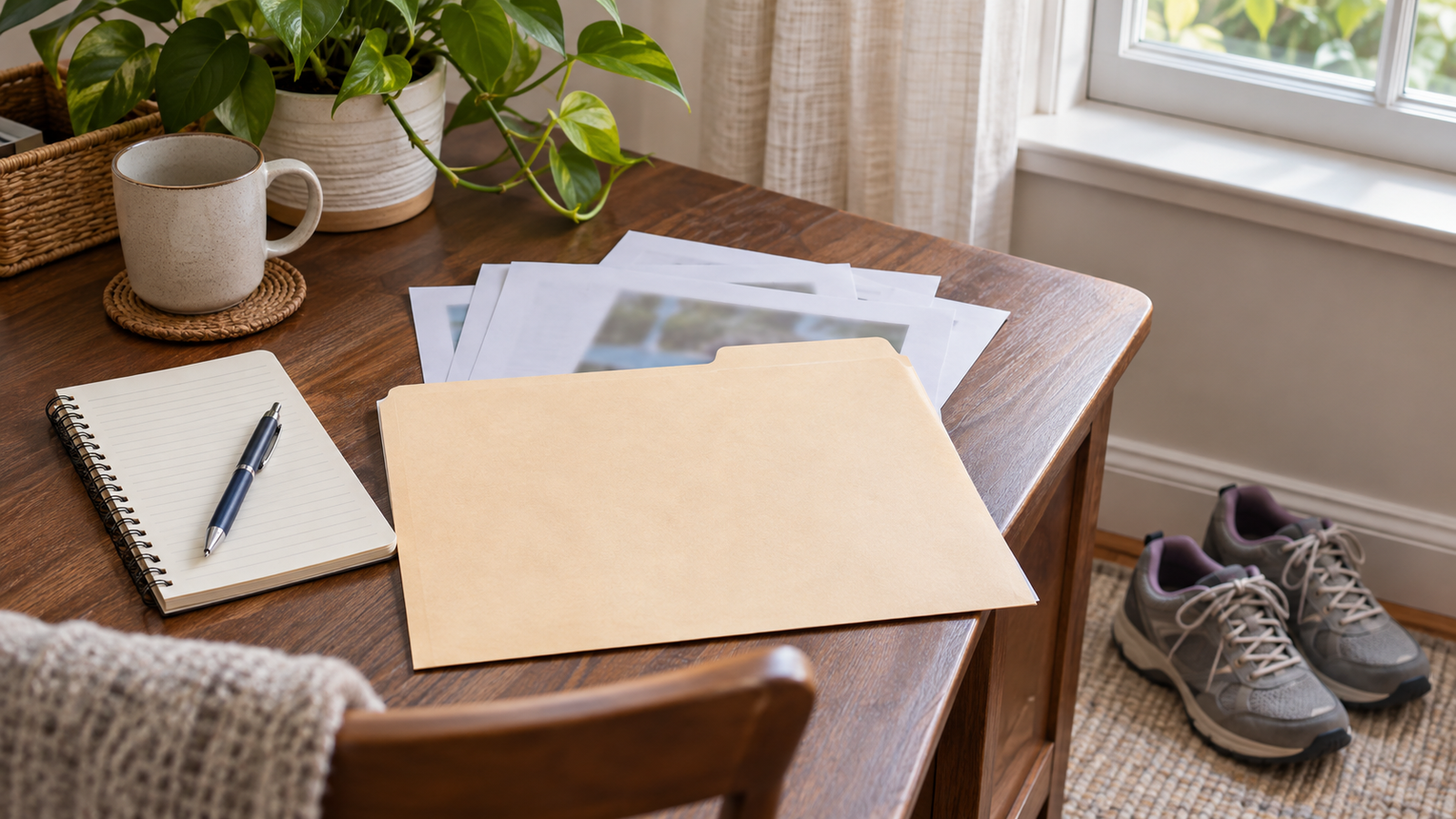
Keep the shoes you wore and avoid discarding or modifying them. Save medical visit information, discharge instructions, bills, receipts, insurance correspondence, and records of missed work. A simple folder with dated subfolders is more useful than scattered screenshots that omit who sent a document or when it arrived.
Write brief factual notes about limitations: a missed shift, trouble using stairs, or help needed with shopping. Distinguish what you experienced from what someone else observed. Include relevant prior symptoms and treatment when discussing the injury; an accurate account is more useful than trying to make every medical issue fit the accident.
Common questions after a sidewalk trip and fall
What if I could not take pictures immediately?
Obtain care first. Preserve the location and your recollection, and identify anyone who may have taken photographs. Later images can still help explain a place, but record their date and any known changes. Tell counsel promptly if repairs or temporary conditions may affect the evidence.
Does a sidewalk violation prove my case?
Not by itself. A violation record may help investigate a condition, but its location, date, and description must be compared with what caused the fall. The claim still requires analysis of responsibility, causation, and documented injury. Avoid treating any violation at the address as proof of the particular defect involved.
Can I pursue a claim if I may share some fault?
For an ordinary sidewalk premises-liability claim, CPLR § 1411(a) generally allows damages to be reduced proportionally for the claimant’s culpable conduct rather than automatically barring recovery. An allegation about your shoes or attention is not a final finding. Preserve the evidence and describe your actions candidly.
What should I have ready for a consultation?
Bring the accident date, exact location, original photos, witness details, reports, medical documents, and correspondence. List missing items rather than delaying until the folder is complete. Review the slip and fall FAQs for broader questions, or use the contact page to make an inquiry. Identify any possible City or public-authority involvement at the outset so notice requirements receive prompt attention.