
Long Island Scooter & E-Bike Lawyer
An electric-bicycle or scooter injury in Nassau or Suffolk County can involve a driveway, a station connection, a commercial entrance, a turning vehicle, or a pedestrian crossing. A Long Island scooter and e-bike lawyer should identify the actual device and location before discussing operating rules, insurance, or responsibility. Rules described for New York City should not automatically be applied to a trip outside the city.
This guide focuses on practical investigation after an injury in communities such as Hempstead, Mineola, Hicksville, Freeport, Huntington, Babylon, and Brookhaven. Local references help explain where evidence may be found. They do not imply that any named road has a particular crash ranking or that every segment permits electric-device operation.

Two counties, substantial travel, and a careful use of data
The 2020 Census recorded 1,395,774 residents in Nassau County and 1,525,920 in Suffolk County. U.S. Census Bureau county population table.
These population figures describe the scale of the two-county region, not electric-device use or crash risk. They cannot establish how dangerous a road is or how often scooter riders are injured. For a legal claim, the actual collision evidence remains essential.
The practical point is geographical: a trip described simply as “on Long Island” may cross several municipalities and involve different road owners or record holders. Preserve the exact address, intersection, county, and direction. That information helps identify the applicable rules and the people or organizations holding relevant records.
Device classification outside New York City
New York distinguishes legal electric-assist bicycles from other powered devices. A vehicle marketed as an e-bike may require a different analysis if its specifications or modifications place it outside that category. Photograph the model label, motor information, pedals, controls, and any registration.
New York DMV guidance explains the categories and local operating restrictions. The Attorney General's August 2026 notice also warns that devices exceeding the relevant assistance limits may not qualify as legal e-bikes. New York Attorney General notice.
Do not import New York City's class-three framework or a city-specific rule into Nassau or Suffolk without checking applicability. A product's advertised capability, its actual configuration, and the rules governing the place of use should be reviewed separately. A rider's casual terminology does not settle the legal classification.
Hempstead Turnpike and commercial driveways
An incident near a shopping entrance may involve a vehicle crossing a rider's route while entering or leaving a parking area. Identify the particular driveway and the direction of both movements. A business address alone may encompass several entrances with different sight lines.
Photograph the driveway, curb, signs, markings, and any obstruction from a safe position. If parked vehicles or landscaping affected visibility, record what was present at the time. Later photographs can help explain layout while failing to show the original obstruction.
A reference to Hempstead Turnpike is not a statement that every segment permits scooter or e-bike operation. Posted speeds and local restrictions matter. When reviewing an injury, distinguish the question of lawful operation from the separate questions of another driver's conduct and the causal sequence.
Mineola and Hicksville station connections
A person using a device to reach a station may have train timing, parking records, receipts, or phone information relevant to the chronology. Preserve those records without assuming that a scheduled train proves the exact time of a crash.
Identify whether the person was riding, walking the device, crossing, or waiting when injured. A station-area description can cover roads, parking areas, entrances, and other spaces with different ownership and rules. The precise location helps determine which records and duties may be relevant.
If a car door opened during a drop-off or pickup, identify the door and person involved. Preserve the vehicle plate and any available trip information. A passenger's conduct, the driver's positioning, and the rider's approach may require separate investigation rather than one generalized account of a parked-car accident.
Freeport, Babylon, and neighborhood travel
A short errand can produce a serious injury even when no app or rental record exists. A privately owned device may still be identifiable through purchase information, photographs, or service history. Witnesses and nearby cameras may help reconstruct the route and event.
For a collision near Sunrise Highway or a connecting street, identify the precise location rather than only naming the larger corridor. An event at a crossing or driveway is not the same as travel along every part of that road. Do not infer operating permission from the fact that a collision occurred there.
If a pedestrian was struck, preserve the pedestrian's movement and the device's approach. A person exiting a shop, crossing a driveway, and standing near a curb may encounter different factual issues. A careful account should describe what happened without assuming that one party's status answers every liability question.
Huntington and Brookhaven: locate the responsible record holder
A surface-condition claim may require identifying who owns or maintains the particular road, entrance, or property. County, town, village, state, and private responsibilities cannot reliably be determined from a street name alone. Preserve the location and ask for an appropriate investigation.
A nearby road project does not automatically establish contractor responsibility. Record relevant signs, barriers, and the condition alleged to have caused the fall. The investigation may need contracts, maintenance information, or notice records, depending on the actual theory.
Public-entity claims can involve earlier procedural requirements. A complaint to a general service number may document a concern but should not be assumed to satisfy a formal claim notice. Obtain timely advice rather than waiting for an ordinary lawsuit deadline to approach.
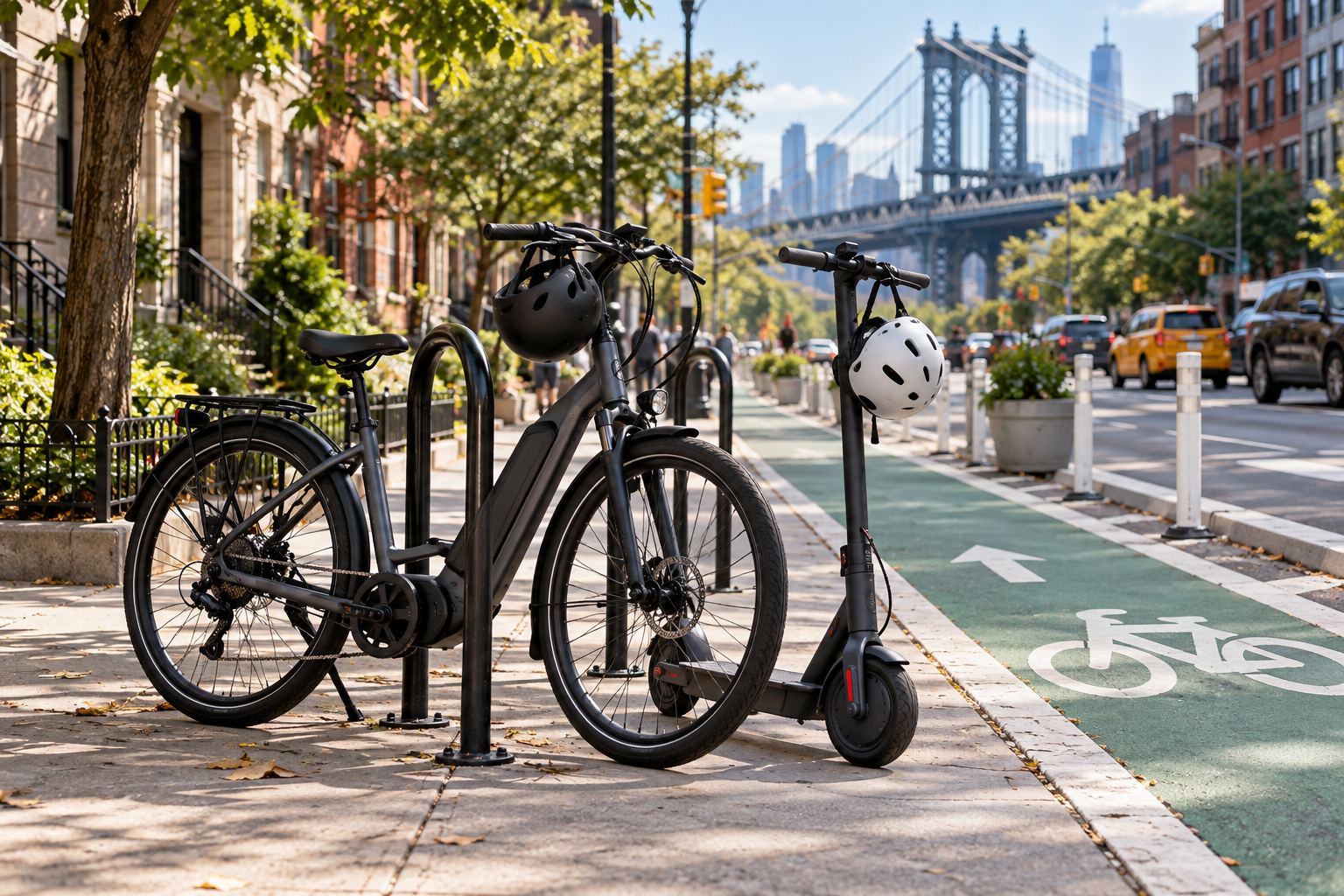
Equipment history can separate a defect allegation from impact damage
If a rider reports an unexpected brake or steering response, record the observation in ordinary language. What control was used, what happened, and had the rider noticed anything similar before? A technical cause should be evaluated by a qualified person rather than inferred from the rider's description alone.
Save maintenance invoices, purchase documents, and earlier complaints. A broken part after impact does not automatically prove it failed first. Conversely, a device appearing intact does not resolve every question about how it operated. The inspection plan should fit the disputed issue.
Before substantial repair, return, or disposal, consider whether preservation is needed. Safety remains essential. Do not charge or dismantle a damaged battery that presents danger. Seek appropriate emergency or professional assistance and retain handling records and photographs where safely available.
Rental and borrowed devices require accurate identification
For a rental, preserve the operator, unit identifier, trip receipt, and messages. Distinguish unsuccessful rental attempts from the device actually used. A complaint concerning a different unit should not be attributed to the involved device simply because it appears in the same account history.
For a borrowed device, identify the owner and what each person knew about condition and modifications. The rider may not know the full maintenance history. An honest statement of uncertainty is preferable to an unsupported specification later contradicted by an inspection.
If someone else retrieves or repairs the device, record that transfer. A clear possession history helps explain condition changes. Do not accuse a repair shop or owner of wrongdoing merely because routine handling occurred before a dispute was anticipated; identify what evidence remains and what was done.
Insurance analysis must start with the actual event
A rider struck by a registered car, a pedestrian struck only by a scooter, and someone injured in a single-device fall may face different coverage questions. Review the claimant's role, vehicle classifications, policies, and any work or rental arrangement.
The definitions in Insurance Law 5102 are relevant to motor-vehicle claims. They do not justify a blanket promise that all electric-device injuries receive identical benefits. Current statutory language should also guide any discussion of injury thresholds.
Ask insurers to state coverage decisions in writing. Preserve the policy information, claim number, and requested forms. A denial may address one coverage while leaving a separate claim unresolved. Multiple potentially relevant policies also do not mean the same loss will be paid repeatedly.
Unknown drivers and riders require different questions
If a car leaves, preserve its description, plate information, direction, and witnesses. If an electric-device rider leaves, preserve identifying details about that device and person. The available remedy can differ depending on what caused the injury.
Do not chase or confront a departing road user. Prompt reporting and lawful evidence preservation are more useful than creating another dangerous encounter. A partial plate should be recorded as partial; uncertainty should not be converted into a confident identification.
The Long Island hit-and-run guide explains related issues. Eligibility for any unidentified-vehicle benefit requires individual review, including the actual device, contact sequence, insurance, and reporting history.
Treatment records should tell a consistent, truthful story
Obtain appropriate care and follow treating professionals' advice. Keep referrals, appointment information, prescriptions, and receipts. Explain earlier conditions as well as changes after the event. This page cannot diagnose an injury or recommend a personal treatment plan.
For someone who normally uses a device to reach work or transit, transportation disruption may affect both treatment and employment. Record actual alternatives and costs. Distinguish a medical restriction from an equipment problem or an unrelated scheduling difficulty.
Document everyday limitations specifically. Carrying groceries, standing through a shift, using stairs, or caring for a family member can involve different demands. A factual record of changed tasks helps explain the impact without exaggerating or assuming every difficulty has the same cause.
Earnings, repair costs, and household help
Preserve pay records, schedules, invoices, and communications about missed or modified work. A self-employed person should distinguish revenue from net earnings and postponed assignments from permanently lost business. Use a representative comparison period rather than only a peak week.
Device repair or replacement belongs in a separate record with photographs and estimates. If a phone or helmet was damaged, retain supporting documents where available. The cost of restoring transportation and the value of an injury claim are not interchangeable questions.
When relatives provide assistance, record the task and time honestly. Do not manufacture receipts for unpaid help. If a paid service becomes necessary, preserve its invoice and explain the connection to the injury. Clear documentation allows another person to assess the actual loss.

A hypothetical driveway collision shows why sequence matters
Imagine a rider approaching a shopping entrance while a vehicle turns across the path. The rider brakes, falls, and reports both the vehicle movement and an unusual brake response. That account may require investigation of driver conduct and equipment, but it does not prove either theory by itself.
A recording could establish the turn. Device inspection could address the brake allegation. Witnesses might describe contact or an evasive movement. Scene measurements could clarify available space. Each piece should be used for the question it can actually answer.
This is an illustration, not a reported case or a prediction. Its purpose is to show why early statements should distinguish observation from inference. A useful investigation tests competing explanations and acknowledges missing evidence instead of building certainty from a single dramatic detail.
Current fault rules and urgent dates
The present CPLR 1411 distinguishes Article 51 personal-injury claims from the general comparative-fault framework. The claim, vehicle category, and effective dates require review. An older generalization about partial fault may not fit a current case.
Many ordinary negligence actions use the three-year period in CPLR 214, but earlier notices and other deadlines may apply. Insurance and public-entity issues should be identified promptly. Video and physical evidence may disappear much sooner than the filing period ends.
Ask a prospective attorney about immediate preservation, missing records, coverage questions, and procedural dates. Clarify representation scope and written fee terms. A useful initial plan identifies concrete next steps rather than predicting a settlement before the evidence is reviewed.
Keep location evidence precise across municipal boundaries
A mailing address, village name, and road-maintenance jurisdiction may not answer the same question. Record the actual collision point with photographs and a map reference, then verify the relevant ownership or responsibility through appropriate records. Do not choose a defendant solely because its name appears in the mailing address.
For an event near a shopping center, preserve the transition between public roadway and private entrance. A camera inside the property may show a vehicle approaching the exit, while another source may show the roadway. The investigation should identify both rather than assume one organization holds the entire sequence.
If the rider moved to safety after the event, distinguish the original location from the place where emergency assistance arrived. A report's address can reflect the latter. Explain that difference with reliable records instead of treating it as evidence that someone necessarily gave an inaccurate account.
A communication log can separate the different claim tracks
Record the date, organization, claim number, and purpose of each important contact. One adjuster may discuss property damage while another requests information about benefits. Preserve letters and attachments so the scope of each request remains clear.
Before signing a release, identify which claims and parties it covers. An offer described casually as paying for a bicycle may use broader language. Discuss practical transportation needs with counsel while obtaining a clear explanation of the document's effect. Prompt payment and a fully understood settlement are related goals, but one should not be assumed to guarantee the other.
Long Island scooter and e-bike FAQs
Do New York City e-bike rules apply automatically in Nassau or Suffolk?
No. Confirm the device category and the rules governing the actual place and date. A city-specific classification or operating provision should not be carried over without review. Local restrictions and posted road conditions can matter.
What if the crash happened on a road that may restrict the device?
Preserve the facts and obtain advice. The applicable restriction, its causal role, another party's conduct, and coverage are separate questions. Do not assume a disputed violation answers the entire claim or conceal it from counsel.
Can a damaged device be repaired immediately?
Necessary practical steps should be discussed alongside preservation needs. Photograph condition, retain invoices, and ask about inspection if equipment is disputed. Address battery or electrical hazards through appropriate professionals rather than unsafe storage or testing.
What documents make an initial review useful?
Bring the chronology, exact location, device information, report details, images, medical records, and insurer letters. Identify likely records you do not yet possess. The New York scooter and e-bike guide and Long Island car accident page offer related background.