
New York Motorcycle Accident Lawyer
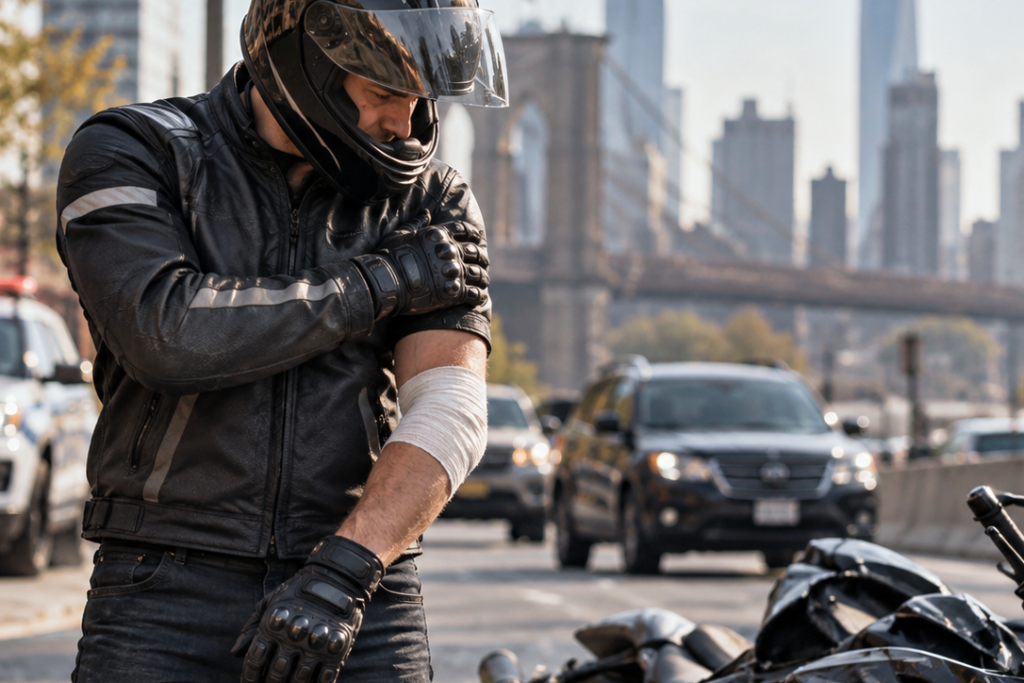
A motorcycle collision can change your life in seconds. Unlike motorists protected by a passenger vehicle’s cabin, riders face direct exposure to traffic, pavement, and roadside hazards. Even a seemingly low-speed crash can produce fractures, road rash, head trauma, or injuries requiring lengthy treatment. If another driver caused your collision, a New York motorcycle accident lawyer can help examine liability, coverage, evidence, and the losses you may be entitled to pursue.
At Tokov Law, we believe motorcycle claims deserve an investigation grounded in facts—not assumptions about how riders behave. New York motorcycle insurance also works differently from ordinary car insurance. Understanding the state’s motorcycle no-fault law is especially important because injured riders generally cannot rely on mandatory Personal Injury Protection (PIP) benefits from a motorcycle policy for their crash-related injuries.
Our [personal injury practice](/personal-injury/) addresses injury claims arising from negligence. If you were hurt while riding in New York City, on Long Island, or elsewhere in the state, contact us to discuss the circumstances of your accident.
Why You Need a Motorcycle Accident Attorney in New York
Many collisions involve a motorist who never noticed the motorcycle. A driver may turn across the rider’s path, merge without checking a blind spot, open a parked vehicle door, or follow too closely. But insurance companies may respond by claiming that a rider was speeding, riding recklessly, or somehow accepting the risk of injury simply by choosing a motorcycle.
A motorcycle accident attorney in New York evaluates what actually happened using witness accounts, nearby video, intersection geometry, vehicle damage, skid or debris patterns, and medical evidence. Depending on the issues, an accident reconstruction expert may be helpful. The goal is to distinguish a supported factual conclusion from speculation or stereotypes.
Motorcycle cases also have special questions about helmets, lane positioning, insurance exclusions, and the serious-injury threshold. Those issues can alter both claim strategy and the way a case is explained to an insurer, judge, or jury.
New York Motorcycle No-Fault Law: Why Riders Are Excluded
Do motorcycles qualify for no-fault insurance in New York? Generally, no—not when the injured person was operating or riding on the motorcycle. Under New York Insurance Law § 5102(f), the statutory definition of a motor vehicle for Article 51 excludes motorcycles. The New York Department of Financial Services likewise explains that motorcycle operators and passengers are excluded from ordinary no-fault benefits.
In a typical car crash, eligible occupants may access PIP for qualifying expenses regardless of which driver was at fault. A motorcycle operator or passenger ordinarily cannot submit the same first-party PIP injury claim under the motorcycle’s policy. Motorcycle liability insurance serves a different purpose: it protects against covered claims by others, subject to policy terms and law.
What This Means for Medical Bills and Lost Wages
An injured rider may need to explore health insurance, available medical-payment coverage if purchased, disability benefits, applicable uninsured/underinsured motorist coverage, and a direct third-party claim against the responsible motorist. Which source pays first can be complicated and should be reviewed with the actual policies and circumstances.
An insurer may insist that you should submit a routine no-fault claim because the crash involved a car. That assumption is often wrong for someone who was actually on a motorcycle. At the same time, a pedestrian struck by a motorcycle can have different no-fault rights. Precise claimant status matters.
Because no-fault does not ordinarily cover the injured motorcyclist’s basic economic losses, the rider may pursue otherwise legally recoverable losses directly against a negligent party. That does not mean immediate payment is guaranteed; negligence and damages must still be proven.
Do Motorcycle Accident Victims Need a Serious Injury to Sue?
New York’s ordinary auto injury lawsuits often involve the serious injury threshold in Insurance Law § 5104. Certain covered-person lawsuits cannot recover non-economic damages without meeting that statutory threshold. However, an injured motorcycle operator or passenger is generally treated differently because the motorcycle is excluded from the relevant no-fault definition.
As a result, a rider injured by a negligent motorist generally does not have to establish an Article 51 “serious injury” merely to pursue pain-and-suffering damages. This is an important distinction, but it is not the same as saying every minor injury produces a substantial claim. A viable lawsuit still requires negligence, causation, legally recoverable harm, and sufficient proof.
Insurance adjusters sometimes discuss the serious-injury categories used for car occupants without adequately addressing motorcycle status. An attorney should analyze the right statutory framework before negotiating. If your crash involved additional occupants, pedestrians, or vehicles, separate claimants may have different insurance and threshold rules.
Common Causes of Motorcycle Accidents in NYC and New York
Left-Turn Collisions
A particularly dangerous pattern occurs when an approaching driver turns left across a motorcycle’s lane. The motorist may misjudge the rider’s speed, fail to yield, or simply not see the motorcycle. A left turn motorcycle accident lawyer in NY may look for traffic-signal timing, intersection cameras, turn-lane markings, witnesses, and damage patterns to establish what occurred.
Unsafe Lane Changes and Blind-Spot Crashes
Drivers have a duty to check that a lane change can be made safely. Motorcycles are smaller and may be overlooked, but their size does not eliminate their right to use a lane. Crash reconstruction may consider mirror positioning, vehicle movement, and the rider’s location immediately before impact.
Distracted, Speeding, and Impaired Drivers
Texting, phone use, excessive speed, fatigue, or impairment can reduce reaction time. Investigations may examine police observations, witness testimony, road evidence, and other lawfully obtainable records. Allegations alone are not proof; they must be supported by admissible evidence.
Doorings, Rear-End Crashes, and Road Hazards
Parked car doors, sudden stops, potholes, loose gravel, and construction hazards can create serious risks. A road-defect claim may involve public entities with much shorter notice deadlines than an ordinary negligence suit. The identity of the party responsible for the hazard matters as much as the physical condition itself.
Other crashes involve delivery vehicles, commercial trucks, rideshare drivers, negligent turning, or vehicles entering traffic from driveways. Visit our car accident page for more information about common New York roadway injury claims.

Lane Splitting Accident New York: Will It Hurt Your Claim?
New York law addresses motorcycle lane use in Vehicle and Traffic Law § 1252. It generally prohibits riding between lanes of traffic or adjacent rows of vehicles and passing another vehicle within the same occupied lane. The statute also recognizes a motorcycle’s right to full use of a lane and permits limited side-by-side motorcycle operation. There is a specific law-enforcement exception to certain restrictions.
If you were lane splitting when an accident occurred, do not assume you automatically lose your case. The carrier may argue that the maneuver contributed to the collision, while other evidence may reveal a driver failed to signal, abruptly moved into traffic, or committed a separate negligent act.
Fault must be analyzed under the current version of CPLR § 1411, including rules applicable to claims governed by Insurance Law Article 51. A motorcycle’s circumstances may raise different threshold and comparative-fault issues from a standard covered-person auto claim. Evidence of a traffic violation is relevant, but whether it caused the injury remains a separate question.
New York Motorcycle Helmet Law and Accident Claims
Under New York Vehicle and Traffic Law § 381(6), motorcycle operators and passengers generally must wear a helmet meeting the specified federal motorcycle helmet standard. New York also has rules concerning approved eye protection. A proper helmet is critical safety equipment, but it cannot prevent every concussion, facial injury, or traumatic brain injury.
A defense insurer may raise helmet use or compliance after a crash. That issue should be examined carefully rather than treated as proof that the rider caused the collision. A helmet argument may relate to the nature or extent of a particular injury, and any claimed connection ordinarily requires medical and factual support. The driver who made an unsafe turn does not become blameless simply because helmet compliance is disputed.
Save the helmet, jacket, gloves, and other protective gear after a collision if doing so is safe. Photograph the damage and avoid discarding items that may later help explain impact mechanics or injury patterns.
Injuries We See in Motorcycle Collision Claims
Motorcycle road rash injuries range from abrasions to deeper wounds requiring cleaning, grafting, or treatment for infection. They may leave scars, changes in sensation, or permanent cosmetic effects. Photographs, follow-up visits, and surgical records help document the severity and course of recovery.
A traumatic brain injury from a motorcycle crash in NY may involve headaches, memory difficulty, dizziness, concentration problems, sleep disruption, or changes in mood. Such symptoms should be evaluated by qualified medical professionals. A helmet may reduce risk without eliminating the possibility of head injury.
Other common injuries include shoulder and clavicle fractures, broken wrists or legs, spinal injuries, nerve damage, ligament tears, internal injuries, and amputations. Some riders may need orthopedic surgery, occupational or physical therapy, adaptive equipment, or months away from work. Psychological effects can also affect driving confidence and everyday life.
A fair damages assessment looks beyond the emergency department bill. It considers prognosis, the practical effect of limitations on employment and home responsibilities, and whether future treatment is medically supported.
How a Motorcycle Accident Lawyer Builds the Case
The first stage is documenting the roadway: traffic signals, turn restrictions, lane widths, damage locations, skid evidence, and available security or dashcam footage. Witnesses may recall a driver’s turn or the rider’s position differently; statements should be compared with physical evidence rather than accepted blindly.
The next stage is documenting injuries. Treatment records should connect symptoms to the crash where medically appropriate, while also accurately recording any preexisting conditions. Insurers commonly scrutinize gaps in treatment, delayed diagnoses, or inconsistent descriptions. Complete and candid records are more useful than exaggerated claims.
Finally, the claim requires an insurance analysis. The responsible driver’s liability limits, any additional defendants, uninsured/underinsured motorist provisions, liens, and available benefits can affect how a case is pursued. Settlement negotiations should account for reasonably anticipated future losses, not just bills already paid.
What Compensation Can an Injured Motorcyclist Recover?
Potential recoverable damages can include past and future medical expenses, lost earnings, reduced earning capacity, documented out-of-pocket costs, and non-economic losses such as pain and suffering and diminished enjoyment of life. In an appropriate wrongful death case, surviving family members may have claims governed by separate rules.
The amount depends on the defendant’s fault, the nature and duration of injuries, medical evidence, financial losses, coverage, and legal limitations. No honest motorcycle accident lawyer in NYC can calculate case value from a diagnosis alone. A fracture that heals fully may present different damages from an injury that permanently prevents someone from performing their job.
Insurers may offer a quick payment before the full medical picture is known. Before signing a release, consider whether further imaging, rehabilitation, or surgery has been recommended and whether the proposal extinguishes additional claims.
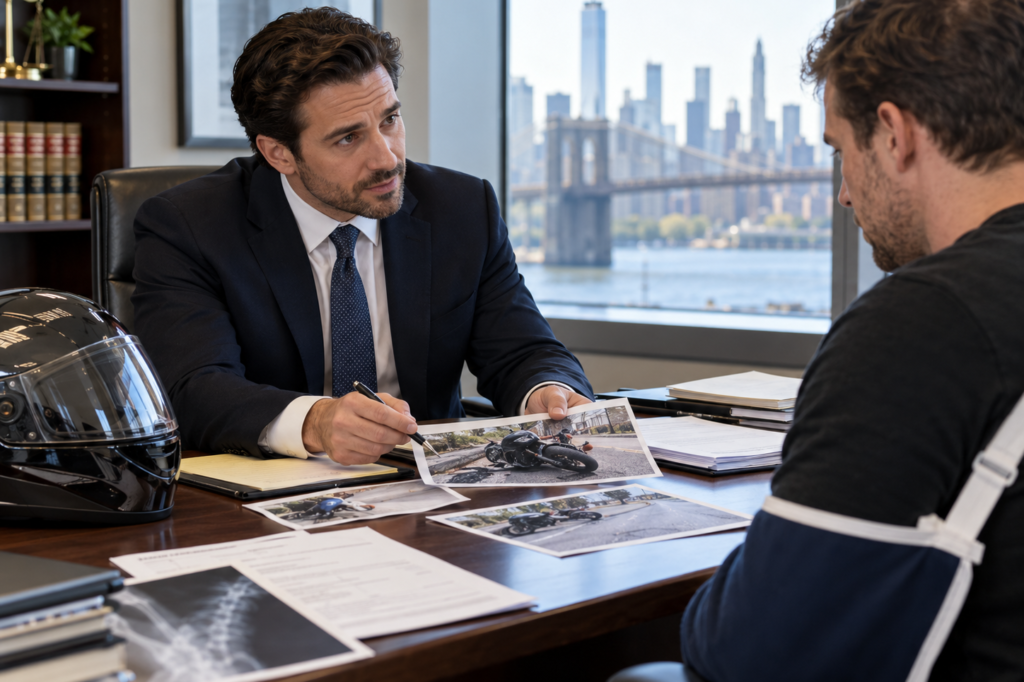
Steps to Take After a Motorcycle Crash
Seek medical care immediately for serious symptoms and follow your providers’ recommendations. Report the accident and preserve a copy of the report when possible. Take photographs of the vehicles, road, traffic signs, clothing, helmet, and visible injuries. Get contact information for witnesses without delaying urgent care.
Save bills, employment records, insurance notices, photographs, and a factual account of symptoms. Avoid posting speculative accounts of fault or physical ability on social media. If an adjuster asks for a broad medical authorization or recorded statement, understand what it covers before agreeing.
Many New York personal injury negligence lawsuits must ordinarily be filed within three years under CPLR § 214, but exceptions, shorter government-claim rules, and insurance-specific deadlines may apply. Do not wait for the last months of a limitations period to seek advice.
Frequently Asked Questions About New York Motorcycle Accidents
Does my motorcycle insurance pay no-fault medical benefits?
Ordinarily no. Motorcycle operators and passengers are excluded from New York’s standard no-fault PIP system. Health insurance and other available coverages may still be relevant. The precise payment options depend on your policies and facts.
Can I recover pain and suffering without a serious injury?
An injured rider generally is not bound by the standard Article 51 serious-injury threshold that applies to certain car-accident claims. You still must prove negligence, causation, and actual compensable harm.
Is lane splitting legal in New York?
Generally no. VTL § 1252 prohibits operating a motorcycle between lanes of traffic or adjacent rows of vehicles. The statute has limited exceptions. A possible lane-splitting violation does not replace a full analysis of how a particular crash happened.
What if the driver says they never saw me?
That statement does not automatically excuse a failure to yield or check surrounding traffic. Evidence such as video, sightlines, witnesses, and vehicle damage may help explain whether the driver acted reasonably.
Can I sue if I was not wearing a compliant helmet?
A claim may still be possible. Helmet compliance and any effect on particular injuries require a fact-specific analysis. A helmet issue does not necessarily resolve who caused the collision.
How long do I have to bring my motorcycle accident case?
Three years is the ordinary New York personal injury negligence period, but shorter notice requirements may govern claims against certain public entities. Prompt investigation also improves the chances of preserving nearby video and witness evidence.
What if the other driver has little or no insurance?
Coverage may be available under applicable uninsured or underinsured motorist provisions, subject to their conditions and limits. Identifying additional legally responsible parties can also matter. Review the actual policy rather than assuming protection exists.
Talk to a New York Motorcycle Accident Lawyer
If you were hurt in a left-turn crash, lane-change collision, road-hazard incident, or another motorcycle accident, you deserve an explanation of your insurance rights and legal options. [Contact Tokov Law](/contact/) to request an individualized discussion of your case.
This content is general information, not individualized legal advice. Reading it or submitting an inquiry does not establish an attorney-client relationship. Results depend on evidence, coverage, and applicable law.