
Property Tax Grievance Guide for Nassau County

Nassau County property tax grievance filings go through the Assessment Review Commission, an independent agency that annually reviews assessment corrections and has produced substantial taxpayer savings. Eligible homeowners, buyers under contract, or authorized agents challenge assessed value to lower taxes. Tokov Law handles the filing and advocacy on a contingency basis, charging fees only from recovered tax savings.
Key Takeaways
- Nassau County’s Assessment Review Commission independently reviews all property tax correction applications filed annually in the county.
- Property owners must file grievance forms before Nassau County’s annual deadline, typically requiring annual resubmission to challenge assessments.
- The property tax grievance process in Nassau County is complex, multistep, and demands strict adherence to filing deadlines and documentation requirements.
- Tokov Law handles the complete Nassau County property tax grievance process on contingency, 40% of recovered tax savings, zero upfront cost.
What Is a Property Tax Grievance in Nassau County?
A property tax grievance is a formal challenge to the assessed value Nassau County assigns to a home. Nassau County, not the local town, holds authority over this assessment, and that figure becomes the basis for every tax bill a homeowner receives. Filing a property tax reduction claim gives property owners a structured way to dispute a number that may no longer reflect market reality.
Oversight of this process falls to the Assessment Review Commission, known as the ARC. The ARC operates as an independent agency, separate from the Nassau County Department of Assessment, and reviews every correction-of-assessment application filed in the county each year. This separation matters: the body reviewing the dispute is not the same body that set the original value.
Does grieving an assessment actually lower a tax bill?
Corrections processed through this system have delivered substantial savings for Nassau County taxpayers. Results vary by property and market conditions, so outcomes depend on the specifics of each case.
How often should a homeowner review their assessment?
Nassau County property owners should check their Notice of Tentative Assessment every year to confirm accuracy. Values shift annually, and an outdated assessment left unchallenged keeps costing money long after it stops reflecting true market worth. Tokov Law guides Nassau County homeowners through this annual property tax grievance Nassau County filing with attorney-led representation built around one principle: Your Case Deserves Attention.
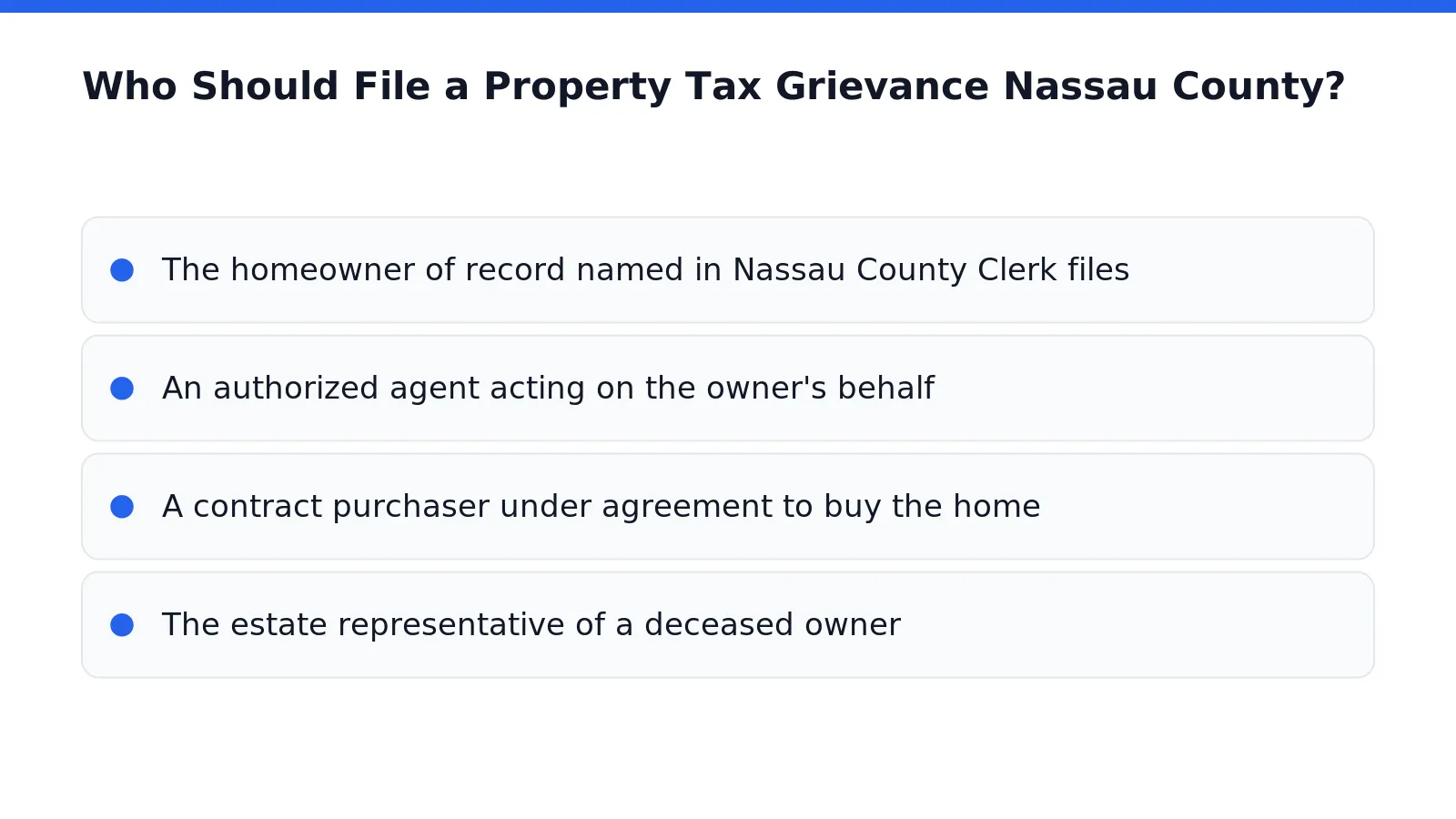
Who Should File a Property Tax Grievance Nassau County?
Nassau County homeowners who believe their assessed value exceeds fair market value qualify to file. Eligibility extends beyond the person holding the deed. Owners of one, two, or three family residential parcels, residential condominiums, and qualifying mixed-use parcels generally meet the property type requirements for a Property Tax Grievance.
Ownership status matters as much as property type. A Property Tax Grievance Nassau County filing accepts applications from several categories of filers:
- The homeowner of record named in Nassau County Clerk files
- An authorized agent acting on the owner’s behalf
- A contract purchaser under agreement to buy the home
- The estate representative of a deceased owner
Does a Nassau County grievance go to a town board?
No. Nassau County residents direct grievance forms, deadlines, and instructions to the Nassau County Assessment Review Commission, not a local town board. This distinguishes Property Tax Grievance Long Island filings in Nassau from processes elsewhere in the state. Town-level boards handle complaints.
Who benefits most from pursuing a reduction?
Owners carrying an assessment that outpaces current market value stand to gain the most. Long Island property owners pursuing a Property Tax Grievance LI filing, alongside those weighing a Property Tax Grievance Suffolk County claim, face similar eligibility questions. For Nassau residents, confirming filer status and property classification first prevents a rejected application and protects the window for pursuing Property Tax Reduction Nassau County.

Can STAR-Eligible Homeowners Save Even More?
Homeowners already enrolled in New York’s School Tax Relief (STAR) program may see additional value from filing a grievance. STAR reduces the school tax portion of a bill for an eligible owner-occupied primary residence, and that reduction is calculated against the home’s assessed value. Lowering an inflated assessment through a successful grievance can therefore compound with an existing STAR exemption, reducing both the base tax bill and the amount STAR is calculated against. Nassau County homeowners who receive Basic or Enhanced STAR and suspect their assessment runs high stand to gain on two fronts from a single filing.
How Does the Assessment Review Commission Process Work?
The Assessment Review Commission reviews every grievance filed against a Nassau County property’s assessed value and issues a determination based on market evidence. Homeowners file their appeal through AROW, Assessment Review on the Web, Nassau County’s online system built specifically for this purpose. No paper forms, no mailing delays. The process moves on a strict calendar, and missing a date closes the window for an entire tax year.
When Is the Nassau County Grievance Deadline?
Nassau County starts grievance filing on January 4th. Nassau County sets March 1 of each year as the filing deadline for a property tax grievance application, and that date does not shift for individual circumstances. A grievance missed on March 1 must wait for the next annual filing window to be refiled.
The timeline connects directly to the county’s assessment roll schedule. In January 2026, the Department of Assessment will publish its tentative assessment roll, built on each property’s market value as of that date. Nassau County homeowners generally have from that January publication date until the March 1 deadline to review the tentative assessment and file a grievance. Those figures then flow into the 2027/2028 school tax bills and the 2028 general tax bills, meaning a single valuation snapshot shapes two full years of tax obligations.
Who Represents Homeowners Before the Commission?
Tokov Law prepares and files the grievance application on the homeowner’s behalf. The firm represents clients throughout proceedings before Nassau County Assessment Review Commissions, and, when a case warrants further action. Small Claims Assessment Review.
- File through AROW before the posted deadline
- Track the tentative roll’s January publication date
- Let Tokov Law manage filings, deadlines, and commission proceedings
Your Case Deserves Attention, and a missed filing window means waiting another full cycle for relief.
Why Choose Tokov Law for Your Property Tax Reduction?
Nassau County homeowners gain attorney-led representation, transparent fees, and a firm built specifically around assessment challenges. Tokov Law manages the entire Property Tax Grievance Nassau County process on contingency, charging 30 percent of any tax savings recovered and requiring no upfront cost. That structure matters for homeowners who want to challenge an inflated assessment without risking money on a case that goes nowhere.
Fee clarity sits at the center of the firm’s approach. Tokov Law operates on a no fees unless we win model for Property Tax Grievance matters, meaning payment only comes due after savings land in the client’s pocket. Nothing about the arrangement hides behind fine print. No confusion. No pressure.
Does Tokov Law only handle Nassau County cases?
Representation extends across NYC, Nassau County, and Long Island, giving property owners consistent, attorney-led service regardless of municipality. Clients across the region choose the firm for direct communication and local familiarity with assessment procedures, not a call center that passes files between departments.
What track record backs the firm’s property tax work?
Tokov Law’s results show in over 100 resolved cases and millions of dollars recovered for clients. That record reflects practical negotiation skill paired with readiness to litigate when an assessing authority refuses a fair resolution.
Homeowners evaluating a Property Tax Reduction Nassau County filing should weigh the following before choosing representation:
- Contingency-based fees tied directly to savings achieved
- Attorney involvement from filing through resolution
- A documented history exceeding 100 closed matters
- Local focus across Nassau County and greater Long Island
Your Case Deserves Attention, and an overpaid tax bill deserves a direct challenge, not guesswork.
How Do You Get Started with Tokov Law?
A free consultation opens every case at Tokov Law. Nassau County homeowners, real estate owners, and property investors describe their situation first, then learn their options before committing to anything. In select matters, including injury claims and tax grievances, no legal fees apply unless the firm wins. Your Case Deserves Attention, and that principle shapes how intake begins: no confusion, no pressure, just a clear path forward.
Reaching the firm happens by phone, email, or online form. Nassau County property owners receive timely updates throughout their case, so decisions never happen in the dark. Tokov Law handles injury matters, real estate transactions, and property tax reduction filings under one roof, meaning homeowners pursuing a fairer assessment sit alongside clients navigating closings or accident claims.
What Does It Cost to Start a Property Tax Grievance?
Authorizing Tokov Law to pursue a property tax grievance in Nassau County typically carries no upfront fee. Payment ties directly to achieved savings, so homeowners risk nothing by filing. This structure applies broadly across property tax grievance Nassau County and property tax grievance Long Island cases, giving owners a low-risk way to challenge an inflated assessment.
Who Can File?
Eligible Nassau County residents include homeowners, authorized agents, and buyers under contract seeking a property tax reduction Nassau County review. Starting the process requires only a signed authorization before the filing deadline.
FAQ
Who reviews property tax grievance filings in Nassau County?
The Assessment Review Commission, an independent agency separate from the Nassau County Department of Assessment, reviews every correction-of-assessment application filed in the county each year.
Who is eligible to file a property tax grievance in Nassau County?
Eligible filers include the homeowner of record, an authorized agent, a contract purchaser under agreement to buy the home, and the estate representative of a deceased owner.
How does Tokov Law charge for handling a Nassau County property tax grievance?
Tokov Law handles the complete filing and advocacy process on contingency, charging 30% of any recovered tax savings with zero upfront cost.
Conclusion
In closing, Nassau County property owners who challenge an inflated assessment through attorney-led representation gain clarity, contingency-based protection, and direct advocacy from filing through resolution. The process demands precision and deadline discipline. The structure itself remains straightforward: file before the posted date, present market evidence, and let the Assessment Review Commission determine fair value. Tokov Law manages that entire sequence on your behalf, charging only when savings materialize. Homeowners pursue relief without upfront risk or uncertainty about costs.
Speak With Tokov Law Today
If you or a loved one has been injured in a New York car accident, you deserve knowledgeable guidance and strong advocacy. Tokov Law is committed to protecting your rights, challenging insurance companies, and pursuing the compensation you need to move forward.